


Last verified: June 2026
A scooter goes missing from outside a Pune apartment building on a Tuesday morning. The owner walks to the nearest police station, explains what happened, and is told to come back later, or to try a different police station because “the theft did not happen in our area.” He leaves without a single piece of paper in his hand. No complaint number, no acknowledgement, nothing he can show his insurer. By the time he figures out what he was entitled to, three days have passed and the CCTV footage from the lane has been overwritten.
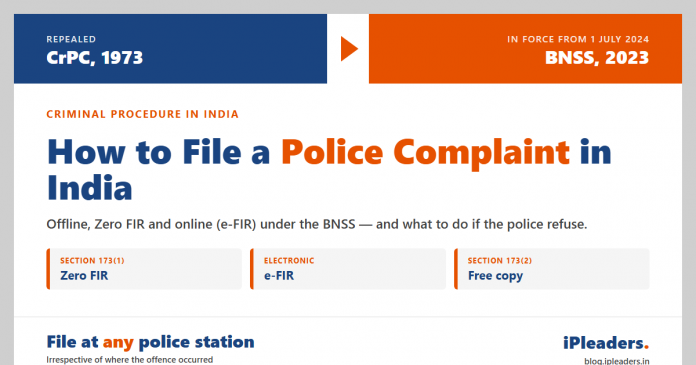
This is the most common way a police complaint fails in India: not because the law is against the citizen, but because the citizen does not know what the law actually requires the police to do. The officer who turned him away was wrong on two counts, and both of those counts changed for the better when the Bharatiya Nagarik Suraksha Sanhita, 2023 replaced the old Code of Criminal Procedure on 1 July 2024.
Under the new code, a complaint about a cognizable offence has to be registered at any police station, regardless of where the crime took place. That is the Zero FIR, and it is now written into the statute rather than living in a Supreme Court direction. The complainant is entitled to a copy of that First Information Report (FIR) free of cost, the moment it is recorded. And if the station house officer still refuses, there is a written escalation ladder that ends with a Magistrate who can order the police to investigate.

Most people only learn these rules at the worst possible moment, standing at a counter while a constable shakes his head. The point of knowing them in advance is leverage. A complainant who can name the section, ask for the free copy, and reference the Zero FIR provision is treated very differently from one who is simply pleading. The law did not become friendlier in 2024; it became more specific, and specificity is what you can hold an officer to.
There is also a quieter problem the scooter owner ran into: he did not know whether he was filing a “complaint” or an “FIR,” and those are not the same thing. Nor is either of them a “non-cognizable report.” Picking the wrong route, or letting the police quietly downgrade your matter to the wrong route, is how serious complaints end up going nowhere. So before the step-by-step, the first job is to sort out which of the three you are actually filing.
To file a police complaint in India, go to any police station, or use your state police’s online portal, and give your information in writing or orally. If it discloses a cognizable offence – theft, assault, cheating, and most serious crimes – the police must register an FIR under Section 173 of the Bharatiya Nagarik Suraksha Sanhita, 2023, give you a free copy, and begin investigating. If it is a non-cognizable offence, the officer records it in a register and refers you to a Magistrate. You can file at any station as a Zero FIR irrespective of where the offence occurred, and if the police refuse, you escalate in writing to the Superintendent of Police and then to the Magistrate under Section 175(3).
Here is how each of those routes works, what to carry, what to write, and how to push back when the system stalls.
Complaint, FIR, or NCR: which one are you filing?
The word “complaint” gets used loosely, and that looseness costs people. In legal terms, three different documents could result from the same trip to a police station, and which one you get determines what happens next.
A First Information Report (FIR) is what the police record when they receive information about a cognizable offence – an offence serious enough that the police can investigate and arrest without first asking a Magistrate’s permission. Theft, robbery, assault causing hurt, cheating, rape, kidnapping, and most offences the public thinks of as “crimes” are cognizable. Section 2(1)(g) of the Bharatiya Nagarik Suraksha Sanhita, 2023 (“BNSS”) defines a cognizable offence as one for which a police officer may arrest without a warrant. When you give information about such an offence, the police are obliged to register an FIR under Section 173 of the BNSS.
A complaint, in the strict sense, is an allegation made to a Magistrate – not to the police – with a view to the Magistrate taking action. This is the route under Section 223 of the BNSS. People use “complaint” colloquially for anything they tell the police, but the statutory complaint is a distinct, court-facing document, and it matters when the police route has failed you.
A non-cognizable report (NCR) is what the police record for a non-cognizable offence – a less serious offence, such as simple hurt, public nuisance, or defamation, where the police cannot investigate or arrest without a Magistrate’s order. Section 2(1)(o) of the BNSS defines this category. Here the officer notes your information in a register and points you towards the Magistrate; there is no FIR and no automatic investigation.
The practical danger is downgrading. A complainant arrives with what is plainly a cognizable matter, and the station, reluctant to add to its FIR numbers, records it as an NCR instead. The complainant walks away thinking something has been filed, when in fact nothing that triggers an investigation has happened. Knowing whether your offence is cognizable is therefore the single most useful thing you can establish before you walk in. The classification of every offence as cognizable or non-cognizable is set out in the First Schedule of the BNSS – the offence is defined in the Bharatiya Nyaya Sanhita, 2023, but whether it is cognizable is a matter of procedure, and procedure lives in the BNSS.
| FIR | NCR | Complaint to Magistrate | |
|---|---|---|---|
| Filed with | Police (Section 173 BNSS) | Police (Section 174 BNSS) | Magistrate (Section 223 BNSS) |
| Offence type | Cognizable | Non-cognizable | Either |
| Police can investigate? | Yes, immediately | Only with Magistrate’s order | Magistrate decides |
| Arrest without warrant? | Possible | No | No |
| You get a free copy? | Yes, instantly | Entry in register | Court record |
The law that governs police complaints in 2026
Until 1 July 2024, the procedure for filing a police complaint lived in the Code of Criminal Procedure, 1973 (CrPC). On that date, the BNSS replaced the CrPC entirely. The substance is similar in many places, but the section numbers have all changed, and several provisions have been tightened in the citizen’s favour. Any guide, template, or video that still talks about “Section 154 CrPC” is describing a code that no longer applies, even if the underlying right survives.
The core provision for filing a complaint about a cognizable offence is now Section 173 of the BNSS, which carries forward and expands the old Section 154 CrPC. It is the section that obliges the police to register an FIR. Section 174 deals with non-cognizable offences (formerly Section 155), and Section 175 sets out the police power to investigate cognizable offences and the Magistrate’s power to order an investigation (formerly Section 156).
The constitutional backbone of all this is still the Supreme Court’s Constitution Bench decision in Lalita Kumari v. Government of Uttar Pradesh, (2014) 2 SCC 1. That ruling held that registration of an FIR is mandatory whenever information discloses a cognizable offence, and that the officer has no discretion to refuse on the ground that the allegation seems doubtful. The BNSS now writes a narrow, controlled exception to that rule into Section 173(3), discussed further below, but the default remains what Lalita Kumari laid down: cognizable offence in, FIR out.
Two features of the new code are worth fixing in your mind before you file, because they are the levers you will actually use. First, the FIR copy is yours by right and free of cost – Section 173(2) requires it to be given to the informant or victim at once. Second, the Zero FIR is now statutory: Section 173(1) says information about a cognizable offence may be recorded “irrespective of the area where the offence is committed.” No officer can lawfully send you away for being at the wrong station.
How to file a police complaint offline at a police station
The in-person route is still the default for most serious matters, and for good reason – it puts a human being across the counter who has to act, and it produces a signed document on the spot. Here is the sequence.
Step 1: Go to the police station and ask to file an FIR. You do not have to go to the station nearest the crime; you can go to any station (see the Zero FIR section). Ask specifically to “register an FIR,” not just to “make a complaint,” if your matter is a cognizable offence. The wording signals that you know your matter triggers Section 173.
Step 2: Give your information, orally or in writing. You can hand over a written complaint or simply narrate what happened. If you narrate it, Section 173(1) requires the officer to reduce it to writing and then read it back to you. Listen to the read-back carefully – this is where details get softened or offences get dropped. Insist that what you said is what is recorded.
Step 3: Read the FIR before you sign it. Once written, the FIR must be read over to you, and you sign it. Do not sign a version that misstates the facts, omits an accused you named, or changes the offence. You are entitled to have it corrected before signing.
Step 4: Collect your free copy. Under Section 173(2), a copy of the FIR must be given to you immediately and without charge. This copy carries the FIR number, the date and time, the police station, and the sections invoked. Keep it safe; you will need it for insurance, for follow-up, and for any court process.
Step 5: Note the FIR number and the investigating officer. The FIR number is your reference for every future interaction. Ask who the investigating officer (IO) is and how to reach them.
A few practical points. Carry your own identity proof, but the absence of ID cannot be used to refuse your FIR. Bring any documents that support the complaint – for a theft, the bill or registration of the stolen item; for a cheating case, the messages, contracts, or transaction records. Keep your narration chronological and factual, naming the people involved where you can, and avoid editorialising; the police record facts, not adjectives.
For offences against women – including offences under the Bharatiya Nyaya Sanhita such as rape and sexual harassment – Section 173(1) requires the information to be recorded by a woman police officer or any woman officer. Where the victim is temporarily or permanently mentally or physically disabled, the information is to be recorded at the victim’s residence or a place of their choice, in the presence of an interpreter or special educator where needed, and the recording is to be videographed. These are not courtesies; they are statutory requirements you can ask for.
Zero FIR: filing at any police station, anywhere
The Zero FIR is the provision that would have saved the Pune scooter owner. It allows you to file an FIR at any police station, even one that has no territorial jurisdiction over the place where the offence happened. It is called a “Zero” FIR because it is registered with serial number zero before being transferred to the police station that does have jurisdiction, which then registers a regular numbered FIR and investigates.
The concept existed before 2024 – it came out of the recommendations following the 2012 Delhi gangrape case and was reinforced by Ministry of Home Affairs advisories – but it depended on circulars and goodwill, which meant it was routinely ignored. The BNSS removed the excuse. Section 173(1) now records information about a cognizable offence “irrespective of the area where the offence is committed,” which is the statutory basis for refusing to be turned away on jurisdiction grounds.
When to use it: when the offence happened somewhere other than where you currently are; when the nearest station is the practical place to report urgently (a road accident, an assault you have just escaped, a crime in transit); or simply when one station is stalling and you want the matter on record immediately. The receiving station must register the Zero FIR and then forward it to the jurisdictional station. Crucially, in an emergency, the receiving police are still expected to take immediate steps – securing the scene, providing medical aid, preventing the loss of evidence – before the file moves.
What to watch for: after the transfer, follow up with the jurisdictional police station, because that is where the investigation actually proceeds. Get your free copy of the Zero FIR at the point of filing, and later obtain the regular FIR number from the jurisdictional station. The handoff is where complaints can go quiet, so treat the transfer as a step to be confirmed, not assumed.
How to file a police complaint online (e-FIR and portals)
Filing online has moved from a patchwork of state experiments to a genuine option for many matters, though it is not yet a universal substitute for the police station. What is available depends on your state and on the type of offence.
Electronic FIR (e-FIR). Section 173(1) of the BNSS expressly permits information about a cognizable offence to be given “by electronic communication.” There is one condition that catches people out: when information is given electronically, it has to be signed by the person giving it within three days for it to be taken on record. In practice this means you may be able to lodge the information online, but you will often still need to visit the station to sign within three days for the FIR to be valid. States are rolling out e-FIR facilities in phases, frequently starting with specific categories such as vehicle theft and property lost above a threshold; check your state police’s current scope rather than assuming every offence can be filed online.
State police citizen portals. Most state police forces run a citizen or e-services portal where you can lodge a complaint, report lost documents and articles, and track status. The exact name and address differ by state – Delhi, Maharashtra, Tamil Nadu, Uttar Pradesh, Karnataka and others each run their own – so the reliable way to find yours is to search for your state’s police department official website and look for the “citizen services,” “complaint,” or “e-FIR / lost report” section. These portals are well suited to lost-article reports and documentary complaints; for offences needing urgent police action, the station or the 112 emergency route is faster.
Lost-article and document reports. If you have lost a phone, wallet, documents, or other articles – as opposed to having had them stolen – most states let you file a “lost report” online and download an acknowledgement instantly. This acknowledgement is what you need for duplicate documents, SIM reissue, or insurance. Note the distinction: a genuine theft is a cognizable offence and should be an FIR, while a simple loss is usually a lost-property report.
Cybercrime. For online fraud, financial scams, identity theft, and offences against women and children committed online, the dedicated channel is the National Cyber Crime Reporting Portal at cybercrime.gov.in, backed by the helpline 1930 for financial fraud. Reporting a fraudulent transaction quickly through 1930 can trigger a freeze on the money before it is withdrawn, so speed matters more here than anywhere.
The 112 emergency route. For an offence in progress or an emergency, the pan-India emergency number 112 and the associated state apps connect you to police, fire, and medical response. This is for immediate help, not for formally registering an FIR, but it creates a record and gets officers moving.
Online filing is strongest for lost reports, cyber fraud, and documentary complaints, and weakest where an offence needs an officer on the ground now. When in doubt for a serious, time-sensitive crime, the police station or 112 beats a web form.
Non-cognizable offences: the NCR route
Not every grievance is a cognizable offence, and for the ones that are not, the procedure is different and more limited. Simple hurt, criminal intimidation in some forms, public nuisance, and defamation are examples of non-cognizable offences, where the law judges the matter not serious enough for the police to investigate or arrest on their own initiative.
When you report such an offence, Section 174 of the BNSS requires the officer to enter the substance of the information in a register and refer you to the Magistrate. The police will not investigate at this stage. To take the matter forward, you need an order from the Magistrate empowering the police to investigate, or you proceed as a complaint case before the Magistrate directly.
This is exactly the category where downgrading happens, in both directions. Sometimes a cognizable matter is wrongly recorded as non-cognizable to avoid an FIR; sometimes a complainant assumes the police will investigate an NCR and waits in vain. If your matter is genuinely cognizable and you are being handed an NCR, say so, point to the offence, and ask for an FIR under Section 173. If it is genuinely non-cognizable, understand that the Magistrate, not the police station, is your forum, and plan accordingly.
What to write in a police complaint, with a sample
Whether you file offline or online, a clear written complaint does most of the work. The police record what you give them, so a well-structured complaint reduces the room for facts to be softened or dropped.
A complete complaint covers, in order: who you are and how to reach you; when and where the incident happened; what happened, narrated factually and in sequence; who was involved, named or described as closely as you can; what was lost, damaged, or done; and what you want the police to do. Attach copies – never originals – of any supporting documents, and list them at the end.
Keep the tone factual. The complaint is not the place for legal argument or emotional language; it is a record of events. Write in the first person, date it, and sign it. If you can identify the offence, you may name it (“this appears to be theft / cheating / criminal breach of trust”), but you are not required to get the legal label right – that is the officer’s job. Getting the facts right is yours.
A simple working template looks like this:
To,
The Station House Officer,
[Name] Police Station, [City]
Subject: Complaint regarding [theft / assault / cheating] on [date]
Sir/Madam,
I, [full name], aged [ ], residing at [address], contactable at [phone / email], wish to report the following.
On [date] at approximately [time], at [place], the following occurred: [factual, chronological account of what happened, who was involved, and what was lost or done].
The persons involved were [names / descriptions]. The following items / amounts were [stolen / lost / involved]: [list].
I request that an FIR be registered and the matter investigated. I enclose copies of [documents] in support.
Yours faithfully,
[Signature, name, date]
Make two copies. Hand one in and ask the officer to stamp and sign the second as acknowledgement of receipt – that stamped copy is your proof that you filed, and it is valuable if the matter later stalls.
When the police can hold back: preliminary enquiry under Section 173(3)
The BNSS introduced one genuinely new wrinkle that complainants should understand, because it can delay an FIR lawfully. Section 173(3) allows the police, for a cognizable offence punishable with three years or more but less than seven years, to conduct a preliminary enquiry before registering an FIR – but only with the prior permission of an officer not below the rank of Deputy Superintendent of Police, and only to decide whether a prima facie case exists. That enquiry must be completed within fourteen days.
This is a controlled exception to the mandatory-FIR rule of Lalita Kumari, and it sits in some tension with that decision, which had allowed only a much shorter preliminary enquiry in limited categories. Under the BNSS, the enquiry is time-bound and senior-officer-gated, which is meant to stop it from becoming an open-ended way to avoid registering FIRs. For offences punishable with less than three years, and for offences of seven years or more, this provision does not apply and the FIR obligation is immediate.
What this means for you: if your matter falls in the three-to-seven-year band and the police say they are conducting a preliminary enquiry, that can be lawful – but ask whether DSP-level permission was obtained and note the fourteen-day clock. If the enquiry drags past fourteen days, or if your offence is outside the band, the delay is not justified and you move to the escalation steps below.
What to do if the police refuse to register your complaint
Refusal is the situation people fear most, and the BNSS gives you a clear, escalating set of remedies. Use them in order, and keep a paper trail at every stage.
Step 1: Escalate to the Superintendent of Police under Section 173(4). If the officer in charge of the police station refuses to record your information about a cognizable offence, you may send the substance of that information, in writing and by post, to the Superintendent of Police (SP) concerned. If the SP is satisfied that the information discloses a cognizable offence, the SP must either investigate the case personally or direct a subordinate officer to investigate. Send this in writing, by post or a mode that creates a record, and keep proof of dispatch – you will need it for the next step.
Step 2: Approach the Magistrate under Section 175(3). If the SP route also fails, you can apply to the Magistrate empowered under Section 210 of the BNSS, who can order the police to investigate. This step has become more demanding than it was under the old CrPC. Following the Supreme Court’s decision in Om Prakash Ambadkar v. State of Maharashtra, 2025 INSC 139, the Magistrate under Section 175(3) – unlike the old Section 156(3) CrPC – must consider the application supported by an affidavit, must require a copy of your earlier Section 173(4) application to the SP, may hold such enquiry as is necessary, and must consider the submissions of the police officer on why the FIR was refused before ordering an investigation. In short, you cannot jump straight to the Magistrate; you must show you first went to the SP, and you must put your application on affidavit.
Step 3: Consider a complaint to the Magistrate or a writ petition. If you do not want to route the matter through a police investigation at all, you can file a complaint directly before the Magistrate under Section 223 (covered next). In serious cases of police inaction, a writ petition before the High Court is also available, and the courts have repeatedly held that refusing to register an FIR for a cognizable offence is itself a dereliction of duty.
Other channels. Complaints of police misconduct or refusal can also be taken to the State Human Rights Commission or the National Human Rights Commission, to the state police complaints authority, and through the online grievance portals most states maintain. These run in parallel to the statutory ladder and are useful for accountability, but the FIR itself comes through Steps 1 and 2.
The thread running through all of this is documentation. Each refusal you can prove – a stamped acknowledgement, a postal receipt to the SP, a dated affidavit – strengthens the next step. The complainant who keeps records is the one who eventually gets the FIR registered.
Filing a complaint directly with a Magistrate
When the police route is closed to you, or when you would rather not depend on a police investigation, the BNSS lets you take your case straight to a Magistrate. This is the statutory “complaint” in its true sense, under Section 223 of the BNSS, which carries forward the old Section 200 CrPC.
The Magistrate, on receiving such a complaint, examines the complainant and any witnesses on oath, records their statements, and then decides whether to take cognizance of the offence. If satisfied, the Magistrate can proceed against the accused, or can direct an investigation under Section 175(3). This route is common where the accused is influential, where the police are seen as unlikely to act fairly, or where the offence is one the complainant wants prosecuted as a private complaint.
The BNSS added an important safeguard here that did not exist before. The proviso to Section 223(1) requires that, before taking cognizance of an offence on a complaint, the Magistrate must give the proposed accused an opportunity to be heard. This is a meaningful change: it means the accused is no longer entirely absent from the pre-cognizance stage, and a complainant should expect that the person complained against will be put on notice and allowed to make submissions before the case proceeds. Courts have already begun applying this proviso strictly, so a well-prepared complaint and sworn statement matter more than ever.
A complaint to the Magistrate is more formal than a police complaint, and at this stage the guidance of a lawyer is genuinely useful, both to frame the complaint and to lead the complainant’s evidence on oath.
After you file: investigation, arrest safeguards, and your rights
Filing the FIR sets the investigation in motion, but it helps to know what happens next and where your rights sit, both as a complainant and, if you are on the other side, as someone who has been named.
Once an FIR for a cognizable offence is registered, the police investigate under Section 175 of the BNSS – recording statements, collecting evidence, and, where warranted, making arrests. As the informant or victim, you are entitled to be kept informed of the progress of the investigation, and the law increasingly recognises the victim’s right to participate, including a right to be heard at certain stages and to receive a copy of the final police report.
On arrest, the BNSS carries forward the safeguards the Supreme Court built in Arnesh Kumar v. State of Bihar, (2014) 8 SCC 273. For offences punishable with imprisonment of less than seven years, the police are not to arrest automatically; Section 35(3) of the BNSS requires the officer, where arrest is not necessary, to issue a notice directing the person to appear, and a person who complies with that notice is not to be arrested unless the officer records reasons. For an offence punishable with less than three years, where the person is infirm or above sixty years of age, arrest needs the prior permission of an officer not below the rank of Deputy Superintendent of Police. These provisions matter to complainants too: an FIR is the start of a legal process, not a verdict, and the accused has rights that the investigation must respect for any eventual prosecution to hold up.
The investigation should ordinarily conclude with a police report (charge sheet) filed before the Magistrate, or a closure report if no case is made out. If a closure report is filed and you are the complainant, you have the right to be notified and to file a protest petition challenging it. The case does not simply vanish because the police decided not to proceed; the Magistrate has the final say on whether to accept a closure.
Two cautions are worth keeping in view. First, filing a knowingly false FIR is itself an offence and exposes the complainant to prosecution, so the facts you put on record must be true. Second, the power to quash an FIR exists – the Supreme Court’s categories in State of Haryana v. Bhajan Lal, 1992 Supp (1) SCC 335 set out when a High Court can quash an FIR that discloses no offence or is manifestly an abuse of process – which is why a complaint grounded in real, provable facts is far more durable than one built on exaggeration.
Common mistakes to avoid
The same handful of errors recur, and each one is avoidable.
Accepting “wrong jurisdiction” as a refusal. The Zero FIR provision in Section 173(1) means no station can lawfully send you away because the offence happened elsewhere. If you are told to go to another station for a cognizable offence, name the Zero FIR and ask for it to be registered where you stand.
Leaving without your free copy. The FIR copy under Section 173(2) is free and immediate. Walking out without it leaves you with no proof and no reference number. Always collect it and check that the FIR number, sections, and facts are correct.
Letting a cognizable matter be recorded as an NCR. If your offence is cognizable, an NCR is not a substitute for an FIR – it triggers no investigation. Push for registration under Section 173, and if refused, escalate.
Signing without reading. The read-back exists so you can catch errors before you sign. Correct any misstatement of facts, dropped accused, or changed offence before signing, not after.
Skipping the SP before going to the Magistrate. After Om Prakash Ambadkar, a Section 175(3) application to the Magistrate must show you first approached the SP under Section 173(4) and must be supported by an affidavit. Going straight to the Magistrate without the SP step now invites dismissal.
Exaggerating the complaint. A false or inflated FIR is both an offence and a weakness – it makes the complaint easier to quash under the Bhajan Lal categories. Stick to what you can prove.
Frequently asked questions
What is the difference between a complaint and an FIR?
An FIR is the record the police make of information about a cognizable offence, under Section 173 of the BNSS, and it sets an investigation in motion. A “complaint” in the strict legal sense is an allegation made to a Magistrate under Section 223, not to the police. Colloquially people call any report to the police a “complaint,” but only a cognizable matter produces an FIR.
Can I file a police complaint online in India?
Yes, for many matters. The BNSS allows information to be given by electronic communication, and most states run citizen portals for complaints, lost reports, and e-FIRs, with cybercrime handled at cybercrime.gov.in. For an e-FIR, you usually have to sign the information within three days for it to be taken on record, which may still require a station visit.
Is the police bound to register my FIR?
For a cognizable offence, yes. The Supreme Court held in Lalita Kumari v. Government of Uttar Pradesh that FIR registration is mandatory when the information discloses a cognizable offence. The only controlled exception is a preliminary enquiry under Section 173(3) for offences punishable between three and seven years, with senior-officer permission and a fourteen-day limit.
What is a Zero FIR?
A Zero FIR is an FIR registered at a police station that does not have territorial jurisdiction over the offence, before being transferred to the station that does. Section 173(1) of the BNSS now requires information about a cognizable offence to be recorded irrespective of where the offence occurred, so any station must register it.
Do I have to pay to file a police complaint or FIR?
No. Filing is free, and Section 173(2) entitles you to a copy of the FIR free of cost and immediately.
What can I do if the police refuse to register my complaint?
Escalate in writing to the Superintendent of Police under Section 173(4); if that fails, apply to the Magistrate under Section 175(3) with an affidavit and a copy of your SP application. You can also file a complaint directly before the Magistrate under Section 223, or, in serious cases, a writ petition before the High Court.
How long does the investigation take?
There is no fixed period for completion in every case, but the investigation should ordinarily conclude with a charge sheet or closure report filed before the Magistrate. As the complainant, you are entitled to be informed of progress and to challenge a closure report.
Can an FIR be cancelled or quashed?
Yes. A High Court can quash an FIR under its inherent powers in the categories the Supreme Court set out in State of Haryana v. Bhajan Lal – for instance, where the allegations, even taken at face value, disclose no offence, or where the proceeding is a manifest abuse of process.
Is filing a false police complaint an offence?
Yes. Knowingly giving false information to the police is itself punishable, and a false FIR is also easier to get quashed. The facts you put on record should be true and provable.
Which law governs police complaints now – CrPC or BNSS?
The Bharatiya Nagarik Suraksha Sanhita, 2023 replaced the Code of Criminal Procedure, 1973 on 1 July 2024. Police complaints are now governed by the BNSS. References to “Section 154 CrPC” describe the old code; the equivalent today is Section 173 of the BNSS.
References
Case law
- Lalita Kumari v. Government of Uttar Pradesh, (2014) 2 SCC 1 – Constitution Bench; FIR registration mandatory for cognizable offences.
- Arnesh Kumar v. State of Bihar, (2014) 8 SCC 273 – safeguards against automatic arrest for offences punishable up to seven years.
- Om Prakash Ambadkar v. State of Maharashtra, 2025 INSC 139 – Section 175(3) BNSS requires the Magistrate to consider the police officer’s submissions and the prior Section 173(4) application before ordering investigation.
- State of Haryana v. Bhajan Lal, 1992 Supp (1) SCC 335 – categories in which a High Court may quash an FIR.
Statutes
- Bharatiya Nagarik Suraksha Sanhita, 2023 – sections cited: 2(1)(g), 2(1)(o), 35(3), 173, 174, 175, 210, 223; in force 1 July 2024.
Government resources
- National Cyber Crime Reporting Portal – for online fraud and cyber offences; financial-fraud helpline 1930.
This article is for informational and educational purposes only and does not constitute legal advice. The procedure for filing a police complaint can vary by state and by the facts of each case, and the law is subject to amendment and judicial interpretation. For advice on a specific situation, consult a qualified advocate.