


Last verified: July 2026
Two companies sign a supply contract worth eight crore rupees. Eighteen months in, the buyer stops paying, the seller stops shipping, and each blames the other. Neither wants to spend the next six years in a civil court watching the file gather dust. So they reach for a single clause buried on the last page of their contract, the one nobody read closely at signing: “All disputes arising out of this agreement shall be referred to arbitration.” That one sentence changes everything about how their fight will be resolved, who decides it, how fast, and whether the outcome can be dragged through years of appeals.
That clause is the doorway to arbitration, and understanding what lies on the other side of it is worth real money to anyone who signs commercial contracts in India. Arbitration is not a softer, chattier cousin of a court case. It is a binding, enforceable, largely private adjudication run by a decision-maker the parties themselves chose, under a statute that gives the result almost the same force as a court decree. Get the mechanics right and you resolve a dispute in a year, in confidence, before an expert. Get them wrong, and you end up with an unenforceable award, a stalled tribunal, or a matter that a court sends back to square one.
India’s arbitration law has moved a lot in the last three years, and much of what you’ll read on older explainer pages is now out of date. The Supreme Court has settled long-running fights over whether unstamped contracts can be arbitrated, whether a company that never signed the contract can still be dragged into the arbitration, and (as of April 2025) whether a court can modify an arbitral award at all. A draft Bill to overhaul the 1996 Act is sitting in consultation. This guide brings the whole picture up to date.

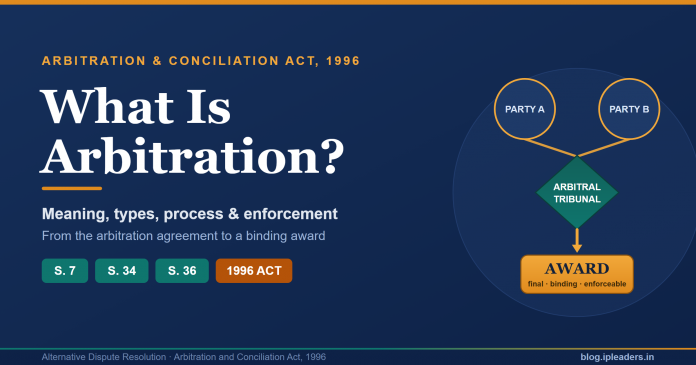
The short version: Arbitration is a private, binding method of resolving disputes in which the parties agree to submit their disagreement to one or more neutral arbitrators instead of going to court. In India it is governed by the Arbitration and Conciliation Act, 1996, which is based on the UNCITRAL Model Law. The process runs from a written arbitration agreement (Section 7), through appointment of the tribunal (Section 11), a hearing, and a final award (Section 31), to enforcement of that award as if it were a court decree (Section 36). Court involvement is deliberately limited: courts step in mainly to appoint arbitrators, grant urgent interim relief (Section 9), set aside a defective award on narrow grounds (Section 34), and enforce the result.
Here is how each of those pieces fits together, and what has changed.
What arbitration means
Arbitration is a form of dispute resolution in which two or more parties agree to have their dispute decided, not by a judge in a public courtroom, but by a private tribunal of one or more arbitrators whose decision is binding on them. The tribunal hears both sides, weighs the evidence, applies the law, and issues a written decision called an arbitral award. That award is final and, once the challenge window closes, enforceable in the same way as a decree of a civil court.
The statutory anchor is the Arbitration and Conciliation Act, 1996 (the “1996 Act” or “the Act”). Section 2(1)(a) defines arbitration simply as “any arbitration whether or not administered by a permanent arbitral institution.” It sounds circular, and it is: the Act deliberately leaves the concept broad so that both a formal, institution-run proceeding and a bare two-party reference count equally. What actually makes something arbitration, in the legal sense, is consent recorded in an arbitration agreement under Section 7 of the Act.
Here’s the thing most people miss. Arbitration is a creature of contract, not of the court system. A judge hears your case because the state gives that court jurisdiction over you whether you like it or not. An arbitrator hears your case only because you agreed, in writing, that they could. Pull away the agreement and the arbitrator’s authority collapses. This single idea (that the whole edifice rests on party consent) explains almost every rule that follows, from who can be made a party to why courts are told to keep their hands off.
Arbitration also sits inside a larger family called Alternative Dispute Resolution, or ADR, which covers arbitration, conciliation, mediation and negotiation. They are not the same thing, and treating them as interchangeable is a common and costly error. The defining feature of arbitration is that the third party decides for you and the decision binds you. In mediation and conciliation, the third party helps you reach your own settlement but cannot impose one. That distinction (decision versus facilitation) is the line that separates arbitration from the rest of ADR, and it matters enormously when you’re choosing a clause. For a fuller side-by-side, iPleaders has a dedicated breakdown of the difference between arbitration, conciliation and mediation.
So why do commercial parties keep choosing it? Because a well-run arbitration is faster than litigation, private rather than public, decided by someone who actually understands the subject matter, and (for cross-border deals) enforceable in over 170 countries through the New York Convention. Those are not small advantages when your dispute involves a construction defect, a shareholders’ quarrel, or an international supply contract.
Before going deeper, it helps to fix arbitration’s place on the map. Where does it sit relative to the three things people most often confuse it with? The quick answer: arbitration is the only private option that produces a binding decision imposed by the neutral, and litigation is the only option that plays out in public before the state’s own judges.
| Feature | Litigation | Arbitration | Conciliation | Mediation |
|---|---|---|---|---|
| Who decides | A judge (the State) | The arbitral tribunal the parties chose | The parties (conciliator only proposes terms) | The parties (mediator only facilitates) |
| Binding outcome | Yes, a judgment | Yes, an award enforceable as a decree | Only if parties sign a settlement | Only if parties sign a settlement |
| Governing law in India | Civil Procedure Code, 1908 | Arbitration and Conciliation Act, 1996, Part I | 1996 Act, Part III | Mediation Act, 2023 |
| Privacy | Public record | Private and confidential (Section 42A) | Private | Private |
| Right of appeal | Full appeal on facts and law | Very limited: set-aside on narrow grounds (Section 34) | Not applicable | Not applicable |
| Typical control over process | Low | High (parties pick arbitrator, seat, rules) | High | High |
Two points are worth flagging here. First, conciliation lives inside the same 1996 Act as arbitration (Part III, Sections 61 to 81), which is exactly why the statute is called the Arbitration and Conciliation Act. Second, mediation is no longer the unlegislated cousin it was when older guides were written: the Mediation Act, 2023 is now on the books and gives mediated settlements statutory enforceability. If a page still tells you mediation in India is governed only by “a Bill yet to be passed,” that page predates September 2023. For the litigation comparison specifically, see our detailed treatment of arbitration versus litigation.
The practical takeaway? Choose arbitration when you want a binding, private, expert decision and you can live with almost no appeal. Choose mediation or conciliation when preserving the relationship matters more than winning, and you’d rather craft your own settlement than have one imposed.
The types of arbitration
Arbitration is not one thing. The word covers several distinct models, and the labels matter because they change who runs the process, how much it costs, and how the tribunal gets appointed. Which type applies to you depends on what your clause says and who the parties are.
Ad hoc versus institutional arbitration
This is the most consequential split. In ad hoc arbitration, the parties run the show themselves. There’s no administering body; the parties (or, failing agreement, the court under Section 11) appoint the tribunal, fix the procedure, and manage timelines. It’s cheaper on paper because you don’t pay institutional fees, but it demands cooperation that disputing parties rarely have, and it tends to leak time.
In institutional arbitration, an arbitral institution administers the case under its own published rules: appointing arbitrators, scrutinising the award, managing deadlines and fees. In India the main institutions include the Mumbai Centre for International Arbitration (MCIA), the India International Arbitration Centre (IIAC, formerly the New Delhi International Arbitration Centre), and the Delhi International Arbitration Centre; internationally, the SIAC (Singapore), the LCIA (London), and the ICC (Paris). Institutional arbitration costs more upfront and saves money and grief later. The Government of India, the Law Commission, and the 2024 draft reform Bill have all been pushing India toward institutional arbitration for exactly this reason. Our overview of the types of arbitration and their significance goes deeper on the trade-off.
Domestic versus international commercial arbitration
A domestic arbitration is one seated in India between parties who are, broadly, Indian. An international commercial arbitration is defined in Section 2(1)(f) of the Act: a commercial dispute where at least one party is a foreign national or resident, a foreign company, or a foreign government. The distinction is not academic. It changes which court has supervisory jurisdiction, whether the “patent illegality” ground for challenge is available (it isn’t, for international commercial awards), and how the tribunal is appointed.
Fast-track, emergency and statutory arbitration
Three more variants round out the picture. Fast-track arbitration under Section 29B lets parties agree to a documents-only procedure with the award due in six months. Emergency arbitration is a mechanism offered by many institutions to grant urgent interim relief before the main tribunal is even constituted. India’s Supreme Court held in Amazon.com NV Investment Holdings LLC v. Future Retail Ltd., (2022) 1 SCC 209 that an emergency arbitrator’s order in an India-seated arbitration is enforceable as an order of the tribunal under Section 17. And statutory arbitration arises where a special statute (say, certain provisions of electricity or telecom law) mandates arbitration by force of law rather than by a private clause.
Which one fits you? For most commercial contracts, an institutional, domestic arbitration with a fast-track option for smaller claims is the sensible default. The bespoke stuff (emergency relief, foreign seats) matters only when the deal’s size and cross-border character justify it.
The legal framework: the Arbitration and Conciliation Act, 1996
Every road in Indian arbitration leads back to the Arbitration and Conciliation Act, 1996. It came into force on 22 August 1996, replacing a fragmented regime of three colonial-era statutes, and it was built on the UNCITRAL Model Law on International Commercial Arbitration (1985) and the UNCITRAL Conciliation Rules (1980). That Model Law pedigree is why Indian arbitration looks familiar to practitioners in Singapore, London or Dubai: they’re all speaking dialects of the same code. For a section-by-section walkthrough, see our overview of the Arbitration and Conciliation Act, 1996.
The Act is organised into four Parts, and knowing which Part governs your situation saves a lot of confusion:
- Part I (Sections 2 to 43) governs every arbitration seated in India, domestic or international. This is where the machinery lives: the arbitration agreement, appointment, interim measures, the conduct of proceedings, the award, and setting aside.
- Part II (Sections 44 to 60) governs the enforcement of foreign awards in India, split between the New York Convention (Sections 44 to 52) and the older Geneva Convention (Sections 53 to 60).
- Part III (Sections 61 to 81) governs conciliation.
- Part IV (Sections 82 to 86) holds supplementary provisions.
One doctrine cuts across all of this and confuses newcomers: the difference between the seat and the venue of arbitration. The seat is the legal home of the arbitration, the jurisdiction whose courts supervise it. The venue is merely the physical place hearings happen. You can hold hearings in a Mumbai hotel while the seat, and therefore the supervising court, sits in Singapore. The Supreme Court sorted much of this out in BGS SGS Soma JV v. NHPC Ltd., (2020) 4 SCC 234, and in the foundational Bharat Aluminium Co. v. Kaiser Aluminium Technical Services Inc., (2012) 9 SCC 552 (“BALCO”), which held that Part I does not apply to arbitrations seated outside India. Getting seat and venue wrong in a clause is one of the most expensive drafting mistakes there is.
The amendments that reshaped the Act
The 1996 Act has been amended three times, and each round matters for reading any older commentary correctly:
- 2015 Amendment. The big one. It introduced strict neutrality rules for arbitrators (Section 12(5) read with the Seventh Schedule), a twelve-month time limit for awards (Section 29A), the “patent illegality” ground for setting aside domestic awards (Section 34(2A)), and, crucially, it removed the automatic stay on enforcement that used to follow the mere filing of a challenge (Section 36).
- 2019 Amendment. Created the Arbitration Council of India (a body to grade arbitral institutions), added a confidentiality obligation (Section 42A), and pushed institutional appointment of arbitrators.
- 2021 Amendment. Allowed a court to grant an unconditional stay on enforcement of an award where the arbitration agreement or the award itself was induced by fraud or corruption, and it scrapped a rigid schedule of arbitrator qualifications from 2019.
Two institutions are worth knowing by name. The Arbitration Council of India (ACI), created by the 2019 amendment, is meant to accredit and grade arbitral institutions; in practice it is still finding its feet and is not yet a fully operational regulator. The India International Arbitration Centre (IIAC) in New Delhi, established under its own 2019 statute and taking over the earlier NDIAC, is the government’s flagship institution meant to make India a serious arbitration hub. Whether either delivers is one of the open questions of the next few years.
The arbitration agreement: where it all begins
No arbitration agreement, no arbitration. Everything traces back to Section 7 of the Act, which requires the agreement to be in writing and to record the parties’ intention to submit their disputes to arbitration. It can be a standalone agreement or, far more commonly, a single clause inside a larger contract. It can even be formed through an exchange of emails or a pleading in which one side asserts the agreement and the other doesn’t deny it.
Three doctrines give the arbitration agreement its surprising toughness, and they trip up people who assume that killing the main contract kills the arbitration clause with it.
Separability. Under Section 16, the arbitration clause is treated as an agreement independent of the contract it sits inside. So even if the main contract is terminated, expires, or is later found void, the arbitration clause survives to decide the very dispute about that contract. The clause is a lifeboat, not a passenger.
Competence-competence. The same Section 16 lets the tribunal rule on its own jurisdiction, including on any objection that the arbitration agreement doesn’t exist or is invalid. The tribunal gets first crack at the “do you even have authority over me?” question, and courts are told to stay out until the award stage in most cases.
The stamping question, finally settled. For years, Indian arbitration was tangled in a fight over whether an arbitration clause inside an unstamped or under-stamped contract was even enforceable. A seven-judge bench of the Supreme Court put it to rest on 13 December 2023 in In re: Interplay Between Arbitration Agreements under the Arbitration and Conciliation Act 1996 and the Indian Stamp Act 1899, (2024) 6 SCC 1, holding that non-stamping is a curable defect that makes a document inadmissible in evidence, not void. The arbitration clause is enforceable; the stamping can be fixed later. That overruled the earlier N.N. Global line and removed a favourite delay tactic.
Who is bound, and what can even be arbitrated
Ordinarily only the parties who signed are bound. But in Cox & Kings Ltd. v. SAP India Pvt. Ltd., (2024) 4 SCC 1, a five-judge bench confirmed that the “group of companies” doctrine applies in India, so a non-signatory company within the same corporate group can be bound to an arbitration where the facts show it was genuinely part of the transaction. If you thought signing nothing kept you safely outside the arbitration, that’s no longer a safe assumption.
Then there’s the threshold question of arbitrability: is this kind of dispute even capable of being arbitrated? Some subjects are reserved for courts and public tribunals. The controlling test comes from Vidya Drolia v. Durga Trading Corporation, (2021) 2 SCC 1, which laid down a four-fold test for when a dispute is non-arbitrable. Criminal offences, insolvency, most matrimonial and testamentary matters, tenancy under special rent-control statutes, and disputes affecting rights in rem (rights against the world, not just against a specific person) generally cannot go to arbitration. For the full framework, we’ve mapped it out in the arbitrability of disputes in India hub.
Drafting the clause well is a skill in itself, and a bad clause (a “pathological” clause, in the trade) can sink an otherwise strong case. If you’re writing one, start with our guide on how to draft an arbitration agreement in India and the accompanying arbitration agreement primer and checklist.
How arbitration actually works, step by step
So what does an arbitration actually look like from the day the dispute erupts to the day you hold an enforceable award? The process under Part I of the Act runs through a recognisable sequence. The exact choreography varies with the institution’s rules, but the statutory backbone is fixed.
- Commencement (Section 21). Unless the parties agree otherwise, the arbitration begins on the date the respondent receives a written request to refer the dispute to arbitration. This date matters: it stops the clock on limitation. Our note on Section 21 and the commencement of proceedings explains why.
- Appointing the tribunal (Sections 10 and 11). The parties decide how many arbitrators (an odd number, per Section 10, most often one or three). They appoint by the method in their clause; if that fails, either party asks the High Court or Supreme Court (or a designated institution) to appoint under Section 11. Our explainer on appointment under Section 11 covers the mechanics.
- Independence and challenge (Sections 12 and 13). A prospective arbitrator must disclose anything that could raise doubts about their independence. Section 12(5), read with the Seventh Schedule, makes certain people flatly ineligible, and the Supreme Court has enforced this strictly: in TRF Ltd. v. Energo Engineering Projects Ltd., (2017) 8 SCC 377 and Perkins Eastman Architects DPC v. HSCC (India) Ltd., (2020) 20 SCC 760, it held that a person ineligible to act as arbitrator cannot appoint one either. Unilateral appointment clauses have been dying a slow death ever since.
- Interim relief (Sections 9 and 17). Need to freeze an asset or preserve goods before the tribunal can act? A party can go to court under Section 9, or to the tribunal itself under Section 17 once it’s constituted. Post-2015, a Section 17 order carries the same force as a court order.
- Pleadings and hearings (Sections 23 and 24). The claimant files a statement of claim, the respondent its defence and any counterclaim. Section 23(4), added in 2019, requires the pleadings to be completed within six months of the tribunal’s appointment. The tribunal then holds hearings or, if the parties prefer, decides on documents alone.
- The time limit (Section 29A). Here’s a rule with real teeth. For domestic arbitrations, the award must be made within twelve months from the date the pleadings are complete. The parties can extend that by consent for another six months. Beyond that, only a court can grant more time, and it can cut the tribunal’s fees if the delay is on the arbitrators.
- The award (Section 31). The tribunal issues a written, signed and dated award stating its reasons. It fixes who pays costs and, under Section 31(7), the interest.
For a more granular walk through each stage, our post on the arbitration procedure under the 1996 Act is the companion to this section.
The arbitral award and how it is challenged
The award is the whole point of the exercise. Under Section 31, it must be in writing, signed by the arbitrators, dated, and (unless the parties agree otherwise or it merely records a settlement) it must state the reasons on which it rests. An unreasoned commercial award is a defective award.
Once the award is made, the losing party has one narrow escape route: an application to set it aside under Section 34. And “narrow” is the operative word. A Section 34 court does not sit in appeal over the tribunal. It cannot re-hear the dispute or substitute its own view of the evidence. It can set the award aside only on the limited grounds the statute lists: a party was under some incapacity; the arbitration agreement was invalid; the party wasn’t given proper notice or a chance to present its case; the award goes beyond the scope of the reference; the tribunal was improperly composed; the dispute wasn’t arbitrable; or the award conflicts with the public policy of India.
For purely domestic awards (not international commercial ones), Section 34(2A) adds one more ground: “patent illegality” appearing on the face of the award. Even this is deliberately limited. The Supreme Court in Ssangyong Engineering & Construction Co. Ltd. v. NHAI, (2019) 15 SCC 131 confirmed that the post-2015 public policy ground is a tight one, and that mere erroneous application of the law or re-appreciation of evidence is not enough to knock out an award.
The 2025 shift: courts can now modify awards
Here’s the development that makes every pre-2025 explainer on this topic obsolete. For years the settled position, anchored in National Highways Authority of India v. M. Hakeem, (2021) 9 SCC 1, was that a court hearing a Section 34 challenge could set aside an award but could not modify it. Section 34, the reasoning went, is a power to annul, not to rewrite.
That changed on 30 April 2025. A five-judge Constitution Bench of the Supreme Court in Gayatri Balasamy v. ISG Novasoft Technologies Ltd., 2025 SCC OnLine SC 986, held by a 4:1 majority that courts do have a limited power to modify an arbitral award. The Court confined that power to four situations: severing an invalid part of the award from a valid part where the two are separable; correcting clerical, computational or typographical errors and other manifest errors apparent on the face of the record; modifying post-award interest in appropriate cases; and exercising the Supreme Court’s own power under Article 142 of the Constitution to do complete justice, used with great care and caution. Justice K.V. Viswanathan dissented, warning that the majority was reading a power into the statute that Parliament had not put there.
So does that turn Section 34 into a full appeal? No, and that’s the point most hot takes miss. The modification power is narrow and exceptional; the default remains set-aside on limited grounds. But it does mean a party no longer has to choose between swallowing a flawed award whole and getting it struck down entirely. That’s a meaningful shift in the risk calculus of any arbitration, and it’s why the Balasamy decision has been called both a pragmatic correction and a dent in the finality of awards. Older content that still states flatly that “a court cannot modify an award” is now simply wrong.
Enforcing the award (including foreign awards)
An award you can’t enforce is a piece of paper. The 1996 Act is built to make sure it isn’t.
For a domestic award, Section 36 is the engine. Once the three-month window to challenge under Section 34 has passed (or the challenge has failed), the award is enforced in the same manner as a decree of a civil court under the Code of Civil Procedure, 1908. And here’s a change many people still get wrong: before 2015, merely filing a Section 34 challenge automatically stayed enforcement. Not anymore. Since the 2015 amendment, a challenge does not automatically stay the award; the challenging party must apply separately for a stay, and the court can impose conditions such as depositing the award amount. The 2021 amendment carved out one exception, allowing an unconditional stay where the arbitration or award was tainted by fraud or corruption. Appeals against certain orders (a refusal to refer to arbitration, a grant or refusal of interim measures, a setting aside or refusal to set aside) lie under Section 37, and that list is exhaustive.
Foreign awards run on a separate track under Part II. India is a signatory to the 1958 New York Convention, and Sections 44 to 52 give effect to it. A New York Convention award, made in a country the Central Government has notified as a reciprocating territory, is enforced in India by filing it before the competent court along with the evidence required by Section 47. The court can refuse enforcement only on the narrow grounds in Section 48, which mirror Article V of the Convention: an invalid agreement, lack of proper notice, the award exceeding the scope of the reference, improper composition of the tribunal, the award not yet being binding, non-arbitrability, or conflict with the public policy of India. Indian courts have made clear they read these grounds narrowly and lean pro-enforcement, most notably in Vijay Karia v. Prysmian Cavi E Sistemi SRL, (2020) 11 SCC 1, where the Supreme Court stressed that Section 48 is not a gateway to a merits review.
One more point catches people out. Can two Indian parties choose a foreign seat of arbitration? Yes. In PASL Wind Solutions Pvt. Ltd. v. GE Power Conversion India Pvt. Ltd., (2021) 7 SCC 1, the Supreme Court held that two Indian parties can validly agree to arbitrate outside India, and the resulting award is enforceable in India as a foreign award. If your matter touches foreign awards, our detailed guide to the enforcement of foreign arbitral awards in India is the place to go next.
The advantages and the real limitations
Why do sophisticated commercial parties keep choosing arbitration? And where does it actually let them down? An honest account needs both halves.
The advantages are real. Arbitration is usually faster than litigation, especially with the Section 29A time limit doing its work. It’s private: proceedings and awards are confidential (Section 42A), which matters when the dispute touches trade secrets or reputational risk. Parties get to pick a subject-matter expert as arbitrator instead of a generalist judge rotating through a crowded docket. The result is final, with almost no appeal, so the loser can’t drag it through three tiers of courts. And for cross-border deals, a New York Convention award is enforceable in over 170 countries, which no domestic court judgment can match.
But let’s be honest about the limitations, because the glossy version oversells it. Arbitration is not always cheap: arbitrators’ fees, institutional charges and venue costs can, for a mid-sized dispute, rival or exceed litigation, particularly in ad hoc proceedings that drift. The very finality that’s an advantage cuts the other way if the award goes against you on a bad day, because your grounds to challenge are painfully thin. Arbitrators cannot bind non-parties the way a court sometimes can, and multi-party, multi-contract disputes get procedurally messy. And in India specifically, the promise of speed is often undercut when the losing party runs to court under Section 34, turning a “final” award into the opening round of years of litigation. The practical reality is that arbitration works beautifully when both sides play fair and badly when one side treats every stage as an opportunity to delay.
Would we still recommend it for most commercial contracts? Yes, with a good clause and, ideally, an institution administering it. The gap between a well-drafted institutional arbitration and a sloppy ad hoc one is enormous.
Frequently asked questions
What is arbitration in simple terms?
Arbitration is a private way of settling a dispute where, instead of going to court, the parties agree to let one or more neutral arbitrators hear the case and give a binding decision called an award. It’s built on the parties’ consent and is governed in India by the Arbitration and Conciliation Act, 1996.
Is an arbitration award legally binding in India?
Yes. Under the 1996 Act, an arbitral award is final and binding on the parties. Once the three-month window to challenge it under Section 34 passes, it is enforced in the same manner as a decree of a civil court under Section 36.
What is the difference between arbitration and mediation?
In arbitration, the arbitrator decides the dispute and the decision binds the parties. In mediation, the mediator only helps the parties reach their own settlement and cannot impose an outcome. Arbitration produces an enforceable award; mediation produces a settlement only if the parties agree to one.
Which law governs arbitration in India?
The Arbitration and Conciliation Act, 1996, based on the UNCITRAL Model Law. Part I covers arbitrations seated in India, Part II covers enforcement of foreign awards, and Part III covers conciliation.
Can a court change an arbitral award?
Until 2025, the settled view was that a court could set aside an award but not modify it. In Gayatri Balasamy v. ISG Novasoft Technologies Ltd. (April 2025), a five-judge bench held that courts have a limited power to modify an award, for example to sever an invalid part, correct manifest errors, or adjust post-award interest. The power is narrow, not a general right of appeal.
How long does arbitration take in India?
For domestic arbitrations, Section 29A requires the award within twelve months of completed pleadings, extendable by six months with party consent. A disciplined arbitration can finish inside eighteen months, though a court challenge afterward can add years.
Does filing a challenge under Section 34 stop the award from being enforced?
No, not automatically. Since the 2015 amendment, a Section 34 challenge does not automatically stay enforcement. The challenging party must apply separately for a stay, and the court may impose conditions such as depositing the awarded sum.
What disputes cannot be arbitrated?
Broadly, criminal offences, insolvency and winding-up, most matrimonial and testamentary matters, guardianship, tenancy under special rent-control statutes, and disputes affecting rights in rem. The controlling test is the four-fold test in Vidya Drolia v. Durga Trading Corporation (2021).
What is the difference between ad hoc and institutional arbitration?
In ad hoc arbitration the parties run the process themselves without an administering body. In institutional arbitration, a body such as the MCIA, IIAC, SIAC or ICC administers the case under its published rules. Institutional arbitration costs more upfront but is usually smoother and faster.
Can two Indian parties arbitrate outside India?
Yes. In PASL Wind Solutions v. GE Power Conversion India (2021), the Supreme Court held that two Indian parties can validly choose a foreign seat, and the resulting award is enforceable in India as a foreign award.
Does an unstamped contract kill the arbitration clause?
No. A seven-judge bench in In re: Interplay (December 2023) held that non-stamping is a curable defect that makes a document inadmissible in evidence, not void. The arbitration clause remains enforceable, and the stamping can be cured later.
What is the seat of arbitration?
The seat is the legal home of the arbitration, the jurisdiction whose courts supervise it and whose law governs the arbitration. It is different from the venue, which is just the physical place hearings are held. The seat, not the venue, decides which court has supervisory jurisdiction.
References
Case law
- Amazon.com NV Investment Holdings LLC v. Future Retail Ltd., (2022) 1 SCC 209. Emergency arbitrator’s order enforceable under Section 17.
- Bharat Aluminium Co. v. Kaiser Aluminium Technical Services Inc., (2012) 9 SCC 552 (BALCO). Part I does not apply to arbitrations seated outside India.
- BGS SGS Soma JV v. NHPC Ltd., (2020) 4 SCC 234. Seat versus venue.
- Cox & Kings Ltd. v. SAP India Pvt. Ltd., (2024) 4 SCC 1. Group of companies doctrine (5-judge bench).
- Gayatri Balasamy v. ISG Novasoft Technologies Ltd., 2025 SCC OnLine SC 986. Limited power of courts to modify awards (5-judge bench, 4:1).
- In re: Interplay Between Arbitration Agreements under the Arbitration and Conciliation Act 1996 and the Indian Stamp Act 1899, (2024) 6 SCC 1. Unstamped arbitration agreement enforceable (7-judge bench).
- National Highways Authority of India v. M. Hakeem, (2021) 9 SCC 1. Section 34 does not permit modification (now qualified by Gayatri Balasamy).
- PASL Wind Solutions Pvt. Ltd. v. GE Power Conversion India Pvt. Ltd., (2021) 7 SCC 1. Two Indian parties may choose a foreign seat.
- Perkins Eastman Architects DPC v. HSCC (India) Ltd., (2020) 20 SCC 760. Unilateral appointment by an interested party invalid.
- Ssangyong Engineering & Construction Co. Ltd. v. NHAI, (2019) 15 SCC 131. Narrowed public policy ground post-2015.
- TRF Ltd. v. Energo Engineering Projects Ltd., (2017) 8 SCC 377. An ineligible person cannot appoint an arbitrator.
- Vidya Drolia v. Durga Trading Corporation, (2021) 2 SCC 1. Four-fold test for arbitrability.
- Vijay Karia v. Prysmian Cavi E Sistemi SRL, (2020) 11 SCC 1. Narrow reading of Section 48; pro-enforcement.
Statutes
- Arbitration and Conciliation Act, 1996. Sections cited: 2(1)(a), 2(1)(f), 7, 8, 9, 10, 11, 12, 12(5), 13, 16, 17, 21, 23, 24, 29A, 29B, 31, 34, 34(2A), 36, 37, 42A, 44 to 52, 61 to 81.
- Code of Civil Procedure, 1908. Enforcement of an award as a decree.
- Mediation Act, 2023. Statutory framework for mediation and enforceability of mediated settlements.
- Draft Arbitration and Conciliation (Amendment) Bill, 2024. Consultation draft (proposed Sections 9A and 34A); not enacted as of mid-2026.
(URLs for each case and statute are resolved and live-verified by the Fact-Checker at Stage 6: Indian Kanoon for case law, a working government PDF or Indian Kanoon fallback for statutes.)
Disclaimer: This article is for informational and educational purposes only and does not constitute legal advice. Arbitration law in India is evolving, and its application depends on the specific facts of each matter. Readers should consult a qualified advocate before acting on any information contained here.