Adv. Harjeet Singh

Cross-border and group insolvency under the IBC Amendment Act 2026

Cross-border and group insolvency under the IBC Amendment Act 2026 rest on two new provisions: Section 240C, which lets the Central Government prescribe rules for recognising and cooperating with foreign insolvency proceedings, and Chapter VA, which does the same where two or more companies in a group go through insolvency together. Neither provision is in […]

Cross-border and group insolvency under the IBC Amendment Act 2026 Read More »
Arbitration vs Conciliation vs Mediation

Arbitration vs conciliation vs mediation turns on a single question: does the neutral decide the dispute, or do the parties? Arbitration is adjudicatory, and it ends in a binding award under the Arbitration and Conciliation Act, 1996. Conciliation and mediation are not adjudicatory, because the neutral only helps the parties reach their own settlement, which

Arbitration vs Conciliation vs Mediation Read More »

Arbitration procedure in India through the judgments that shaped it

The arbitration procedure in India runs from a written arbitration agreement under Section 7 of the Arbitration and Conciliation Act, 1996, through reference to arbitration, appointment of the tribunal, pleadings, hearings and the award, to enforcement of that award as a decree of the court. What the bare text of the Act does not show

Arbitration procedure in India through the judgments that shaped it Read More »

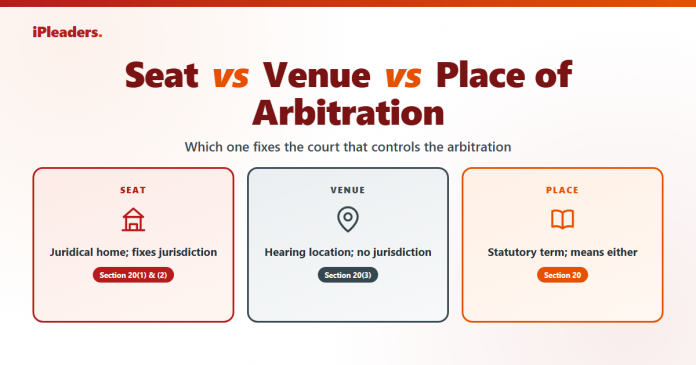
Seat vs venue vs place of arbitration

Seat vs venue vs place of arbitration is a three-way distinction that decides which court controls an arbitration, not merely where the hearings sit. “Place” is the word the Arbitration and Conciliation Act, 1996 actually uses in Section 20; the “seat” is the juridical home that fixes the supervisory court and the law governing the

Seat vs venue vs place of arbitration Read More »

Arbitration Agreement under section 7 of the Arbitration and Conciliation Act, 1996

An arbitration agreement under Section 7 of the Arbitration and Conciliation Act, 1996 is an agreement to submit present or future disputes arising out of a defined legal relationship, whether contractual or not, to arbitration, and it is valid only if it is in writing in one of the forms set out in Section 7(4).

Arbitration Agreement under section 7 of the Arbitration and Conciliation Act, 1996 Read More »

Arbitration clause drafting mistakes that make it unenforceable in India

The most common arbitration clause drafting mistakes in India are permissive “may” language, a missing or confused seat, one-sided appointment mechanisms, and over-broad scope that captures non-arbitrable disputes, and each one can make the clause unenforceable or stall it for months. Two Supreme Court rulings in 2023 and 2024 reset the ground: an unstamped agreement

Arbitration clause drafting mistakes that make it unenforceable in India Read More »

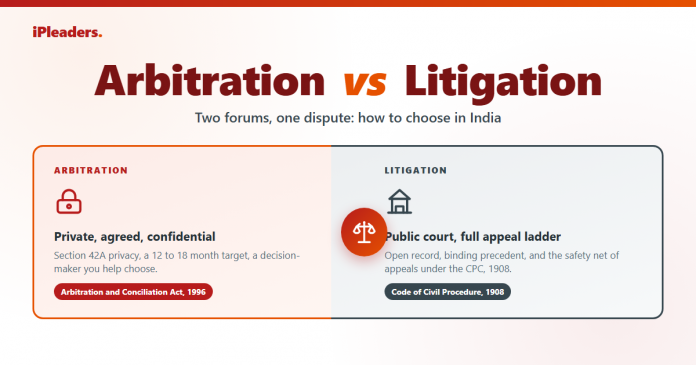
Arbitration vs litigation in India

Arbitration vs litigation is, at heart, a choice between two forums for the same fight: arbitration is a private, consent-based process under the Arbitration and Conciliation Act, 1996, usually faster and confidential, but with almost no route to reargue the merits; litigation is the public court process under the Code of Civil Procedure, 1908, slower

Arbitration vs litigation in India Read More »

Advantages and disadvantages of arbitration

The advantages and disadvantages of arbitration decide whether a business should keep its disputes out of court or not. Arbitration in India, governed by the Arbitration and Conciliation Act, 1996, offers party autonomy, confidentiality, a subject-expert decision-maker, a final award with no appeal on merits, and cross-border enforceability under the New York Convention. Its disadvantages

Advantages and disadvantages of arbitration Read More »

Call Us Now
WhatsApp
Scroll to Top