


Last verified: 23 June 2026
In December 2025, a record 92,344 people registered for a single law entrance exam. That was CLAT 2026, the Common Law Admission Test, and almost all of those candidates wanted the same thing you probably do: to become a lawyer in India, starting right after the 12th. The number was the highest in the test’s history, a jump of roughly 17% over the year before. And they were all chasing a little over four thousand five-year law seats spread across the country’s National Law Universities.
Read that ratio again. Tens of thousands of school-leavers, a few thousand of the most coveted seats. It sounds brutal, and at the top end it is. But here’s what that headline hides: the seat you want may not be at a National Law University at all, the exam you fear may not be the only door, and half the people who drop out of the race do so not because they failed an exam, but because nobody handed them the actual map.
That map is newer than most people assume. Until the late 1980s, becoming a lawyer in India almost always meant finishing a regular degree first, then doing a three-year LLB. Then India’s first National Law University (established in 1987, with its first batch in 1988) launched a five-year integrated law programme you could join straight out of school. That single idea reshaped legal education. Today more than two dozen NLUs and hundreds of private and government colleges run the same five-year model, and “law after 12th” is a mainstream, aspirational choice rather than an odd one.

So the competition is real. The confusion, though, is the bigger enemy. Which degree, which exam, which college, what marks, is there an age limit, what happens after the degree, when do you actually become an “advocate” who can stand up in court? Most guides answer two of those and skip the rest.
This is the full map. Every step from your class 12 result to the day you hold a Certificate of Practice, with the 2026 rules, honest costs, and the questions other roadmaps quietly avoid.
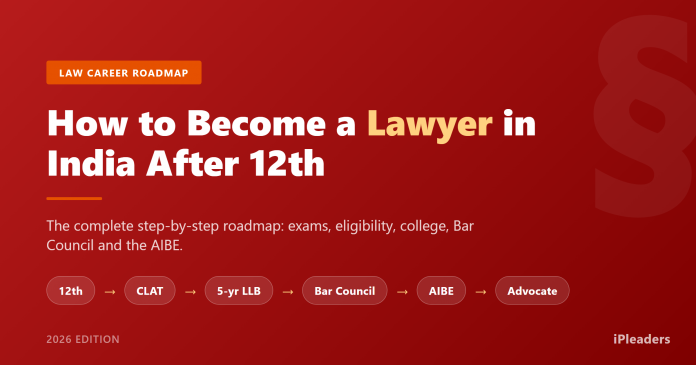
To become a lawyer in India after the 12th, pass 10+2 with the required minimum marks (usually 45%, relaxed to 40% for SC/ST candidates), clear a law entrance exam such as CLAT, AILET, SLAT or a state CET, complete a five-year integrated LLB (BA/BBA/BCom/BSc LLB), enrol with a State Bar Council, and clear the All India Bar Examination (AIBE) to earn your Certificate of Practice.
That’s the whole journey in one breath. Now let’s slow it down, because each of those words hides a decision that can save or cost you years. We’ll start with the single choice that defines everything else: which route into law is actually yours.
Two ways to become a lawyer after 12th (and why the five-year route is yours)
Most people who “want to do law” don’t realise there are two completely different doors, and picking the wrong one can cost you three years. So which door is yours?
There are two recognised routes to a law degree in India. The first is the five-year integrated LLB, which you join straight after class 12. The second is the three-year LLB, which you can only join after you’ve already finished a bachelor’s degree in any subject. If you’ve just finished (or are about to finish) the 12th, the five-year route is built for you. The three-year LLB is the path for graduates and career-changers, not for school-leavers.
The five-year integrated degree combines a bachelor’s subject with law. That’s why you see names like BA LLB, BBA LLB, BCom LLB and BSc LLB. You study political science, economics, management, or science alongside your legal subjects, and you walk out with two qualifications fused into one. The three-year LLB skips the general-subject half because you’ve already done a full degree.
Here’s the comparison in plain terms.
| Five-year integrated LLB | Three-year LLB | |
|---|---|---|
| When you join | Right after class 12 | After any bachelor’s degree |
| Best for | School-leavers (you) | Graduates, career-changers |
| Degree names | BA/BBA/BCom/BSc LLB | LLB |
| Total time to the degree | 5 years | 3 years (plus your earlier degree) |
| Main entrance exams | CLAT, AILET, SLAT, state CETs | DU LLB, state CETs, some CLAT-PG-unrelated tests |
Now, a distinction that trips up almost every beginner: lawyer versus advocate. People use the words as if they’re the same. They aren’t, not legally. Anyone with a law degree is a “lawyer” in the loose sense. An “advocate” is a lawyer who has enrolled with a State Bar Council and is entitled to practise in court under the Advocates Act, 1961. The degree makes you a law graduate. Enrolment plus the bar exam makes you an advocate. That gap, between graduating and being allowed to practise, is exactly where this guide spends its second half.
A question we see constantly from students is whether BA LLB is “better” than BBA LLB or BCom LLB. The honest answer? The “LLB” half is identical across all of them, and that’s the part that makes you a lawyer. The prefix just decides your non-law subjects. If you love debate, history and politics, BA LLB feels natural. If you’re drawn to companies, finance and deal-making, BBA LLB or BCom LLB gives you a head start on the commercial vocabulary. BSc LLB suits students eyeing intellectual property, patents, or tech law. None of them locks your career. Many corporate lawyers hold a BA LLB; many litigators hold a BBA LLB.
The mistake we see most often is treating this first choice as irreversible. It isn’t. Your specialisation in practice is decided far more by your internships, your electives in the final years, and your first job than by whether your degree said “BA” or “BCom” on the cover. Pick the integrated subject you’ll enjoy studying for five years, and move on to the choice that actually has gatekeepers: the entrance exam.
The complete roadmap at a glance (8 steps and a realistic timeline)
Before we go deep, here’s the entire journey on one page. If you remember nothing else, remember these eight steps.
- Finish class 12 with at least 45% marks (40% for SC/ST candidates).
- Choose your five-year integrated degree (BA/BBA/BCom/BSc LLB).
- Prepare for and clear a law entrance exam (CLAT, AILET, SLAT or a state CET).
- Take admission into a BCI-recognised five-year law college.
- Complete the five-year degree, with internships and moot courts along the way.
- Enrol as an advocate with your State Bar Council after graduating.
- Clear the All India Bar Examination (AIBE) conducted by the Bar Council of India.
- Collect your Certificate of Practice and start practising as an advocate.
That’s the skeleton. Every section below is just one of these steps, opened up.
How long does it actually take?
So how many years from your class 12 result to standing in a courtroom as an advocate? Plan for five and a half to six years, not five.
The degree is five years. But enrolment with the State Bar Council and the AIBE happen after you graduate, and the bar exam plus the wait for your Certificate of Practice adds a few months. The five-year figure that competitors quote is the degree alone. The realistic figure to becoming a practising advocate is closer to five and a half to six years. Here’s the honest breakdown.
| Stage | Time | What happens |
|---|---|---|
| Entrance prep | Class 11–12 (alongside school) | Prepare for CLAT or another exam |
| Five-year LLB | 5 years | The integrated degree, with internships |
| Bar Council enrolment | A few weeks after graduating | Provisional enrolment as an advocate |
| AIBE + Certificate of Practice | Within months of enrolment | Clear the bar exam, receive the CoP |
It’s worth flagging that the clock for the AIBE starts after you enrol, not after you graduate, and there’s a window within which you’re expected to clear it (more on that in the AIBE section). Treat the degree as the long middle, not the finish line.
Step 1: Pick your stream and subjects in class 11 and 12
Every year, students in the science stream message us in a panic: “I’m in PCM, have I ruined my chance at law?” The fear is understandable. It’s also misplaced.
Legally, no specific stream is required to study law after the 12th. The eligibility rule is about your overall percentage, not your subjects. A science student, a commerce student and an arts student stand on exactly the same line at the CLAT registration desk. We’ve seen PCM students top law entrances and we’ve seen arts students struggle. The stream is not the gate.
Does your stream actually matter?
Not for eligibility. A little, for comfort. Subjects like political science, economics, history and legal studies overlap with what you’ll read in law school, so arts and commerce students sometimes feel an early familiarity. But CLAT and most law entrances test aptitude, not syllabus: reading comprehension, reasoning, current affairs, and basic quantitative skills. None of that rewards a physics background or punishes one.
Here’s the part most people miss. The single most useful “subject” for a future lawyer isn’t on any board timetable. It’s the habit of reading dense English quickly and accurately. CLAT 2026 is built around long passages you must read, understand and reason from, under time pressure. A student who reads a newspaper editorial every day for two years walks in with a bigger advantage than one who memorised a GK book the week before.
What to focus on in class 11 and 12
Build three habits early. Read long-form English daily (editorials, good magazines, judgments written in plain language). Follow current affairs with a focus on law, politics and the courts, not just headlines. And practise reasoning, both logical and the “legal reasoning” style where you apply a given rule to a fact situation.
Fair warning: don’t sacrifice your board percentage chasing entrance prep. You need that 45% (or 40%) to be eligible at all, and some colleges and scholarships look at board marks too. Balance the two. The aspirants who flame out are usually the ones who treated class 12 boards and CLAT as a war between subjects rather than two halves of the same year.
Step 2: Understand your five-year integrated law degree options
You’ve decided law is the goal and your stream isn’t a barrier. The next question is what you’re actually signing up for when you join a five-year programme. What does an integrated LLB even contain?
A five-year integrated law degree is a single, continuous programme that blends a bachelor’s degree with the bachelor of laws. The first couple of years lean heavier on your general subject (the BA, BBA, BCom or BSc half) plus foundational law. The later years go deep into core legal subjects: constitutional law, contracts, criminal law, torts, company law, procedure, and a stack of electives. It’s not two separate degrees stapled together. It’s an integrated curriculum designed by the institution and approved by the Bar Council of India.
That BCI approval matters more than the brand on the gate. Only a law degree from a BCI-recognised institution lets you enrol as an advocate later. A flashy programme that isn’t BCI-approved can leave you with a certificate that won’t get you into any State Bar Council. Before you pay a rupee, confirm the college’s BCI recognition. We’ll come back to this when we talk about distance degrees, where this exact trap catches people.
The integrated degree formats you’ll encounter are BA LLB (Hons), BBA LLB (Hons), BCom LLB (Hons) and BSc LLB (Hons). The “Hons” usually signals a research component and extra credits. In day-to-day practice, the difference between them fades fast. What endures is the LLB core, which is identical, and your own record of internships and skills. Which colleges run which format, and what they cost, is the subject of Step 5. First, the gate everyone worries about: the entrance exam.
Step 3: Crack a law entrance exam (the complete exam map)
Here’s the myth that quietly costs aspirants their best options: that CLAT is the only way in. It isn’t, and treating it as the only door is the single most common strategic error we see. So what’s the full set of exams, and which ones actually matter for you?
For five-year law admission after the 12th, you’ll be looking at one or more of these: CLAT, AILET, SLAT, and state-level CETs. Each opens a different set of colleges. The smart move is to sit more than one, so a bad day at a single exam doesn’t end your year.
CLAT and the 2026 pattern change
CLAT is the big one. It’s conducted by the Consortium of National Law Universities and is your gateway to the large majority of NLUs, plus dozens of private and affiliated colleges that accept CLAT scores. If you sit one law exam, it’s almost certainly this.
CLAT changed shape for the 2026 cycle, and this is fresh enough that older guides still get it wrong. The UG paper now has 120 questions, down from 150, to be answered in 2 hours, with a 0.25-mark penalty for each wrong answer. It tests five areas: English language, current affairs including general knowledge, legal reasoning, logical reasoning, and quantitative techniques. The whole exam is comprehension-driven. You’re given passages and asked to reason from them, which rewards understanding over memorisation.
AILET, and how it differs from CLAT
AILET is the odd one out, and it surprises people. India’s National Law University in Delhi does not admit through CLAT at all. It runs its own exam, the All India Law Entrance Test (AILET), through its own admissions process. So if NLU Delhi is on your wishlist, CLAT alone won’t get you there. You sit AILET separately. Plenty of aspirants prepare for both, since the syllabuses overlap heavily and the second exam is a low-cost insurance policy.
Beyond CLAT: SLAT, state CETs and CUET
Now the part the roadmap blogs skip. Several strong programmes run entirely outside CLAT.
SLAT, the Symbiosis Law Admission Test, feeds the Symbiosis Law Schools. Maharashtra runs MH CET Law for its government and many private colleges in the state. The Telugu states run TS (now TG) LAWCET and Andhra Pradesh runs AP LAWCET for colleges there. And the CUET (UG) conducted by the National Testing Agency is used for integrated law programmes at several central universities such as BHU, AMU and Allahabad. A few private universities admit through their own tests or accept national scores directly.
One correction, because it matters in 2026: LSAT India, which used to be a common alternative, has been discontinued. If an older article tells you to “also try LSAT India,” that advice is out of date. Don’t waste a prep cycle on an exam that no longer runs.
Is CLAT compulsory? Can you become a lawyer without it?
The short answer: no, CLAT is not compulsory, and yes, you can absolutely become a lawyer without ever sitting it. CLAT is one entrance route among several. Clear AILET and you’re at NLU Delhi. Clear SLAT and you’re at Symbiosis. Clear MH CET Law and you’re at a Maharashtra college. Every one of those leads to a BCI-recognised five-year LLB, the same degree, the same bar enrolment, the same Certificate of Practice at the end.
What makes you a lawyer isn’t which entrance you cleared. It’s the recognised degree, the enrolment, and the AIBE. The entrance exam just decides where you study. We’ve watched students refuse every option except CLAT, miss the cutoff by a few marks, and sit out a whole year, when a parallel exam would have put them in a perfectly good college that September.
What if you don’t clear it the first time?
You have real options, not just “try again next year.” You can take admission through a state CET or a private university’s exam for the current year. You can join a strong non-NLU college and transfer your ambition into internships and grades. Or you can take a focused gap to retake CLAT or AILET with a clearer strategy. The point is that a single exam result is not a verdict on whether you’ll become a lawyer. Here’s the exam map in one view.
| Exam | Conducted by | Opens the door to |
|---|---|---|
| CLAT | Consortium of NLUs | Most NLUs + many private/affiliated colleges |
| AILET | NLU Delhi | NLU Delhi only |
| SLAT | Symbiosis International | Symbiosis Law Schools |
| MH CET Law | Maharashtra State CET Cell | Maharashtra government and private colleges |
| AP / TG LAWCET | State higher-education bodies | Colleges in Andhra Pradesh / Telangana |
| CUET (UG) | National Testing Agency | Integrated law at several central universities |
Step 4: Meet the eligibility criteria, marks and the age-limit myth
Two numbers cause more anxiety than anything else in this whole journey: the marks you need, and your age. One of them is real. The other is a myth that competitors keep repeating. Let’s settle both.
Minimum marks in class 12
The standard eligibility for the five-year integrated LLB through CLAT is 45% in class 12 for general, OBC, PwD, NRI and similar categories, and 40% for SC and ST candidates. These are the Consortium’s current figures for CLAT 2026, and most colleges mirror them. Some individual colleges set a slightly higher bar, so always check the specific college’s rule, but 45% (general) and 40% (SC/ST) is the baseline.
Two practical points. First, “appearing” students can apply. You don’t need your class 12 result in hand to register for CLAT; you apply while you’re still in 12th and show proof of passing at the time of admission. Second, do you really need exactly 45%? For eligibility, yes, that’s the floor. But your entrance rank matters far more than your board percentage for getting into a good college, as long as you clear that minimum. The marks make you eligible. The exam decides your seat.
Is there an age limit to become a lawyer?
No. There is no upper age limit, and this is the single fact competitors get wrong most often. The Consortium’s own eligibility rules for CLAT state plainly that there is no upper age limit to appear. And there’s no statutory upper age limit to enrol as an advocate either.
This isn’t a casual claim. It has a legal backbone. The Supreme Court, in Indian Council of Legal Aid & Advice v. Bar Council of India (1995), struck down a Bar Council rule that had tried to bar people above 45 from enrolling as advocates, holding it beyond the powers granted by the Advocates Act, 1961. Years later, when the BCI attempted to cap the age for admission into law courses, that move too was challenged; in Rishabh Duggal v. Bar Council of India (2019) the Court was unpersuaded that age should bar education, observing in effect that there’s no age to acquire learning, and the age-cap notification did not survive in force. The net position today is clean: no upper age limit for CLAT, and none for becoming an advocate.
So if you’re 24, or 34, and reading this thinking you’ve missed the boat, you haven’t. What most people don’t notice is the second-order effect of this rule. Because there’s no age ceiling, the five-year (and three-year) routes are genuinely open to graduates and working professionals who want to switch into law, not just to 18-year-olds. The funnel is wider than the coaching-class marketing suggests.
The pitfall here is believing the outdated articles, of which there are many, that still list “maximum age 20 for general, 22 for SC/ST.” That cap was scrapped. Acting on stale information and not applying because you think you’re too old is a self-inflicted wound. Check the Consortium’s current eligibility page, not a blog from 2015.
Step 5: Choose the right law college (NLU vs private vs government)
You’ve cleared (or are about to clear) an entrance exam. Now comes a choice that will shape your network, your fees and your first job: where you actually study. Is an NLU the only “real” option, or is that another myth?
Indian law colleges fall into three broad buckets. National Law Universities, private universities and law schools, and government or government-affiliated colleges. Each has a different cost and a different reputation, and the right pick depends as much on your budget as on your rank.
NLUs, top private colleges, and affordable government options
The NLUs are the most sought-after, and for good reason: strong peer groups, intense academics, and the best campus recruitment. There are more than two dozen of them now (the Consortium lists over twenty-five participating universities for CLAT, and the count has kept growing). Remember the AILET exception: NLU Delhi sits outside CLAT.
Private law schools such as the Symbiosis Law Schools, Jindal Global Law School and several university law departments offer excellent programmes, often with strong placements, at a higher fee. Government and government-affiliated colleges, including many state university law departments, offer the same BCI-recognised degree at a fraction of the cost, though campus recruitment varies widely.
What it actually costs
Let’s be honest about money, because the brochures rarely are. Fees for a five-year integrated LLB vary enormously by college type. As an indicative picture for 2026 (always verify with the specific college, since fees revise most years):
| College type | Indicative five-year fee | Notes |
|---|---|---|
| Top NLU (e.g. NLSIU Bangalore) | Around Rs 24–25 lakh total | Includes hostel and mess at the high end |
| NLU Delhi | Around Rs 20–21 lakh total | Admits via AILET, not CLAT |
| Typical NLU | Roughly Rs 2–3 lakh per year | Wide variation between NLUs |
| Top private (e.g. Jindal) | Around Rs 30 lakh and up | Tuition alone, residence extra |
| Government college | Often under Rs 1 lakh total | Same recognised degree, far cheaper |
So can a middle-class family afford law? Yes, and this is the reassuring part competitors skip. The expensive private number isn’t the only number. State government law colleges deliver a BCI-recognised LLB for a tiny fraction of the NLU cost, and education loans plus the merit scholarships that most NLUs and private schools offer can bridge a large part of the gap. Don’t let a sticker price scare you off the profession before you’ve checked the cheaper, equally valid routes.
Will a non-NLU college ruin your career?
No, and we’d push back hard on anyone who says otherwise. An NLU brand helps at the very start, mainly with that first campus placement. After your first job or two, the market stops asking where you studied and starts asking what you can do. We’ve seen graduates of modest colleges build excellent practices and NLU graduates stall. The college opens the first door. Your skills decide every door after that.
The distance and online LLB warning
Here’s a trap that genuinely ends careers before they start. The Bar Council of India does not recognise a distance, correspondence, online or part-time LLB for the purpose of enrolling as an advocate. The degree must be a regular, full-time course from a BCI-approved institution. This has been the position for years, and the Ministry has reiterated it.
So if a programme offers you a “law degree” you can do entirely online or by post, treat it as a red flag. It might be fine as general legal knowledge, but it will not let you enrol with a State Bar Council, sit the AIBE, or practise. (There is an ongoing legal challenge to aspects of this rule, but as things stand you should plan around the BCI’s regular-degree requirement.) Pay for a recognised, full-time course or don’t pay at all.
Step 6: Make your law degree count (internships, moots, skills)
Getting into law school is the result of one good exam. Doing well as a lawyer is the result of five years of choices inside it. So what separates the graduate who gets hired from the one who doesn’t?
A law degree is not a passive five years where you collect a certificate at the end. The students who land the best first jobs treat the degree as a launchpad: they intern early and often, they compete in moot courts, and they build the skills that no exam tests. The classroom gives you the doctrine. Everything that makes you employable, you build on the side.
The skills that actually matter
What does a good lawyer actually need? Sharp legal research, clear writing, the ability to read a problem and spot the issue, persuasive speaking, and a steady temperament with clients and deadlines. These are the muscles that decide whether you thrive in litigation or in a corporate team. And here’s where the future is pulling: routine legal research and first drafts are increasingly assisted by technology, which raises the premium on the human skills, judgement, advocacy, negotiation, that machines don’t replace. Build those deliberately.
Internships and moots: why they decide your first job
Internships are the real currency of law school. They turn abstract subjects into experience, get your name in front of firms and chambers, and teach you how the profession actually works. Start small (a local advocate, a legal-aid clinic) and aim higher each year. Moot court competitions, where you argue a simulated case, sharpen your research and advocacy faster than any lecture, and a strong mooting record is a genuine signal to recruiters.
A question students ask a lot: is law school very hard? It’s demanding, not impossible. The reading volume is heavy and the analytical jump from school can feel steep in the first year. But thousands of ordinary students clear it every year. The ones who struggle are usually those who coast through the early years and try to cram experience into the final semester. Spread the effort. Your second-year self will thank your first-year self for that internship.
Step 7: Enrol with a State Bar Council
You have your degree. You are, in the loose sense, a “lawyer.” But can you walk into a courtroom and argue a case tomorrow? Not yet. There’s one formal step between the degree and the right to practise.
After completing your LLB, you must enrol as an advocate with a State Bar Council, the one for the state where you intend to practise. This enrolment, governed by the Advocates Act, 1961, is what converts a law graduate into an advocate on the rolls. It’s a formal registration, not another exam, and it’s the gateway to the bar exam that follows.
When and how you enrol
You apply to the relevant State Bar Council soon after your results. You submit your application with the required documents and fees, and on acceptance you receive provisional enrolment as an advocate. At this stage you’re enrolled, but to keep the right to practise you’ll need to clear the AIBE within the prescribed window (the next step). Procedures and fees vary a little by state, so check your own State Bar Council’s website for the exact process.
Documents you’ll need
Keep these ready, because chasing them later slows everything down. Typically you’ll need your LLB degree certificate and mark sheets, your class 10 and 12 certificates as proof of age and qualification, proof of identity and address, passport-size photographs, and the prescribed enrolment fee. Some councils ask for a character or no-objection certificate from your college. The exact list is on each council’s site, and it’s worth assembling the file before your results even arrive.
So can you practise the moment you enrol? Effectively you get a provisional right, but the AIBE is what secures your standing as a practising advocate. Which brings us to the real gate.
Step 8: Clear the AIBE and get your Certificate of Practice
Here’s the step most roadmaps reduce to a single sentence, and it’s arguably the one that actually decides whether you become a practising lawyer. Your degree marks don’t gatekeep this. The bar exam does.
The All India Bar Examination (AIBE) is conducted by the Bar Council of India. Clearing it earns you the Certificate of Practice, the document that lets you practise law across India. The Supreme Court has upheld the BCI’s power to require this exam, so it’s a settled, mandatory part of the path, not an optional extra.
What the AIBE is, and whether it’s compulsory
Yes, it’s compulsory for anyone who wants to practise as an advocate. The AIBE is a test of basic professional competence, not a brutal filter designed to fail most candidates. It’s an open-book exam, which surprises people: you’re allowed to carry bare acts and printed material into the hall. The aim is to check that you can find and apply the law, which is what practice actually demands, rather than that you’ve memorised it.
Qualifying marks, format and pass rate
The AIBE has 100 multiple-choice questions and no negative marking. The qualifying mark is 45% for general and OBC candidates and 40% for SC, ST and PwD candidates. There is no minimum LLB percentage required to sit the exam, which reinforces the point: your degree marks don’t decide whether you become a lawyer, this exam does. And it’s a qualifying exam, not a ranking one, so you don’t compete against other candidates for a limited number of passes. To put the difficulty in perspective, the most recent edition (AIBE XX, held in late 2025) saw a pass rate of around 69%. The exam is now offered twice a year, a recent change from the earlier once-a-year schedule, which gives you more chances and less waiting.
The Certificate of Practice and the enrolment window
Once you clear the AIBE, the BCI issues your Certificate of Practice, and you’re a fully qualified practising advocate. There’s a catch worth planning for: you’re expected to clear the AIBE within a set window after your provisional enrolment (it has historically been two years, with reports of an extension to three for more recent enrollees). Because the exact window has shifted, confirm the current rule on the BCI’s site rather than relying on an old figure. Either way, don’t drift. Enrol, prepare, and clear the AIBE promptly so your right to practise never lapses.
What you can do once you’re a lawyer (careers and salary)
You’ve got the Certificate of Practice. Now the question flips from “how do I become a lawyer” to “what kind of lawyer do I want to be?” The answer is broader than most school-leavers imagine.
A law qualification opens far more than the courtroom. The classic path is litigation, arguing cases in court, usually starting under a senior advocate. But there’s also corporate and law-firm practice (drafting contracts, advising on deals, mergers and compliance), in-house roles inside companies, judicial service, academia, policy and legal journalism, and a growing world of legal-technology and compliance roles. The degree is a base, not a cage.
Litigation, corporate, judiciary and beyond
If you love advocacy and the courtroom, litigation is the traditional route, and the long game there can lead to building a serious practice or moving up the ranks at a firm; our breakdown of the associate-to-partner track at law firms maps that trajectory. If you’re drawn to business, corporate practice and in-house counsel roles are booming. Prestigious specialist routes exist too, such as a Supreme Court judicial clerkship, which gives young lawyers a front-row view of the country’s highest court. And for those who eventually want to practise abroad, qualifications like the SQE route in the UK are an option after you’ve qualified here.
What a fresher actually earns
Let’s talk numbers, with the honesty the topic deserves: early law salaries are bimodal, meaning they cluster at two very different levels. Graduates who land top corporate or tier-1 law-firm jobs, often from NLUs, can start in the range of roughly Rs 15–22 lakh a year. The broader pool of corporate freshers earns more modestly, often in the Rs 6–14 lakh range. Litigation, by contrast, usually starts low: a junior under a senior advocate may earn a stipend of a few thousand to the low tens of thousands a month, growing substantially over years as the practice builds. These are indicative bands, not guarantees, and they shift with city, college and firm.
The judiciary path, and the 2025 rule you shouldn’t fear
Many aspirants dream of becoming a judge, and you can aim for the judiciary after your law degree by clearing a state judicial services exam. But there’s a 2025 development that’s been widely misunderstood, so let’s be precise. In 2025 the Supreme Court restored the requirement that a candidate must have a minimum of three years’ practice as an advocate before sitting the entry-level Civil Judge exam.
Here’s the crucial point: that rule is about becoming a judge, not about becoming a lawyer. It does not add three years to your path to advocacy. You become an advocate exactly as described in this guide; the three-year practice requirement only applies later, if and when you choose to enter judicial service. We’ve seen this conflated all over the internet, and it causes needless panic. If the judiciary interests you, our guide to Civil Judge eligibility in 2026 lays out the rule state by state. Looking ahead, expect legal-technology and specialised compliance to keep expanding the kinds of roles a law degree can lead to, well beyond the traditional courtroom image.
Common mistakes that derail law aspirants
After all the steps, here’s what actually goes wrong, the avoidable errors we watch repeat year after year. Why lose the race on a mistake when you can sidestep it?
Prepping only for CLAT
The most expensive mistake is treating CLAT as the only door and refusing every parallel exam. Aspirants who sit only CLAT, miss the cutoff, and then sit out a full year, when AILET, SLAT or a state CET could have placed them that same admission season. Spread your bets across two or three exams.
Believing the age and distance myths
The second cluster of mistakes is acting on outdated information. Not applying because you think you’re “too old” (there’s no upper age limit). Or paying for a distance or online LLB that the Bar Council won’t recognise for enrolment. Both errors come from trusting stale articles instead of the Consortium and BCI’s current rules. Verify at the source.
Treating the degree as the finish line
The third mistake is mental: thinking the LLB is the end. It isn’t. The enrolment and the AIBE are what make you a practising advocate, and the AIBE, not your degree marks, is the real gate. Plan for the bar exam from your final year, not as an afterthought once you’ve graduated and lost momentum.
Your quick-reference checklist
Keep this somewhere you’ll see it. It’s the whole roadmap, compressed.
- Pass class 12 with at least 45% (40% for SC/ST).
- Decide on a five-year integrated degree (BA/BBA/BCom/BSc LLB).
- Prepare through class 11 and 12: reading, current affairs, reasoning.
- Register for and clear an entrance exam: CLAT, AILET, SLAT or a state CET (sit more than one).
- Confirm your chosen college is BCI-recognised and full-time, never distance or online.
- Complete the five-year LLB, interning every year and trying moot courts.
- Enrol as an advocate with your State Bar Council after graduating.
- Clear the AIBE (open-book, 45%/40% qualifying, now twice a year).
- Collect your Certificate of Practice, then choose your path: litigation, corporate, judiciary or beyond.
Frequently asked questions
How do you become a lawyer in India after the 12th?
Pass class 12 with the minimum marks, clear a law entrance exam such as CLAT, complete a five-year integrated LLB, enrol with a State Bar Council, and clear the AIBE to get your Certificate of Practice. The whole journey takes roughly five and a half to six years.
What is the difference between an LLB and a BA LLB?
A BA LLB is a five-year integrated degree you join after class 12, combining a BA with the law degree. A plain LLB is a three-year degree you can only join after completing a bachelor’s degree in any subject. Both lead to the same advocate enrolment.
What is the difference between a lawyer and an advocate?
A lawyer is anyone with a law degree. An advocate is a lawyer who has enrolled with a State Bar Council and is entitled to practise in court under the Advocates Act, 1961. Enrolment and the AIBE turn a law graduate into a practising advocate.
What is the minimum percentage in class 12 to study law?
The standard requirement for CLAT is 45% for general category candidates and 40% for SC and ST candidates. Some individual colleges may set a slightly higher bar, so check each college’s specific rule.
Is there an age limit to become a lawyer in India?
No. The Consortium of NLUs sets no upper age limit for CLAT, and there is no statutory upper age limit to enrol as an advocate. Older articles citing a “maximum age of 20 or 22” are out of date.
Can I study law after the 12th from any stream?
Yes. Science, commerce and arts students are all eligible. Law entrances test aptitude, reasoning and comprehension rather than stream-specific subjects, so no stream is at a disadvantage.
Can appearing (class 12) students apply for CLAT?
Yes. You can register and sit CLAT while you’re still in class 12, and you provide proof of passing at the time of admission.
How many years does it take to become a lawyer after the 12th?
The five-year integrated degree is five years, but enrolment and the AIBE happen afterwards. Realistically, plan for about five and a half to six years from class 12 to becoming a practising advocate.
Is AIBE compulsory to practise law?
Yes. The All India Bar Examination, conducted by the Bar Council of India, is mandatory to obtain the Certificate of Practice. The Supreme Court has upheld the BCI’s power to require it.
Do I have to clear the AIBE within a time limit after enrolling?
Yes, there is a window after your provisional enrolment within which you’re expected to clear the AIBE. It has historically been two years, with reports of an extension, so confirm the current rule on the Bar Council of India’s website.
Is CLAT compulsory to become a lawyer?
No. CLAT is only one entrance route. You can become a lawyer through AILET, SLAT, a state CET or other recognised exams, all of which lead to the same BCI-recognised degree and bar enrolment.
Can I become a lawyer without CLAT?
Yes. Clear AILET for NLU Delhi, SLAT for Symbiosis, MH CET Law for Maharashtra colleges, or another recognised exam. What makes you a lawyer is the recognised degree, enrolment and the AIBE, not which entrance you sat.
What changed in CLAT 2026?
The UG paper now has 120 questions instead of 150, to be done in two hours, with a 0.25-mark penalty for wrong answers. The exam remains comprehension-driven across English, current affairs, legal reasoning, logical reasoning and quantitative techniques.
Is AILET different from CLAT?
Yes. AILET is conducted separately by NLU Delhi, which does not admit through CLAT. If you want NLU Delhi, you must sit AILET; many aspirants prepare for both since the syllabuses overlap.
Is a distance or online LLB valid to practise law?
No. The Bar Council of India does not recognise distance, correspondence, online or part-time LLB degrees for enrolment as an advocate. The degree must be a regular, full-time course from a BCI-approved institution.
What is the salary of a fresher lawyer in India?
It varies sharply. Top corporate and tier-1 firm jobs can start around Rs 15–22 lakh a year, broader corporate roles often Rs 6–14 lakh, while litigation usually starts with a modest stipend that grows over time. These are indicative ranges, not guarantees.
Is law a good career choice in India?
For the right person, yes. Demand for legal skills spans courts, companies, government and legal technology, and the profession offers genuine variety and long-term growth. It rewards reading, reasoning and persistence more than any single stream or college brand.
This article is for informational purposes only and does not constitute legal advice. For specific legal guidance, consult a qualified legal professional.