


On 1 July 2024, India quietly changed how every criminal case is run. The Code of Criminal Procedure, 1973, the procedural rulebook that had governed police investigations and criminal trials for more than five decades, was repealed. In its place came the Bharatiya Nagarik Suraksha Sanhita, 2023, the BNSS.
Overnight, the familiar landmarks of a criminal case did not disappear, but their statutory addresses changed. The section that mandates registering an FIR moved. The provision for framing a charge moved. And for the first time, the law put a clock on almost every stage.
For anyone trying to understand the stages of a criminal trial in India under BNSS, this matters more than it first appears. The sequence a case travels, from FIR and investigation through cognizance, framing of charge, evidence, the accused’s statement, final arguments, judgment and appeal, is broadly the one the 1973 Code laid down. What’s new is the section numbering, a set of hard deadlines, and a handful of genuinely new stages: e-FIR and Zero FIR, mandatory forensic visits, and even trial in the accused’s absence.
The reform didn’t happen in a vacuum. Indian criminal trials have long carried a reputation for taking years, sometimes a decade or more in complex matters, driven by adjournments, witness delays and overloaded dockets. Successive Supreme Court benches read a right to speedy trial into Article 21 of the Constitution and tried, ruling by ruling, to discipline the process. The BNSS attempts what case law alone could not: it writes deadlines directly into the statute.

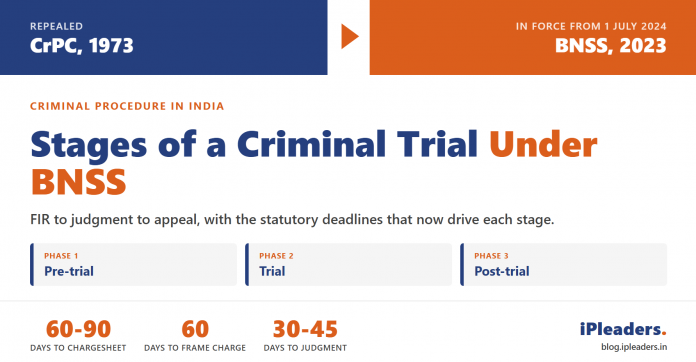
The numbers tell the story. A charge should now be framed within sixty days of the first hearing, and judgment should follow within thirty to forty-five days of arguments, deadlines the old Code never set. The familiar ninety or sixty day limit for filing a chargesheet stays, but it now comes paired with a fresh duty on the police to keep the victim informed of the investigation’s progress. Whether the new deadlines are binding or merely directory is the question the next few years of litigation will answer.
That makes 2026 a confusing moment to be on either side of a criminal case. A person whose name surfaces in an FIR filed today is inside the BNSS system. A person whose case began before 1 July 2024 is still, for most purposes, inside the old CrPC one. Two parallel rulebooks running at once.
The confusion runs wide. Law students are being examined on the new sections, and practitioners are re-learning numbers they had memorised for years. And ordinary readers, often frightened and unsure, simply want to know what comes next. This guide answers all of that, stage by stage, in the order a real case unfolds.
Before the detail, the map. A criminal trial under the BNSS is best understood in three broad phases: pre-trial, trial, and post-trial. Each contains several distinct stages, each now governed by a specific BNSS section and, in many cases, a statutory deadline. Here is the full sequence in order.
The stages of a criminal trial in India under the BNSS, 2023 run in three phases: pre-trial (FIR or Zero FIR, investigation, chargesheet, and cognizance), trial (framing of charge, prosecution evidence, the accused’s statement, defence evidence, and final arguments), and post-trial (judgment, sentencing, and appeal or revision). Each stage is now governed by a specific BNSS section and statutory timeline.
Stages of a criminal trial under BNSS, in order:
- FIR, Zero FIR or e-FIR (Section 173)
- Investigation (Sections 174-187)
- Chargesheet or police report and cognizance (Sections 193, 210)
- Framing of charge (Section 251 for Sessions, 263 for warrant cases)
- Prosecution evidence and examination of witnesses
- Statement of the accused (Section 351)
- Defence evidence
- Final arguments
- Judgment (Section 392)
- Sentence, then appeal or revision
Each of these stages carries its own rules, its own actors, and, under the BNSS, its own deadline. Understanding them in sequence is the difference between watching a case happen and actually following it. Start with the three broad phases.
The three broad stages of a criminal trial under BNSS
A criminal case can feel like a maze when you’re inside it. The single most useful thing to do first is to step back and see the whole shape. Every criminal matter in India, whether a cheque-bounce complaint in a magistrate’s court or a murder trial before a Court of Session, moves through three broad phases: pre-trial, the trial itself, and post-trial. Get those three phases clear and the individual stages stop looking like a jumble of section numbers.
This three-phase architecture is not a BNSS invention. It carried over almost unchanged from the CrPC, 1973, which in turn inherited it from the colonial-era codes of 1861 and 1898. What the BNSS changed is the contents of each phase, not the frame. So a reader who learned the structure under the old Code will recognise the skeleton; the muscles and the section numbers are what’s different.
Here is the full sequence as a single table, with the governing BNSS section and the statutory deadline (where one now exists) for each stage. This is the orientation map for everything that follows.
| # | Stage | Phase | Governing BNSS section | New BNSS deadline |
|---|---|---|---|---|
| 1 | FIR / Zero FIR / e-FIR | Pre-trial | Section 173 | Register without delay; preliminary enquiry up to 14 days where permitted |
| 2 | Investigation | Pre-trial | Sections 174-187 | Forensic visit mandatory for 7+ year offences (Section 176) |
| 3 | Chargesheet / police report | Pre-trial | Sections 187, 193 | Within 90 days for serious offences, 60 for others (extendable in specified cases) |
| 4 | Cognizance | Pre-trial | Section 210 | No fixed window; court takes the case on record |
| 5 | Framing of charge | Trial | Section 251 (Sessions) / 263 (warrant) | Within 60 days of the first hearing on charge |
| 6 | Prosecution evidence and examination of witnesses | Trial | Section 256 | No fixed window; maximum two adjournments per party (Section 346) |
| 7 | Statement of the accused | Trial | Section 351 | After prosecution evidence; answers not on oath |
| 8 | Defence evidence and final arguments | Trial | Sections 256-257 | Defence may lead evidence; arguments follow |
| 9 | Judgment | Post-trial | Section 392 | Within 30 days of arguments (extendable to 45 for reasons) |
| 10 | Sentence, then appeal or revision | Post-trial | Section 413 onward | Appeal within limitation; revision differs from appeal |
Where does a case physically sit during each phase? In the pre-trial phase it lives at the police station and then before a magistrate, who decides whether to take cognizance. The trial phase happens in open court, before either a magistrate or, for grave offences, a Court of Session after committal. The post-trial phase moves upward, to appellate and revisional courts.
Knowing which building a case is in tells you which actor is in control at that moment: the investigating officer, the magistrate, the sessions judge, or the appellate bench.

Pre-trial, trial and post-trial: what each phase covers
Pre-trial covers everything that happens before the court formally puts the accused on trial: the FIR, the investigation, the filing of the chargesheet, and the court taking cognizance. The trial phase begins when the charge is framed and the prosecution starts leading evidence; it ends with final arguments. Post-trial is the judgment and everything after it, sentencing on conviction, then appeal, revision or execution of the sentence.
The boundary lines matter in practice. Default bail, for example, is a pre-trial right that turns on whether the chargesheet was filed within the statutory window. Discharge is a trial-phase remedy available at the charge stage, while appeal is a post-trial remedy with its own limitation clock. Place an event in the wrong phase and you’ll reach for the wrong provision.
Inquiry vs investigation vs trial: three terms readers conflate
Three words get used loosely, and the confusion is costly. Investigation is what the police do: collecting evidence, recording statements, arresting and filing the chargesheet. Inquiry is what a magistrate does short of a full trial, such as examining whether there are grounds to proceed. Trial is the formal judicial process of testing the accused’s guilt, beginning at charge and ending at judgment.
A common question practitioners hear from clients is whether being “under investigation” means the trial has started. It hasn’t. Investigation is the police phase; the trial proper does not begin until a court frames a charge. The distinction decides which rights apply, the right to default bail belongs to the investigation phase, while the right to lead defence evidence belongs to the trial.
The constitutional frame: why every stage must be just, fair and reasonable
None of these stages floats free of the Constitution. Article 21 guarantees that no person shall be deprived of life or personal liberty except according to “procedure established by law”, and the Supreme Court in Maneka Gandhi v. Union of India, (1978) 1 SCC 248 held that this procedure must be just, fair and reasonable, not arbitrary or oppressive. That single principle is the constitutional spine that runs through every stage of a criminal trial.
What does that mean for a reader following a case? It means each stage is not just a box-ticking exercise but a safeguard. The requirement to supply documents to the accused, the right to cross-examine, the chance to explain incriminating evidence, all of these flow from the fair-trial guarantee.
So when does a procedural shortcut become a constitutional problem? The moment it denies the accused a genuine, meaningful opportunity to defend.
The pitfall here is assuming every case marches through all ten stages. It doesn’t. Summary trials compress several stages into one streamlined record, and plea bargaining can short-circuit the sequence entirely with a negotiated outcome. The three-phase map is the default route, not the only one.
Stages of a Criminal Trial Under BNSS: FIR to Judgment to Appeal
Eleven stages across three phases. New machinery and deadlines under the BNSS, 2023 are flagged in orange.
Structure carried over from the CrPC
New or reshaped under the BNSS, 2023
Pre-trial
1
FIR / Zero FIR / e-FIRNew
BNSS Section 173
Zero FIR and e-FIR are new BNSS machinery.
2
InvestigationNew
BNSS Sections 174 to 187
Mandatory forensic visit for 7+ year offences; audio-video recording.
3
Chargesheet / police reportNew
BNSS Section 193
Within 90 days.
4
Cognizance
BNSS Section 210
Court takes the case on record.
Trial
5
Framing of chargeNew
BNSS Section 251 (Sessions) / 263 (warrant)
Within 60 days of first hearing on charge; prima facie test.
6
Prosecution evidence and examination of witnesses
BNSS Section 256
Chief, cross, re-examination; prosecution proves guilt.
7
Statement of the accused
BNSS Section 351 (old CrPC 313)
Accused explains incriminating circumstances; not on oath.
8
Defence evidence and final arguments
BNSS Sections 256 to 257
Defence may lead evidence; final arguments.
Post-trial
9
Judgment: conviction or acquittalNew
BNSS Section 392
Within 30 to 45 days of arguments.
10
Sentencing hearing (on conviction)
BNSS sentencing provisions
Separate hearing on quantum of sentence.
11
Appeal / revision / execution
BNSS Section 413 onward
Appeal within limitation; revision differs from appeal.
Pre-trial stage 1: FIR, Zero FIR and e-FIR under Section 173 BNSS
Most criminal cases begin with a single document: the First Information Report. The FIR is the police record of the first information received about a cognizable offence, and it sets the entire machinery of investigation in motion. If you remember one section number from the pre-trial phase, make it this one.
Under Section 173 of the Bharatiya Nagarik Suraksha Sanhita, 2023, the officer in charge of a police station must record information relating to the commission of a cognizable offence. This is the BNSS successor to the old Section 154 of the Code of Criminal Procedure, 1973. The substance is familiar, but the BNSS bolts on a set of genuinely new features that the 1973 Code never had: registration of an FIR electronically, the express recognition of the Zero FIR, and a defined preliminary-enquiry window for certain offences.
The duty to register is not discretionary for cognizable offences. A Constitution Bench settled this in Lalita Kumari v. Govt. of U.P., (2014) 2 SCC 1, holding that registration of an FIR is mandatory under the law then in force whenever the information discloses a cognizable offence, and that a preliminary enquiry is permitted only in a limited set of categories (such as matrimonial disputes, commercial offences or medical negligence) and only to ascertain whether a cognizable offence is disclosed. Section 173 BNSS now codifies and extends that doctrine, expressly providing a fourteen-day outer window for preliminary enquiry in the permitted categories.
What is an FIR and when must it be registered
An FIR is the formal entry recording the first information about a cognizable offence, signed by the informant and entered in the station records. It must be registered when the information discloses a cognizable offence, an offence for which the police can arrest without a warrant and investigate without a magistrate’s order. For non-cognizable offences, the police instead make an entry and refer the informant to a magistrate.
Who can file an FIR? A common misconception is that only the victim may. In fact, anyone with knowledge of a cognizable offence can set the law in motion: the victim, a witness, a relative, or even a passer-by. The informant need not have seen the offence personally, what matters is that the information, taken at face value, discloses a cognizable offence.
Zero FIR and e-FIR under Section 173 BNSS: what changed
A Zero FIR is an FIR registered at any police station regardless of where the offence took place; it is numbered “zero” and then transferred to the station with territorial jurisdiction. The idea existed in practice and through executive instructions earlier, but the BNSS gives it firmer statutory footing, so a victim no longer loses precious time being turned away for being “in the wrong area”. For offences against women and in time-sensitive matters, that change is more than cosmetic.
The e-FIR, or electronic FIR, lets information be given electronically, with the requirement that it be signed within three days. This is part of a wider digital-policing shift the BNSS sets up, and the practical experience of e-FIR will keep evolving as states build out their reporting portals and integrate them with the police network. Early signals suggest uptake will be uneven across states until the digital infrastructure matures, so don’t assume an online filing is the norm everywhere yet.
FIR vs complaint, and cognizable vs non-cognizable offences
An FIR is not the same as a complaint, and the difference decides who acts first. An FIR is information given to the police about a cognizable offence, triggering police investigation. A complaint is an allegation made directly to a magistrate, who may then take cognizance and order an inquiry or investigation.
Can a case be filed directly without an FIR? Yes, by filing a complaint case before a magistrate, which is the standard route for many private disputes and for cheque-bounce matters.
The cognizable vs non-cognizable line governs who can investigate. For a cognizable offence (typically more serious, such as theft, assault causing hurt, or rape), the police can arrest without a warrant and investigate on their own. For a non-cognizable offence (typically minor), the police cannot investigate without a magistrate’s order, and the matter usually proceeds as a complaint. Practitioners know the schedule to the BNSS classifies each offence, and getting the classification right at the outset shapes the whole case.
What to do if the police refuse to register your FIR
Police refusal to register an FIR is one of the most common real-world problems, and the law provides a clear ladder of remedies. First, the informant can send the information in writing to the Superintendent of Police, who, if satisfied that a cognizable offence is disclosed, can investigate or direct an investigation. If that fails, the informant can approach the magistrate under the BNSS provision that empowers a magistrate to order investigation.
Here’s the practical reality: the Lalita Kumari mandate means refusal to register an FIR disclosing a cognizable offence is itself contrary to law, and an officer who refuses can face disciplinary consequences. The mistake we see most often is people giving up at the station counter. The remedy is statutory and well-trodden; the threat of a magistrate’s direction usually does the work. If you are at this first stage, it helps to know the full step-by-step process to file an FIR online or offline under BNSS, including the documents to carry and the escalation route.
Pre-trial stage 2: investigation and the new BNSS timelines
Once an FIR is registered, the investigation begins, and this is where information turns into evidence. Investigation is the police phase: visiting the scene, seizing material, recording witness statements, conducting searches, making arrests where justified, and finally forming an opinion on whether a case is made out. Almost every contested criminal trial is won or lost on the quality of what happens here.
Investigation under the BNSS is governed by Sections 174 to 187, and the BNSS layers several new obligations and clocks onto the old framework. Under Section 176 of the Bharatiya Nagarik Suraksha Sanhita, 2023, for offences punishable with imprisonment of seven years or more, a forensic team must visit the crime scene to collect forensic evidence. Searches under Section 185 of the BNSS and the recording of statements now carry audio-video recording requirements in defined situations. The outer limit on detention before a chargesheet, ninety days for serious offences and sixty days for others, sits in Section 187 of the BNSS and carries over largely unchanged from Section 167 of the old CrPC. What Section 193 of the BNSS genuinely adds is a new transparency duty: the police must now keep the informant or victim updated on the investigation’s progress within ninety days.
The magistrate’s supervisory role over investigation did not vanish under the new Code. The Supreme Court in Vinubhai Haribhai Malaviya v. State of Gujarat, (2019) 17 SCC 1 held that a magistrate may order further investigation even after the chargesheet is filed and before charges are framed, reading the magistrate’s powers broadly to ensure a complete investigation. That power continues to matter under the BNSS framework, where Section 193 governs the police report and the magistrate retains oversight of investigative completeness.
What investigation involves: from FIR to chargesheet
Investigation is the bridge between the FIR and the trial. The investigating officer records the statements of witnesses, collects documentary and physical evidence, sends material for forensic examination where required, and may arrest the accused. At the end, the officer files a report, the chargesheet (if a case is made out) or a closure report (if it is not), before the magistrate.
In practice, the chargesheet is the document that frames everything that follows. It lists the accused, the offences alleged, the evidence relied on, and the witnesses the prosecution intends to examine. A weak or incomplete chargesheet hands the defence its first opening, and experienced counsel read it line by line before the charge is even framed.
The 90-day chargesheet rule and default bail (Section 187 BNSS)
The time limit for filing a chargesheet is one of the most-searched questions, and the answer connects directly to liberty. Under Section 187 of the BNSS, which carries this structure forward from Section 167 of the old CrPC, investigation should ordinarily be completed and the chargesheet filed within ninety days for serious offences and sixty days for lesser ones. If the police fail to file within that window, the accused becomes entitled to default bail, sometimes called statutory bail, as a matter of right.
The 90-day clock is not just an administrative deadline; it is a check on indefinite custody. The catch? In specified categories of offences, the period can be extended on application, so the accused’s right to default bail crystallises only if the chargesheet is not filed and no valid extension is in force. Defence counsel watch this clock obsessively, because the right is lost if not claimed before the chargesheet lands.
Mandatory forensic investigation for 7-year offences
Section 176 BNSS introduces something the CrPC never had: a mandatory forensic visit. For offences punishable with seven years’ imprisonment or more, forensic experts must visit the crime scene to collect evidence, and the process is to be recorded. The aim is to professionalise investigation and reduce reliance on confessions and oral testimony.
The honest caveat is one of capacity. Mandatory forensic visits for every grave offence will strain state forensic laboratories, and the build-out of forensic infrastructure across states is expected to continue for some years. Practitioners expect early disputes over what happens when a forensic visit was required but, for want of capacity, did not occur. Don’t assume forensic findings will be automatic in every 7-year case while the lab network is still scaling up.
Audio-video recording of search, seizure and statements
The BNSS pushes the investigation toward a documented, auditable record. Searches and seizures are to be recorded through audio-video means in defined circumstances, and the recording of certain statements is similarly contemplated, with the goal of cutting down later disputes about what was found and what was said. Are these recordings mandatory? In the situations the statute specifies, yes, and the trend across the new Code is unmistakably toward an electronic evidentiary trail.
This is one of those second-order changes that quietly reshapes trial strategy. When a search is on video, the old cross-examination staple of attacking the manner of seizure has less room to operate, and both sides re-tool around the recording rather than the recollection of the officer.
Police custody vs judicial custody, and BNSS remand changes
Custody during investigation comes in two forms, and readers constantly confuse them. Police custody means the accused is held in the custody of the investigating police for interrogation; judicial custody means the accused is held in jail under the court’s authority, typically when active interrogation is not required. Under Section 187 of the BNSS, the magistrate authorises remand, and the BNSS reworked the structure of the permissible police-custody period within the overall detention timeline.
The practical point for an accused or their family is simple: custody is authorised and reviewed by a magistrate, not by the police alone, and the type of custody affects access, interrogation and bail strategy. The mistake we see is treating any detention as the same; the form of custody changes what can be done and when.
The new BNSS timelines at a glance: the statutory clock on every stage
If there is one headline reform in the BNSS, it is time. The old Code left most of the trial’s pace to judicial discretion, and the result, over decades, was delay that made justice feel theoretical. The BNSS responds by writing deadlines into the statute at almost every stage, an attempt to convert a long-standing constitutional aspiration into an enforceable schedule.
Here is the consolidated picture, the deadlines no competitor puts in one place. The first hearing-to-charge clock runs under Section 251 of the Bharatiya Nagarik Suraksha Sanhita, 2023 for Sessions cases and Section 263 of the BNSS for warrant cases; the chargesheet clock under Section 193 of the BNSS; the judgment clock under Section 392 of the BNSS and, for Sessions trials, Section 258 of the BNSS; and the adjournment cap under Section 346 of the BNSS.
The BNSS deadline table
| Stage | BNSS section | Position under the old CrPC, 1973 | New BNSS deadline |
|---|---|---|---|
| Chargesheet / police report | Sections 187, 193 | Section 167: same 60/90-day default-bail limit | Investigation and chargesheet within 90 days for serious offences, 60 for others (extendable in specified cases) |
| Mandatory forensic visit | Section 176 | No equivalent mandate | Forensic team must visit the scene for offences punishable with 7+ years |
| Framing of charge | Sections 251 (Sessions) / 263 (warrant) | No statutory time limit | Charge to be framed within 60 days of the first hearing on charge |
| Adjournments | Section 346 | Discretionary; no hard cap | Maximum of two adjournments to a party, for reasons recorded |
| Judgment | Section 392 (and Section 258, Sessions) | No fixed window after arguments | Judgment within 30 days of completion of arguments (extendable to 45 for reasons) |
| Victim hearing on withdrawal | Withdrawal-from-prosecution provision | No express victim-hearing requirement | Victim to be heard before the court permits withdrawal from prosecution |
Why BNSS introduced hard timelines: the speedy-trial cases
These deadlines did not appear out of nowhere; they are the legislature finally writing down what the courts had been demanding for decades. The Supreme Court in Hussainara Khatoon v. Home Secretary, State of Bihar, (1980) 1 SCC 98 held that the right to a speedy trial is implicit in the right to life and personal liberty under Article 21, a landmark that exposed how undertrials languished for years awaiting trial. The Court returned to the theme in Abdul Rehman Antulay v. R.S. Nayak, (1992) 1 SCC 225, laying down a comprehensive set of guidelines on the right to speedy trial and on how courts should weigh delay.
What experienced practitioners know is that case law alone could not fix the pace, because directions from the bench were applied unevenly across thousands of trial courts. Is the right to speedy trial enforceable? Yes, as a facet of Article 21, but its enforcement historically depended on a court being moved to act. The BNSS now embeds the schedule in the statute itself, which is a different kind of lever entirely.
Mandatory or directory? What happens when a deadline is missed
Here’s where it gets genuinely interesting, and genuinely unsettled. A deadline written into a statute can be either mandatory (missing it has automatic legal consequences) or directory (it guides conduct but missing it does not by itself vitiate the proceeding). The BNSS deadlines are new, and the courts have not yet comprehensively settled which category each falls into.
So what does a missed BNSS deadline mean for a real case in 2026? The cautious answer: don’t assume a missed deadline is automatic relief. Early signals suggest a wave of litigation testing exactly this question, whether, say, a charge framed after the sixty-day window or a judgment delivered after forty-five days carries any consequence. Until that body of case law forms, treating these as hard-and-fast escape hatches is a gamble, and a question best framed to a court rather than presumed.
The BNSS Statutory Clock at Every Stage
The BNSS timelines across a criminal trial, set against the old CrPC, 1973 position. Rows marked New are introduced by the BNSS; the chargesheet limit carries over from the CrPC.
New deadline introduced by the BNSS, 2023
The four types of criminal trial under BNSS: summons, warrant, sessions, summary
Not every criminal case runs the same procedure. Before a single stage unfolds, the system sorts each case into one of four trial tracks, and the track determines how detailed the process will be. Pick the wrong mental model of which track a case is on, and the rest of the procedure won’t make sense.
The four types are summons trials, warrant trials, sessions trials and summary trials. The dividing line is mostly the seriousness of the offence, measured by the maximum punishment. Here is the four-way comparison, the clean side-by-side no competitor lays out, with BNSS anchors.
| Dimension | Summons trial | Warrant trial | Sessions trial | Summary trial |
|---|---|---|---|---|
| Statutory anchor (BNSS) | Sections 274-279 | Sections 263-273 | Sections 248-260 (Chapter XIX) | Sections 283-288 |
| Offence type / threshold | Offences punishable up to 2 years; not triable as a warrant case | Offences punishable with imprisonment exceeding 2 years | Serious offences exclusively triable by the Court of Session | Petty offences (e.g. theft up to Rs 20,000); discretionary up to 3 years |
| Court | Magistrate | Magistrate (CJM / JMFC) | Court of Session (after committal) | Magistrate empowered to try summarily |
| Charge framing | No formal charge; substance of accusation stated (Section 274) | Formal charge framed (Section 263) | Formal charge framed (Section 251) | No formal charge; substance of accusation only |
| Record of evidence | Brief record; simplified procedure | Full chief, cross and re-examination on record | Full chief, cross and re-examination on record | Substance of evidence only; speed prioritised |
| Typical use | Minor offences, quick disposal | Mainstream criminal cases on police report or complaint | Murder, rape and other grave offences | High-volume petty matters and certain cheque-bounce cases |
Summons trial: petty offences and the simplified route
A summons trial is the simplest track, used for less serious offences punishable with up to two years. The defining feature: no formal charge is framed. Instead, under Section 274 of the Bharatiya Nagarik Suraksha Sanhita, 2023, the magistrate states the substance of the accusation to the accused and asks whether they plead guilty. The procedure is deliberately stripped down for speed.
What is the difference between a summons case and a warrant case? It comes down to gravity. A summons case carries a lighter maximum sentence and a lighter procedure; a warrant case is more serious and gets the full apparatus of a framed charge and complete evidence on record. That single distinction shapes how a defence is built.
Warrant trial: on police report vs on private complaint
A warrant trial handles offences punishable with imprisonment exceeding two years, and it comes in two flavours depending on how the case reached the court. A warrant case instituted on a police report (a chargesheet) proceeds under Section 263 of the BNSS, where the magistrate considers the police record and frames a charge if a case is made out. A warrant case instituted on a private complaint follows a slightly different route, because the magistrate first records the complainant’s evidence before deciding whether to frame a charge.
The procedural difference is not academic. In practice, a complaint-instituted warrant case gives the accused an early discharge opportunity if the complainant’s own evidence does not disclose an offence, a point sharp defence counsel exploit before the charge is ever framed.
Sessions trial: serious offences and the committal route
A sessions trial is reserved for the gravest offences, those exclusively triable by the Court of Session, such as murder and rape. What makes it distinct from a magistrate’s trial is the committal step: the magistrate cannot try these offences and must commit the case to the Court of Session under the committal provision. The sessions judge then frames the charge under Section 251 of the BNSS and conducts the trial.
How is a sessions trial different from a magistrate trial? Beyond the seriousness of the offence and the committal route, the sessions trial has its own ordered sequence under Chapter XIX, with the prosecution opening its case, leading evidence, the accused’s statement, defence evidence, and arguments, all before a judge who hears only serious matters. The stakes, and the procedural care, are at their highest here.
Summary trial: which offences qualify and the speed trade-off
A summary trial is built for speed and volume. It applies to petty offences, and the magistrate records only the substance of the evidence and a brief judgment under Section 283 of the BNSS onward, rather than a full record. The trade-off is deliberate: faster disposal in exchange for a lighter procedure, with a cap on the sentence that can be passed in summary proceedings.
Which offences qualify? Petty matters, theft of property up to a low value (the BNSS sets the threshold around twenty thousand rupees), and similar low-stakes offences, with the magistrate also having discretion to try certain offences summarily up to a three-year ceiling. The BNSS push toward summary disposal is part of the wider effort to clear high-volume dockets quickly. For a deeper treatment of how this track operates step by step, see the full procedure for a summary trial under BNSS.
Magistrate court vs sessions court: which court tries what
The dividing line between the two courts is the seriousness of the offence. A magistrate’s court tries summons cases, warrant cases and summary cases, the bulk of everyday criminal litigation. The Court of Session tries the gravest offences, but only after committal by a magistrate, since a sessions court does not take cognizance directly except where the law specifically allows.
A common question is which court a particular case will land in. The answer is read off the offence: the BNSS schedule indicates whether an offence is triable by a magistrate or exclusively by the Court of Session, and the maximum punishment usually signals the answer. The pitfall is assuming all four trial types frame a formal charge, they don’t: only warrant and sessions trials frame a charge, while summons and summary trials merely state the substance of the accusation.
Summons vs Warrant vs Sessions vs Summary: Four Trial Types Under BNSS
All four BNSS trial tracks side by side across six decision dimensions.
Trial stage 1: cognizance, committal and framing of charge under BNSS
The pre-trial phase ends, and the trial proper begins, at a cluster of closely linked steps: cognizance, committal (for serious offences), and the framing of charge. This is the gateway. Everything before it is preparation; everything after it is the contest. And it is here that a case can be stopped in its tracks through discharge, or set firmly on the road to a verdict.
Cognizance is the moment the court takes the case onto its judicial file. Under Section 210 of the Bharatiya Nagarik Suraksha Sanhita, 2023, a magistrate may take cognizance of an offence upon a police report, upon a complaint, or upon information received. Taking cognizance is not the same as framing a charge; it is the earlier judicial act of applying the mind to the offence and deciding to proceed. For offences exclusively triable by the Court of Session, the magistrate then commits the case under Section 232 of the BNSS.
At the charge stage, the court tests whether there is enough to put the accused on trial, and two Supreme Court rulings define that test. In State of Orissa v. Debendra Nath Padhi, (2005) 1 SCC 568, the Court held that at the stage of framing charge the court considers the material produced by the prosecution and the accused cannot, as a rule, produce defence material to seek discharge. And in Union of India v. Prafulla Kumar Samal, (1979) 3 SCC 4, the Court explained that the judge sifts and weighs the material only to find whether a prima facie case exists, and that even a strong suspicion founded on the material is enough to frame a charge.
What is cognizance and when does a magistrate take it
Cognizance is the judicial act of taking notice of an offence with a view to proceeding. A magistrate takes cognizance under Section 210 when, on a police report, a complaint or information, they apply their mind and decide the matter should move forward. Crucially, cognizance is taken of the offence, not of the offender, a distinction that surfaces when additional accused emerge later.
The frequent confusion is between cognizance and charge. Taking cognizance happens first and is the court’s decision to engage with the case at all; framing the charge happens later and is the formal accusation the accused must answer. Treating the two as the same leads to muddled timelines and missed remedies.
Committal to the Court of Session for serious offences
A magistrate cannot try an offence that is exclusively triable by the Court of Session. For such offences, after taking cognizance, the magistrate commits the case to the Court of Session under Section 232 BNSS, transferring it upward. Committal is essentially the magistrate’s handover: the magistrate ensures the papers are in order, supplies documents to the accused, and sends the case to the sessions judge who will conduct the trial.
In practice, committal is also a checkpoint. The supply of documents and the framing of issues at this stage set up the discharge argument the defence may raise once the case reaches the sessions court.
Discharge application: when and how it can be filed under BNSS
A discharge application is the accused’s first real chance to exit a case before trial. Under the BNSS discharge provisions (Section 250 for Sessions cases, with parallel provisions for warrant cases), the accused can apply for discharge after the supply of documents and before the charge is framed, arguing that the material discloses no ground to proceed. The BNSS expressly contemplates a window for filing this application, tightening what used to be a more open-ended timeline.
When can it be filed? After the accused has received the documents and before the charge is framed, at the threshold of the trial. If the court agrees there is no prima facie case, it discharges the accused, ending the matter without a full trial. This is why the charge stage is fought hard: a discharge here saves the accused years of litigation.
Framing of charge: the prima facie test
Framing of charge is the formal statement of the accusation the accused must answer, and it happens only in warrant and sessions trials, under Section 263 of the BNSS for warrant cases and Section 251 for Sessions cases. The test is not whether guilt is proved, far from it. The court asks only whether there is a prima facie case, a “ground for presuming” that the accused committed the offence.
What is a prima facie case at the charge stage? Following Prafulla Kumar Samal, the judge weighs the prosecution material to see whether, taken at face value, it raises a strong suspicion or a ground for presuming guilt; if it does, the charge is framed and the trial proceeds. The judge does not conduct a mini-trial or assess whether the evidence will ultimately convict, that comes later, after both sides have led their evidence.
For the mechanics of this stage, see the complete guide to charge framing under BNSS Section 251.
Documents that must be supplied to the accused before charges
Fair trial begins with disclosure. Before the charge is framed, the accused must be supplied with copies of the key documents the prosecution relies on, the police report, the FIR, statements of witnesses recorded during investigation, and other material, under the supply-of-documents provision (Section 230 BNSS). Without these, the accused cannot meaningfully argue for discharge or prepare a defence.
This is one of those requirements that flows straight from the fair-trial guarantee. The practical reality is that delays in supplying documents are a frequent cause of friction at the charge stage, and an accused who has not received complete documents has a legitimate ground to seek them before the charge is framed.
Discharge vs acquittal: the key difference
Discharge and acquittal both free the accused, but they happen at opposite ends of the trial and mean different things. Discharge happens before the charge is framed, when the court finds no prima facie case to put the accused on trial at all. Acquittal happens after a full trial, when the prosecution has led its evidence but failed to prove guilt beyond reasonable doubt.
The distinction has real consequences. A discharge can sometimes be revisited if fresh material emerges, whereas an acquittal after a full trial carries the stronger finality of a verdict on the merits. Confusing the two, a common error, leads people to misjudge how settled their case really is.
Trial stage 2: prosecution evidence and examination of witnesses
Once the charge is framed and the accused pleads not guilty, the trial moves to its core: evidence. This is where guilt is actually proved, or fails to be proved. The prosecution leads first, because the burden is on it, and the examination of witnesses is the engine that drives the whole trial.
Prosecution evidence is recorded under Section 256 of the Bharatiya Nagarik Suraksha Sanhita, 2023 in a Sessions trial, with parallel provisions in warrant trials. Each witness is examined in a fixed order: examination-in-chief by the party calling the witness, then cross-examination by the opposing party, then re-examination to clarify points raised in cross. The detailed rules on how examination, cross-examination and re-examination operate now sit in the Bharatiya Sakshya Adhiniyam, 2023, the evidence statute that replaced the Indian Evidence Act.
The court’s overriding duty at this stage is to ensure a fair trial. The Supreme Court in Zahira Habibulla H. Sheikh v. State of Gujarat, (2004) 4 SCC 158, the Best Bakery case, defined the content of a fair trial and held that courts cannot allow a trial to be reduced to a mockery, with a duty to ensure the integrity of evidence and the protection of witnesses. That principle frames how evidence is led, recorded and tested.
The order of examination: chief, cross, re-examination
Examination of a witness runs in three stages, always in the same order. Examination-in-chief is conducted by the party that called the witness, drawing out their account; leading questions are generally not allowed. Cross-examination follows, conducted by the opposing party, testing the witness’s truthfulness, memory and reliability; this is where leading questions are permitted and where cases are often won. Re-examination, by the party that called the witness, is limited to clarifying matters that arose in cross.
Who conducts examination-in-chief? The party calling the witness, so for a prosecution witness, the public prosecutor. The order never reverses: a witness cannot be cross-examined before being examined in chief. That sequence is the spine of the evidentiary stage, and the detailed rules on how examination-in-chief, cross-examination and re-examination work under the Bharatiya Sakshya Adhiniyam reward close study.
The role of the public prosecutor at trial
The public prosecutor represents the State, not the complainant, and that distinction defines the role. The prosecutor’s duty is not to secure a conviction at any cost but to place the full and fair picture before the court, examining witnesses, producing documents, and assisting the judge in arriving at the truth. A public prosecutor who suppresses material favourable to the accused fails that duty.
What experienced practitioners know is that the prosecutor’s independence is a real safeguard, not a formality. The prosecutor decides which witnesses to examine and how to present the case, and a fair prosecutor will not shy from disclosing weaknesses, because the goal is a just verdict, not a scoreboard win.
Burden of proof: the prosecution proves guilt
Does the accused have to prove innocence? No, and this is the single most important principle of a criminal trial. The prosecution must prove the guilt of the accused beyond reasonable doubt; the accused is presumed innocent until that burden is discharged. The accused need not prove anything, it is enough to raise a reasonable doubt about the prosecution’s case.
This is where many readers go wrong, assuming the accused must establish an alibi or explain away every fact. Not so. The legal architecture places the entire weight on the prosecution, and a defence succeeds the moment it shows the prosecution has not crossed the high threshold of proof beyond reasonable doubt. The presumption of innocence is not a slogan; it allocates the real work.
Summoning additional accused mid-trial under Section 358 BNSS
A trial can surprise everyone by widening mid-stream. Under Section 358 of the BNSS (the BNSS successor to Section 319 CrPC), if evidence during the trial reveals that a person not arraigned as an accused appears to have committed the offence, the court can summon that person to face trial. The Supreme Court in Hardeep Singh v. State of Punjab, (2014) 3 SCC 92, a Constitution Bench, settled the contours of this power, holding it can be exercised on the strength of evidence surfacing during the trial.
Can additional accused be summoned mid-trial? Yes, and it is a genuine risk that readers do not expect. A witness’s testimony can implicate someone who was never named in the chargesheet, and the court has the power to bring them in, restarting the clock for the newly added accused. It is one of the moments where a trial’s shape changes without warning.
Trial stage 3: statement of the accused under Section 351 BNSS
After the prosecution closes its evidence, the trial pauses for a stage that exists for the accused alone: the chance to personally explain the case against them. This is the examination of the accused under Section 351 of the Bharatiya Nagarik Suraksha Sanhita, 2023, the provision that carried over, almost intact, from the old Section 313 CrPC. It is short, but it is far from a formality.
Under Section 351, the court questions the accused on the incriminating circumstances appearing in the evidence, so that the accused can personally explain them. The answers are not given on oath, and the accused cannot be punished for refusing to answer or for giving false answers, though the court may draw appropriate inferences. The BNSS preserves the substance and adds the possibility of conducting this examination through electronic means, a small but telling sign of the Code’s digital direction.
The fair-trial logic, again traceable to the standard set in Zahira Habibulla H. Sheikh v. State of Gujarat, (2004) 4 SCC 158, is that the accused must be given a genuine, meaningful opportunity to respond to the evidence, not a hurried, mechanical reading. A careless Section 351 examination is a real and recurring ground of appeal.
What Section 351 BNSS requires (the old Section 313 CrPC)
Section 351 requires the court to put to the accused, in the form of questions, every material circumstance appearing against them in the prosecution evidence, and to record the accused’s explanation. The questioning happens after prosecution evidence and before the defence is called. Because the answers are not on oath, this is not “defence evidence”, it is the accused’s personal response to the case.
The provision is the BNSS equivalent of Section 313 CrPC, the number practitioners knew for decades. Its purpose is identical: to ensure the accused hears, in plain terms, exactly what is alleged and gets to answer it directly to the court.
Why this stage matters: a genuine opportunity to explain
Why does a short, no-oath questioning matter so much? Because omission can be fatal. If the court fails to put a specific incriminating circumstance to the accused, that circumstance may have to be excluded from consideration, and a conviction built on it can be set aside on appeal. The mistake we see most often is treating this stage as a box to tick.
In practice, defence counsel pay close attention to whether every incriminating point was actually put to the accused. A circumstance not put is a circumstance the accused never got to explain, and appellate courts take that lapse seriously.
Trial stage 4: defence evidence and final arguments
With the accused’s statement recorded, the floor turns to the defence, and then to the closing contest of arguments. These two stages are short relative to the prosecution’s evidence, but they are where the defence makes its case and where both sides distil months of trial into their strongest points.
The defence is entitled, but not obliged, to lead evidence under Section 256 of the Bharatiya Nagarik Suraksha Sanhita, 2023 and the parallel warrant-trial provision. Because the accused need not prove innocence, many defences lead no evidence at all, resting on the argument that the prosecution failed to discharge its burden. Where the defence does lead evidence, its witnesses are examined in the same chief-cross-re-examination order. Final arguments then follow under Section 257 of the BNSS.
Defence evidence: when and why the defence leads it
The defence leads evidence only when it has something affirmative to establish, an alibi, a documentary record, an expert opinion, or a witness who contradicts the prosecution’s version. Since the burden never shifts onto the accused, leading defence evidence is a strategic choice, not a requirement. Sometimes the strongest defence is to lead nothing and argue that the prosecution simply did not prove its case.
When does it make sense to lead defence evidence? When the affirmative material is strong enough to outweigh the risk of opening that material to cross-examination. Experienced counsel weigh that carefully, because weak defence evidence can do more harm than silence.
Final arguments: order, written submissions, who speaks last
Final arguments are the closing summations, where each side argues how the evidence should be read. The prosecution typically argues first, then the defence, with the order designed so the accused gets a meaningful chance to respond to the case against them. Written arguments are increasingly filed alongside oral submissions, giving the court a record to rely on while drafting the judgment.
Who speaks last? The structure gives the defence the advantage of responding to the prosecution’s case, reflecting the principle that the accused should have the final word on the evidence arrayed against them. After arguments close, the case is reserved for judgment, and the post-trial phase begins.
Post-trial stage 1: judgment, conviction or acquittal, and sentencing
Judgment is the moment everything has been building toward. After final arguments, the court delivers its verdict: conviction or acquittal. And if it convicts, a further stage follows that many people overlook entirely, the hearing on the quantum of sentence. Both fall in the post-trial phase, and both now carry the BNSS stamp of a statutory clock.
Under Section 392 of the Bharatiya Nagarik Suraksha Sanhita, 2023, judgment must be pronounced in open court, and the BNSS introduces a deadline: judgment within thirty days of the completion of arguments, extendable to forty-five days for reasons recorded. For Sessions trials, Section 258 of the BNSS governs the judgment. A judgment must contain the points for determination, the decision, and the reasons, it cannot be a bare verdict. The fairness standard from Maneka Gandhi v. Union of India, (1978) 1 SCC 248 runs through this stage too: the outcome must follow a process that was just and reasonable.
When judgment is pronounced: the 30-45 day BNSS timeline
The BNSS puts a clock on the judgment itself. After arguments conclude, the court must pronounce judgment within thirty days, and only for reasons recorded may that be extended to forty-five days. The aim is to stop the long, unexplained gaps between the close of a trial and its verdict that plagued the old system.
Whether this thirty-to-forty-five-day window is treated as mandatory or directory is part of the broader unsettled question about BNSS deadlines. Early signals suggest it will be tested in appeals, but for now the practical effect is pressure on courts to deliver verdicts promptly rather than reserving them indefinitely.
Conviction vs acquittal: what each means
The two possible outcomes of a trial sit at opposite poles. A conviction means the court found the prosecution proved the accused’s guilt beyond reasonable doubt; the case then moves to sentencing. An acquittal means the prosecution failed to discharge that burden, and the accused is set free, the benefit of any reasonable doubt going to the accused.
What is the difference in consequence? Conviction triggers the sentencing stage and the right to appeal; acquittal ends the trial in the accused’s favour, though the State may, in appropriate cases, appeal against it. The threshold, proof beyond reasonable doubt, is what separates the two, and it is deliberately high.
The sentencing hearing on quantum of sentence
A conviction is not automatically followed by a sentence in the same breath. For offences carrying a range of punishment, the court holds a separate hearing on the quantum of sentence, where the convicted person can place mitigating circumstances before the court, age, antecedents, family circumstances, and the prosecution can urge aggravating factors. This hearing flows from the principle that sentencing is a distinct judicial exercise.
Is a separate sentencing hearing always held? Not in every case, for some offences with a fixed or minor punishment, sentence may follow conviction directly, but for serious offences with a sentencing range, the hearing on quantum is an important and frequently litigated stage. Assuming sentencing is automatic on conviction is a mistake; for grave offences, the sentencing hearing can change the outcome materially.
Post-trial stage 2: appeal, revision and execution
A conviction in the trial court is not the end of the road. The post-trial phase opens a set of remedies, appeal, revision, and finally execution, that can reverse, modify or confirm what the trial court decided. The thin guides skip this stage; in reality it is where many convictions are tested and not a few are overturned.
Appeals against conviction are governed by the appeal provisions beginning at Section 413 of the Bharatiya Nagarik Suraksha Sanhita, 2023 and the chapters that follow, which lay down the appellate hierarchy and the routes from magistrate, sessions and High Court. Revision is a distinct, narrower power. And execution of sentence is the machinery by which a confirmed sentence is actually carried out. Each has its own timing and its own logic.
Can a convicted person appeal, and within what time
Yes. A convicted person has a right of appeal, and the appeal lies to a higher court depending on which court convicted, from a magistrate to the Court of Session, from a Court of Session to the High Court, and so on up the ladder. The appeal must be filed within the limitation period prescribed for that class of appeal, which is why diarising the date of judgment is critical.
The catch is the limitation clock. Miss the window, and the appeal can be barred unless the court condones the delay for sufficient cause. Defence counsel treat the date of judgment as the start of a countdown, because an appeal filed late starts on the back foot.
Appeal vs revision: the key difference
Appeal and revision are different tools for different problems. An appeal is a full re-hearing on facts and law; the appellate court can re-appreciate the evidence and substitute its own findings. Revision is a narrower, supervisory power, the revisional court checks the legality, propriety or correctness of an order or proceeding, but does not ordinarily re-appreciate evidence as freely as an appeal does.
What is the difference between revision and appeal in practice? Use an appeal where you want the higher court to re-examine the evidence and the merits; use revision where the complaint is about a jurisdictional error, an illegality, or an order that no appeal lies against. A third route exists for some situations: challenging an order through a quashing petition under Section 528 BNSS, the inherent-powers remedy before the High Court. Choosing the wrong remedy wastes the limitation period and can sink an otherwise good challenge.
Execution of sentence: the final step
Once a conviction and sentence are final, execution is the stage at which the sentence is actually enforced, imprisonment served, fine recovered, or other punishment carried out. The court that passed the sentence, and the authorities charged with enforcing it, ensure the order is implemented in accordance with law. For a reader following a case to its end, this is the literal last stage of the journey that began with the FIR.
Execution is also where post-conviction relief, such as suspension of sentence pending appeal, can intervene. An accused who files an appeal may seek suspension of the sentence and bail during its pendency, which is why the appeal and execution stages often overlap in time.
BNSS vs CrPC: the complete section-mapping table for the trial stages
For practitioners, this is the section everyone arrives for. The stages of a criminal trial under BNSS are largely the old stages, but the section numbers have moved, and a wrong number in a petition is the kind of error that draws a judge’s frown. No competitor has published a clean, complete and correct BNSS-to-CrPC mapping for the trial stages; most map a handful and several mislabel. This is that table.
Why does a correct mapping matter so much? Because the renumbering is the practitioner’s daily pain point in 2026. Lawyers who memorised 154, 173, 190, 227, 228, 313 and 319 over a career now have to translate every one of them on the fly. The Bharatiya Nagarik Suraksha Sanhita, 2023 expanded the Code to 531 sections from the CrPC’s 484, so the mapping is rarely a tidy off-by-one shift.
The complete BNSS-CrPC trial-stage mapping table
| Stage | BNSS, 2023 section | CrPC, 1973 section | What it covers |
|---|---|---|---|
| FIR for cognizable offence | Section 173 | Section 154 | Registration of the First Information Report; now includes Zero FIR and e-FIR |
| Non-cognizable offence reporting | Section 174 | Section 155 | Information in non-cognizable cases; investigation needs a magistrate’s order |
| Investigation procedure | Section 176 | Section 157 | Procedure for investigation; BNSS adds mandatory forensic visit for 7+ year offences |
| Custody / remand | Section 187 | Section 167 | Detention and remand during investigation |
| Chargesheet / police report | Section 193 | Section 173 | Filing of the police report on completion of investigation |
| Taking cognizance | Section 210 | Section 190 | Magistrate takes cognizance of an offence |
| Committal to Court of Session | Section 232 | Section 209 | Commitment of a case to the Court of Session |
| Discharge (Sessions) | Section 250 | Section 227 | Discharge of the accused where no sufficient ground exists |
| Framing of charge (Sessions) | Section 251 | Section 228 | Framing of charge in a Sessions trial |
| Charge in warrant case (police report) | Section 263 | Section 240 | Framing of charge in a warrant case on a police report |
| Summons-case procedure | Section 274 | Section 251 | Stating the substance of accusation in a summons case |
| Summary trial | Section 283 | Section 260 | Power to try certain offences summarily |
| Statement of the accused | Section 351 | Section 313 | Examination of the accused on incriminating circumstances |
| Summoning additional accused | Section 358 | Section 319 | Power to proceed against other persons appearing guilty |
| Judgment | Section 392 | Sections 353-354 | Pronouncement and contents of judgment |
| Appeals | Section 413 onward | Section 374 onward | Appeals against conviction and acquittal |
| Repeal and savings | Section 531 | (transition provision) | Repeal of CrPC; pending matters continue under the old Code |
Where the change is substantive, not just a renumbering
Most of the mapping is a renumbering, but some changes go deeper, and conflating the two is the trap. The FIR provision (Section 173) is not merely renumbered; it now expressly carries Zero FIR, e-FIR and a defined preliminary-enquiry window. The investigation provision adds the mandatory forensic visit, and the judgment and adjournment provisions add deadlines and caps that simply did not exist before. So a one-for-one swap of the number is not always a one-for-one swap of the law.
The practical point: when citing a BNSS provision, check whether it is identical to its CrPC ancestor or whether the substance shifted. For the deadline-bearing provisions, it shifted, and a brief drafted on the old understanding will misstate the position.
The case law that governs these stages maps neatly onto the sequence. The table below shows which Supreme Court ruling controls which stage, so a reader can see, at a glance, the authority behind each step of the trial.
| Landmark case | Stage it governs | Core holding |
|---|---|---|
| Maneka Gandhi v. Union of India | The whole trial (constitutional frame) | Procedure under Article 21 must be just, fair and reasonable |
| Lalita Kumari v. Govt. of U.P. | FIR registration (Section 173) | FIR registration is mandatory for a cognizable offence; limited preliminary enquiry |
| Vinubhai Haribhai Malaviya v. State of Gujarat | Investigation / pre-charge (Section 193) | Magistrate may order further investigation even after the chargesheet, before charge |
| Hussainara Khatoon v. State of Bihar | Timelines / speedy trial | The right to a speedy trial is implicit in Article 21 |
| Abdul Rehman Antulay v. R.S. Nayak | Timelines / delay | Comprehensive guidelines on the right to speedy trial and weighing delay |
| State of Orissa v. Debendra Nath Padhi | Framing of charge (Sections 251, 263) | Only prosecution material is considered at charge; no defence material for discharge |
| Union of India v. Prafulla Kumar Samal | Framing of charge (Sections 251, 263) | Sift and weigh the material for a prima facie case; strong suspicion suffices |
| Zahira Habibulla H. Sheikh v. State of Gujarat | Evidence and fair trial | Defined the content of a fair trial; courts must not let a trial become a mockery |
| Hardeep Singh v. State of Punjab | Summoning additional accused (Section 358) | Additional accused may be summoned on evidence surfacing during trial |
The two-system docket: why both codes still run in 2026
Here is the part that confuses everyone: in 2026, both codes are still live. Matters that were pending on 1 July 2024 continue under the CrPC, while matters arising after that date run under the BNSS. The result is a hybrid docket, two procedural systems operating side by side in the same courts, sometimes before the same judge on the same day.
This two-system reality is a downstream effect few anticipated in its full scale. It produces disputes over which code governs a particular step, and it will keep generating transitional litigation for as long as pre-July-2024 cases remain undecided. The section that resolves which code applies, the savings clause, is covered later in this guide.
New BNSS stages and innovations the CrPC never had
The BNSS did more than renumber the old Code. It added genuinely new stages and tools that change what a criminal trial can look like, and these are the features that mark a case as distinctly post-2024. Several of them respond directly to long-standing problems: absconding accused stalling trials, victims sidelined from “their own” cases, and investigations leaning too heavily on oral testimony.
The most striking additions are trial in absentia for proclaimed offenders under Section 355 and Section 356 of the Bharatiya Nagarik Suraksha Sanhita, 2023, a statutory right for victims to be heard at key moments, the mandatory forensic mandate, the e-FIR and Zero FIR machinery, audio-video recording, electronic service of summons, and community service as a sentencing option. Two strands of older jurisprudence sit behind these reforms: the speedy-trial line in Hussainara Khatoon v. Home Secretary, State of Bihar, (1980) 1 SCC 98, and the fair-trial and victim-protection concerns articulated in Zahira Habibulla H. Sheikh v. State of Gujarat, (2004) 4 SCC 158.
Trial in absentia for proclaimed offenders
Can a trial proceed if the accused absconds? Under the BNSS, yes, in defined circumstances. Sections 355 and 356 allow a trial to proceed and conclude even where a proclaimed offender has absconded and evaded the process, so that a determined accused can no longer indefinitely stall justice by staying out of reach. This is one of the most significant departures from the old Code, which generally required the accused’s presence.
The procedure builds in safeguards, the accused must have been declared a proclaimed offender and given the opportunity to appear, so it is not a casual ex parte verdict. Practitioners expect the contours of trial in absentia to be tested and refined through appeals over the next few years, because the balance between finality and fair-trial rights is delicate, and the case law is still forming.
The victim’s right to be heard under BNSS
Under the old Code, the victim was often a spectator to a case fought between the State and the accused. The BNSS shifts that, giving victims a more defined voice, including the right to be heard before the court permits the prosecution to withdraw from a case, and a broader entitlement to information and participation at key stages. Does the victim have a right to be heard? Increasingly, yes, the BNSS embeds victim participation more firmly than the CrPC ever did.
The fairness logic traces back to the standard set in the Best Bakery line of cases, where the Supreme Court underlined that a trial which sidelines the victim and witnesses risks becoming a hollow exercise. The BNSS translates that concern into concrete procedural rights.
Mandatory forensics, e-FIR, audio-video recording: the digital trial
Several BNSS innovations point in one direction: a documented, digital trial process. Mandatory forensic visits for grave offences, e-FIR and Zero FIR, audio-video recording of searches and certain statements, and electronic service of summons together reduce reliance on memory and paper. The intended effect is a trial built on a verifiable record rather than contested recollection.
The honest caveat is that the machinery is new and the supporting infrastructure is still being built. Practitioners expect the day-to-day reality of the digital trial to mature unevenly across states, and overstating how settled it all is would be a mistake while the systems and the case law catch up.
Community service as a new sentencing option
For the first time, Indian criminal procedure formally recognises community service as a sentence for certain petty offences. Instead of a short term of imprisonment or only a fine, the court can direct the convicted person to perform community service, a reformative option aimed at minor offenders. It is a small addition in the scheme of the Code, but a meaningful one for first-time and petty offenders.
This reflects a wider shift in sentencing philosophy toward reform over incarceration for low-level offences. How widely courts use it will become clearer as the lower judiciary settles into the new sentencing menu.
Practitioner reality: delay, adjournments, bail and plea bargaining
There is the trial on paper, and there is the trial as it actually moves. The gap between them is where most of the frustration with the criminal justice system lives. This section is the practitioner’s view, the things the statute’s neat stage-list does not tell a first-time litigant, and the reforms the BNSS aims at the parts of the process that historically broke down.
The honest picture: criminal trials in India have run long, sometimes years for serious offences, driven by adjournments, witness no-shows and overloaded courts. The Supreme Court tried to discipline this through the speedy-trial jurisprudence in Hussainara Khatoon v. Home Secretary, State of Bihar, (1980) 1 SCC 98 and Abdul Rehman Antulay v. R.S. Nayak, (1992) 1 SCC 225, and the BNSS now adds statutory levers, the two-adjournment cap under Section 346 of the Bharatiya Nagarik Suraksha Sanhita, 2023, the deadlines, and an off-ramp through plea bargaining under the BNSS plea-bargaining chapter.
Why criminal trials in India take so long, and how BNSS tries to fix delay
Why do trials take years? The causes are structural: too many cases for too few courts, repeated adjournments, delays in serving summons and producing witnesses, and investigations that drag. No single reform fixes all of that. The BNSS attacks the pieces it can legislate, deadlines for chargesheet, charge and judgment, a cap on adjournments, electronic service to speed up summons, and forensic and audio-video processes to make evidence more reliable.
Will it work? The practical reality is that statutory deadlines change incentives but do not, by themselves, create more courtrooms or more judges. The mistake would be to assume the new clocks will instantly end delay. Whether they bite depends on how strictly courts enforce them and how the directory-versus-mandatory question is resolved.
Adjournments and the BNSS two-adjournment cap
Adjournment culture is the quiet engine of delay. Section 346 BNSS responds with a cap: ordinarily, no more than two adjournments may be granted to a party, and only for reasons recorded in writing. The provision targets the routine, near-automatic adjournments that stretched trials over years under the old regime.
Does the cap actually bite? That is the open question. Courts retain discretion, and “reasons recorded” can be a flexible standard, so whether the two-adjournment limit changes behaviour will depend on judicial firmness. Defence and prosecution alike are re-tooling their tactics around the new limit, because the old assumption of endless adjournments no longer holds as safely.
Where bail and anticipatory bail fit across the stages
Bail is not a single stage; it threads through the whole process. Anticipatory bail is sought before arrest, by a person apprehending arrest for a non-bailable offence, and it operates at the pre-FIR or post-FIR pre-arrest moment. Regular bail is sought after arrest and can be applied for at the investigation stage, during trial, and even pending appeal after conviction. Default bail, the statutory variety, arises specifically when the chargesheet is not filed within the time limit.
Bail vs anticipatory bail comes down to timing relative to arrest: anticipatory bail is protection before arrest, regular bail is release after it. Where each fits in the stages is something every litigant should understand early, because the right application at the right stage can be the difference between custody and liberty while the case grinds on.
Plea bargaining: what it is and at what stage it applies
Plea bargaining is a negotiated resolution: the accused pleads guilty in exchange for a lighter sentence, available for certain offences (excluding the most serious and offences against women and children). It applies after cognizance and before judgment, allowing a case to be settled without a full trial. The BNSS carries forward and refines the plea-bargaining framework introduced in the CrPC era.
In practice, uptake of plea bargaining in India has been modest, far below comparable systems abroad, partly due to limited awareness and cultural hesitation about admitting guilt. Whether the BNSS-era emphasis on speed nudges more litigants toward it remains to be seen, but as an off-ramp that short-circuits the long road to judgment, it deserves more attention than it gets.
“My name is in an FIR”: what happens next
For many readers, the question is not academic, their name has surfaced in an FIR, and they want to know what comes next. An FIR is not a conviction or even a charge; it is the start of an investigation. What follows is the sequence in this guide: investigation, possible arrest (where the offence is cognizable and arrest is justified), the filing of a chargesheet or closure report, and, if the case proceeds, cognizance and charge.
The immediate practical steps are to seek legal advice, consider anticipatory bail if arrest is feared for a non-bailable offence, and gather any material relevant to a defence. The mistake we see most often is panic, treating an FIR as the end. It is the beginning of a process with safeguards at every stage, and the earlier sound advice enters, the better the position.
Which code applies: the CrPC-to-BNSS transition rule
Of every question this guide answers, none causes more confusion than this one: if a case is going on right now, is it under the CrPC or the BNSS? The answer turns on a single transitional provision, and getting it wrong means applying the wrong rulebook to a live case.
The governing provision is Section 531 of the Bharatiya Nagarik Suraksha Sanhita, 2023, the repeal-and-savings clause. It repeals the CrPC, 1973, but it preserves what was already in motion: investigations, inquiries, trials, appeals and other proceedings pending immediately before 1 July 2024 continue under the old CrPC as if the new Code had not come into force. New matters, those arising on or after 1 July 2024, run under the BNSS.
What Section 531 BNSS (the savings clause) says
Section 531 does two things at once. It repeals the Code of Criminal Procedure, 1973, and it saves pending proceedings, providing that anything done or any action taken, and any appeal, application, trial, inquiry or investigation pending, immediately before the commencement of the BNSS, continues to be dealt with under the old Code. The savings clause is what prevents the new Code from disrupting cases already underway.
This is a standard legislative technique for a major procedural overhaul, but its scale here is unusual, because it keeps an entire repealed code alive for years, applied only to the shrinking pool of pre-commencement cases.
Pre-1-July-2024 cases vs new cases: which code governs
The practical rule is a date. If the proceeding was pending before 1 July 2024, the CrPC governs it through to its conclusion. If it began on or after that date, the BNSS applies. So a trial that started in 2023 finishes under the old section numbers and the old procedure, even if it concludes in 2026, while an FIR registered last week runs entirely on the BNSS.
The pitfall is assuming the new Code applies retrospectively to an old case. It does not. A litigant in an ongoing pre-July-2024 matter who reaches for a BNSS deadline or a BNSS innovation will be told, correctly, that their case is on the old rulebook. This single distinction, the date of commencement, resolves most of the “which code is my case on” confusion.
Frequently asked questions
1. What are the stages of a criminal trial in India under BNSS?
A criminal trial under the BNSS runs through three phases. Pre-trial covers the FIR or Zero FIR (Section 173), investigation, chargesheet (Section 193) and cognizance (Section 210). Trial covers framing of charge (Section 251 or 263), prosecution evidence, the accused’s statement (Section 351), defence evidence and final arguments. Post-trial covers judgment (Section 392), sentencing and appeal.
2. What is the process after an FIR is filed in a criminal case?
After an FIR is registered under Section 173 BNSS, the police investigate: visiting the scene, collecting evidence, recording statements and, where justified, arresting the accused. The investigating officer then files a chargesheet (or closure report) before the magistrate, ordinarily within ninety days for serious offences. If a case is made out, the court takes cognizance and the trial proceeds to charge.
3. What is the difference between a summons case and a warrant case?
The difference is the seriousness of the offence. A summons case involves offences punishable with up to two years; the magistrate states the substance of the accusation without framing a formal charge, and the procedure is simplified. A warrant case involves offences punishable with imprisonment exceeding two years; a formal charge is framed and full evidence is recorded. Warrant trials carry the heavier procedure.
4. What is a summary trial and which offences qualify?
A summary trial is a fast-track procedure for petty offences, governed by Sections 283 to 288 BNSS. The magistrate records only the substance of the evidence and a brief judgment, prioritising speed. It applies to minor offences such as theft of property up to roughly twenty thousand rupees, with discretion to try certain offences summarily up to a three-year ceiling. The sentence that can be passed summarily is capped.
5. What is the time limit to file a chargesheet after an FIR under BNSS?
Investigation should ordinarily be completed and the chargesheet filed within ninety days for serious offences, and sixty days for lesser offences, under Section 187 BNSS, which carries this limit forward from Section 167 CrPC. If the police miss the window, the accused becomes entitled to default bail as a right. In specified categories the period can be extended on application, so the right crystallises only if no valid extension is in force.
6. How long does a criminal trial take in India?
Historically, criminal trials have run from a couple of years to a decade or more in complex matters, driven by adjournments, witness delays and court backlog. The BNSS adds new statutory deadlines, a charge within sixty days of the first hearing and judgment within thirty to forty-five days of arguments, alongside the existing ninety or sixty day chargesheet limit. How much they shorten real timelines depends on enforcement, which the next few years will reveal.
7. What happens after the judgment: sentencing, appeal, revision?
On conviction, the court holds a sentencing hearing on the quantum of sentence for offences with a sentencing range. The convicted person can then appeal to a higher court within the limitation period under Section 413 onward. Revision, a narrower supervisory remedy, is available where the complaint is about legality or propriety rather than a full re-hearing on the merits. Execution of sentence is the final step.
8. What is a discharge application and when can it be filed under BNSS?
A discharge application asks the court to drop the case before the charge is framed, on the ground that the material discloses no prima facie case. It is filed after the accused has received the prosecution documents and before the charge is framed, under the BNSS discharge provisions (Section 250 for Sessions cases). If the court agrees there is no ground to proceed, it discharges the accused, ending the matter without a full trial.
9. What is plea bargaining and at what stage can it be used?
Plea bargaining is a negotiated resolution where the accused pleads guilty for a lighter sentence, available for certain offences but not the most serious ones or offences against women and children. It applies after cognizance and before judgment, allowing a case to be settled without a full trial. The BNSS carries forward the plea-bargaining framework, though uptake in India has remained modest.
10. What is the difference between police custody and judicial custody?
Police custody means the accused is held by the investigating police for interrogation; judicial custody means the accused is held in jail under the court’s authority, usually when active interrogation is not required. A magistrate authorises and reviews both forms of remand under Section 187 BNSS. The type of custody affects access, interrogation and bail strategy, so the distinction matters in practice.
11. Can a convicted person appeal, and within what time?
Yes. A convicted person has a right of appeal to a higher court, the route depending on which court convicted, and the appeal must be filed within the limitation period prescribed for that class of appeal. Missing the window can bar the appeal unless the court condones the delay for sufficient cause. The date of judgment starts the limitation clock, so it should be diarised immediately.
12. What is the difference between cognizable and non-cognizable offences?
For a cognizable offence (typically more serious, such as theft or assault causing hurt), the police can arrest without a warrant and investigate without a magistrate’s order. For a non-cognizable offence (typically minor), the police cannot investigate without a magistrate’s order, and the matter usually proceeds as a complaint. The BNSS schedule classifies each offence, and the classification shapes who acts first.
13. What is a Zero FIR and is it recognised under BNSS?
A Zero FIR is an FIR registered at any police station regardless of where the offence occurred; it is numbered “zero” and then transferred to the station with territorial jurisdiction. The BNSS gives the Zero FIR firmer statutory footing under Section 173, so a victim is not turned away for approaching the “wrong” station. This matters most in time-sensitive cases and offences against women.
14. What is an e-FIR or online FIR under Section 173 BNSS?
An e-FIR is information about an offence given electronically, recognised under Section 173 BNSS, with the requirement that it be signed within three days. It is part of the BNSS push toward a digital reporting process. The practical rollout depends on each state’s reporting portals and police-network integration, so the experience of e-FIR is still maturing and varies across states.
15. What is the difference between BNSS and CrPC in criminal trials?
The BNSS, 2023 replaced the CrPC, 1973 on 1 July 2024. The stages of a trial are broadly the same, but the section numbers changed, new deadlines were added (a sixty-day charge and a thirty-to-forty-five-day judgment), and new features were introduced: Zero FIR, e-FIR, mandatory forensics, trial in absentia, the victim’s right to be heard, and community service as a sentence.
16. What are the new timelines under BNSS vs CrPC?
The CrPC already capped pre-chargesheet custody at ninety or sixty days, now Section 187 BNSS, with default bail if the limit is missed. What the BNSS newly writes into the statute is a charge within sixty days of the first hearing (Sections 251 and 263), a maximum of two adjournments per party (Section 346), and judgment within thirty days of arguments, extendable to forty-five (Section 392). Whether the new deadlines are mandatory or directory is still being settled.
17. Why do criminal trials in India take so many years?
The causes are structural: too many cases for too few courts, repeated adjournments, delays in serving summons and producing witnesses, and slow investigations. Courts read a right to speedy trial into Article 21, but uneven enforcement limited the effect. The BNSS now adds statutory deadlines and an adjournment cap, though these change incentives without, by themselves, creating more judges or courtrooms.
18. Can a trial proceed if the accused absconds (trial in absentia under BNSS)?
Yes, in defined circumstances. Sections 355 and 356 BNSS allow a trial to proceed and conclude even where a proclaimed offender has absconded and evaded the process, after the accused has been declared a proclaimed offender and given an opportunity to appear. This is a major departure from the old Code. The precise contours are expected to be tested and refined through appeals.
19. Is forensic investigation now mandatory, and for which offences?
Yes, for grave offences. Section 176 BNSS makes a forensic team’s visit to the crime scene mandatory for offences punishable with seven years’ imprisonment or more, with the process to be recorded. The aim is to professionalise investigation and reduce reliance on oral testimony. The practical constraint is forensic-laboratory capacity, which is expected to scale up across states over the coming years.
20. What happens to cases that started under CrPC before 1 July 2024: which code applies?
The transitional rule is in Section 531 BNSS, the savings clause. Proceedings pending immediately before 1 July 2024, investigations, inquiries, trials and appeals, continue under the old CrPC through to their conclusion. Matters arising on or after that date run under the BNSS. So the date of commencement of the proceeding decides the rulebook; the BNSS does not apply retrospectively to an older case.
References
Case Law
- Abdul Rehman Antulay v. R.S. Nayak, (1992) 1 SCC 225 (AIR 1992 SC 1701)
- Hardeep Singh v. State of Punjab, (2014) 3 SCC 92 (AIR 2014 SC 1400)
- Hussainara Khatoon v. Home Secretary, State of Bihar, (1980) 1 SCC 98 (AIR 1979 SC 1369)
- Lalita Kumari v. Govt. of U.P., (2014) 2 SCC 1 (AIR 2014 SC (Cri) 66)
- Maneka Gandhi v. Union of India, (1978) 1 SCC 248 (AIR 1978 SC 597)
- State of Orissa v. Debendra Nath Padhi, (2005) 1 SCC 568 (AIR 2005 SC 359)
- Union of India v. Prafulla Kumar Samal, (1979) 3 SCC 4 (AIR 1979 SC 366)
- Vinubhai Haribhai Malaviya v. State of Gujarat, (2019) 17 SCC 1 (AIR 2019 SC 5233)
- Zahira Habibulla H. Sheikh v. State of Gujarat, (2004) 4 SCC 158 (AIR 2004 SC 3114, Best Bakery case)
Statutes
- The Code of Criminal Procedure, 1973. Sections cited: 154, 155, 157, 167, 173, 190, 209, 227, 228, 240, 251, 260, 313, 319, 353, 354.
- The Bharatiya Nagarik Suraksha Sanhita, 2023. Sections cited: 173, 174, 176, 185, 187, 193, 210, 232, 250, 251, 256, 257, 258, 263, 274, 283, 346, 351, 355, 356, 358, 392, 413, 531.
This article is for informational and educational purposes only and does not constitute legal advice. For specific legal guidance, consult a qualified legal professional.