


Last verified: June 2026
In October 2024, the US Securities and Exchange Commission settled charges against a former chief executive and chairman who had spent years on the board of a large US consumer-products company in the seat reserved for an independent director. On paper he was perfect for it: long retired from running anyone’s company, no employment ties, an outside voice. The problem was what the proxy statements never said. Over roughly three years he and a sitting senior executive of the same company had taken six holidays together across eight countries on five continents, and he had personally paid more than $100,000 toward the executive’s share of the travel.
None of that reached the board’s independence determination, because, the SEC alleged, he did not disclose the friendship and at points encouraged that it stay quiet. The company kept calling him independent in filings shareholders relied on. When the regulator was done, the settlement carried a $175,000 civil penalty, a five-year bar from serving as an officer or director of a public company, and a permanent injunction. He did not admit or deny the findings.
What makes the case useful is that nothing about his job was the problem. He was not an employee. He ran nothing day-to-day. By the loose vocabulary most people use, he was a textbook “non-executive” or “outside” director. He still failed to be an independent director, because independence in US corporate governance is not a description of someone’s job. It is a legal status, tested against bright-line rules, that turns on the relationships a director has: financial and, as this case shows, personal.

That gap is the whole subject of this article. In ordinary speech, “non-executive director,” “outside director” and “independent director” get used as if they were the same thing, and even authoritative sources blur them. They are not the same. Getting executive, non-executive and independent directors straight matters because the difference decides who can sit on an audit committee, whether a company satisfies its NYSE or Nasdaq listing rules, and even which standard a Delaware court will use to judge a deal. Here is the short answer most readers come for, before the detail.
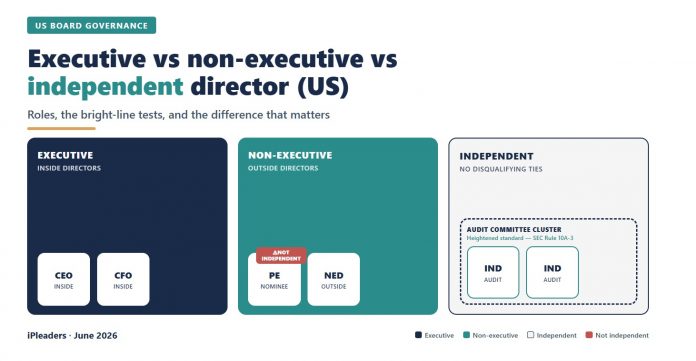
No, a non-executive director and an independent director are not the same thing. A non-executive director is any board member who is not part of day-to-day management, but who may still hold financial, advisory or personal ties to the company. An independent director is a non-executive director who also has no material relationship that would fail the NYSE, Nasdaq and SEC independence tests. All independent directors are non-executive; not all non-executive directors are independent.
That single distinction unlocks everything else: the committee rules, the controlled-company carve-outs, and the litigation stakes. What follows maps the two questions people collapse into one, then walks the precise US tests, the heightened bar for audit committees, how many independent directors a company actually needs, and where independence stops being a listing checkbox and starts changing the outcome of a lawsuit.
Two directors, two different questions: the axes people confuse
The confusion has a simple root: people treat “executive vs non-executive” and “independent vs non-independent” as one spectrum running from insider to outsider. They are two separate questions, and a director’s answer to one does not settle the other.
The first question is about the job. Is this person part of the company’s executive management, an employee or officer who runs the business day-to-day, or not? That is the executive (inside) versus non-executive (outside) axis. It is essentially a factual question about employment and role.
The second question is about relationships. Setting aside the job, does this director have any material tie to the company, past employment, fees, a business the company pays, a family member inside, even a close personal relationship, that could compromise objective judgment? That is the independent versus non-independent axis. It is a legal question, answered against specific tests rather than by job title.
Once you separate the two, the trap in the SEC case above is obvious. “Outside director” answers only the first question. A person can be fully outside management and still flunk the second question because of a relationship. So the useful mental model is not a line but a grid: one axis for the job, one axis for the relationships. The next section draws it.
Non-independent
The ordinary case
Inside management on the board
- CEO
- CFO
- Founder-manager on the board
⚠ The trap
Outside, but still not independent
- PE / VC nominee director
- Ex-CEO inside the 3-year cooling-off window
- Officer of a major customer or supplier
- Partner at the company’s outside law firm
- Undisclosed personal tie
Independent
Executive · Independent
Empty
Executive + Independent
Impossible. Being an employee or officer is itself a disqualifying relationship, so this box can never be filled.
The clean outside director
Independent director
- No disqualifying financial, business, employment, family or personal relationship
Read it this way
- Every independent director is non-executive; not all non-executive directors are independent.
- The top-right box is where most real disputes live: outside management, but still not independent.
- The bottom-left box can never be filled.
iPleaders · blog.ipleaders.in
Executive vs non-executive vs independent director: the comparison at a glance
Three labels, two axes. The table below is the fastest way to hold them apart, and it is worth reading the “independent” column as a stricter version of the “non-executive” column rather than as a separate species.
| Dimension | Executive (inside) director | Non-executive (outside) director | Independent director |
|---|---|---|---|
| Employee or officer of the company? | Yes | No | No |
| Runs day-to-day operations? | Yes | No | No |
| Material relationship with the company allowed? | Inherent (they work there) | May exist | None that fails the exchange tests |
| Typical example | CEO, CFO, founder-manager | PE/VC nominee, ex-CEO still in the cooling-off window, an officer of a major customer | A director with no disqualifying financial, business, employment or family ties |
| Counts toward the NYSE/Nasdaq majority-independent requirement? | No | Only if also independent | Yes |
| Usual pay | Salary as an employee (board seat usually unpaid extra) | Director fees, often equity | Director fees and equity; no consulting or advisory fees if on the audit committee |
The logic the table encodes is a one-way street. Every independent director is, by definition, non-executive: you cannot run the company and be independent of it. But the reverse fails: plenty of non-executive directors are not independent.
The 2×2 map: where each director type really sits
Picture a grid. The horizontal axis runs executive to non-executive; the vertical axis runs independent to non-independent. Three of the four boxes fill easily, and the fourth tells you something.
An executive who is non-independent is the ordinary case, the CEO on the board. A non-executive who is independent is the clean outside director the rules are built around. A non-executive who is not independent is the crowded and most misunderstood box: the private-equity fund’s nominee director, a former executive still inside the three-year cooling-off window, an officer of the company’s largest customer, a partner at its outside law firm, or, per the enforcement action that opened this piece, someone with an undisclosed personal entanglement. They sit outside management yet carry a disqualifying tie.
The fourth box, an executive who is independent, is empty, and necessarily so. Being part of management is itself a disqualifying relationship. That empty box is the single most common error in casual writing about boards, including some glossary pages that treat “non-executive” and “independent” as synonyms. They are not. Non-executive is a starting line; independence is a finish line you can still fail to cross.
Executive (inside) directors: the management on the board
An executive director, often called an inside director in US usage, is a board member who is also an employee or officer of the company. The CEO is the classic example; chief financial officers, chief operating officers and founder-managers frequently hold board seats too. They wear two hats at once: they help set strategy and oversight as directors, and they execute it as managers.
Their value to a board is information. Nobody knows the operating reality of the business better than the people running it, and a board with zero insiders can find itself governing in the dark. Their structural weakness is the mirror image: they are asked, as directors, to oversee themselves as managers. An executive director voting on executive pay, or on whether to disclose a problem in their own division, is conflicted by construction.
That is precisely why an executive director can never be classified as independent, and why the most sensitive board functions are walled off from them. A director who draws a salary from the company, reports to or supervises other insiders, and depends on the firm for a living cannot be the disinterested check that independence rules are trying to guarantee.
It is also why the executive director sits at the opposite pole from a managing director in the way the term is used elsewhere. A managing director (the dominant term in India and the UK) is an executive director with the widest management mandate. The US tends to say “CEO who also serves on the board” rather than “managing director,” but the governance point is the same: this is management on the board, not oversight of management.
Non-executive (outside) directors: oversight without a desk
A non-executive director (an outside director, in common US phrasing) is a board member who is not part of the executive management team. They do not run a division, do not draw an employee salary, and typically serve part-time, attending board and committee meetings and bringing outside perspective, industry experience or specialist expertise. Their job is oversight, strategy and challenge, not execution.
So far this sounds identical to “independent director,” and that is the heart of the confusion. The difference is that “non-executive” tells you only what the director is not: a member of management. It says nothing about the director’s other ties to the company. And a non-executive director can carry ties heavy enough to defeat independence while remaining entirely outside management.
Outside director does not mean independent director
Consider the non-executive directors who routinely fail the independence test. A venture-capital or private-equity fund that has invested in the company will usually take a board seat through a nominee; that nominee manages nothing day-to-day but represents an investor with its own agenda, so they are non-executive and non-independent. A recently retired CEO who joins the board is non-executive the day they step down, but the exchanges treat them as non-independent until a three-year cooling-off period has run. An officer of the company’s largest customer or supplier, a partner at the firm that does the company’s legal or audit work, or a director whose close family member is a senior executive. Each of them is outside management and each is non-independent.
The practical takeaway for anyone reading a proxy statement: do not infer independence from the “non-executive” or “outside” label. US-listed companies must affirmatively determine and disclose which directors are independent, director by director, and a board can have several non-executive directors who are not counted as independent. The non-executive chairman is a good illustration: a non-executive chair can be a founder, a former CEO or a controlling shareholder’s representative, in which case they chair the board without being independent at all.
Fails if ANY box is ticked → NOT independent
Employment
Employed by the company now, or within the past 3 years?
3-year look-backNYSENasdaq
Not independent
Direct compensation
Director or immediate family member received more than $120,000 in direct compensation in any 12-month period within the past 3 years?
> $120,000any 12 months / 3 yrs
Not independent
Business relationship
Payments to or from the director’s other company exceed the exchange threshold?
NYSEGreater of $1M or 2% of that company’s gross revenues
NasdaqGreater of 5% of revenues or $200,000 (any of past 3 years)
Not independent
Outside auditor
Affiliation with the company’s outside auditor (director or family member) within the look-back?
3-year look-back
Not independent
Family as executive officer
Immediate family member was an executive officer of the company within the past 3 years?
3-year look-back
Not independent
Compensation-committee interlock
Interlocking compensation-committee relationship?
Not independent
Otherwise: INDEPENDENT
None of the above, AND the board affirmatively finds no other material relationship.
Independent
Audit committee = a higher bar under SEC Rule 10A-3: see the two-tier graphic
iPleaders · blog.ipleaders.in
What makes a director independent in the US: the bright-line tests
Independence is the strict subset. An independent director is a non-executive director who also clears the exchange’s independence standard, and that standard has two layers: a principles-based judgment plus a set of bright-line disqualifiers that operate automatically, regardless of how the board feels about the person.
On the New York Stock Exchange, the rules sit in Section 303A of the NYSE Listed Company Manual. The board must first affirmatively determine that a director has no material relationship with the company. On top of that judgment, Section 303A.02(b) layers bright-line bars. The most cited one disqualifies any director who, or whose immediate family member, received more than $120,000 in direct compensation from the company during any twelve-month period within the last three years (director and committee fees, and non-contingent deferred compensation for prior service, are excluded). Other bars cover current or recent employment within the same three-year window, ties to the company’s outside auditor, interlocking compensation-committee relationships, and a business-relationship test that disqualifies a director whose other company makes payments to, or receives payments from, the listed company exceeding the greater of $1 million or 2% of that other company’s consolidated gross revenues.
Nasdaq reaches the same place with slightly different numbers. Nasdaq Listing Rule 5605(a)(2) defines an independent director as “a person other than an Executive Officer or employee of the Company or any other individual having a relationship which, in the opinion of the Company’s board of directors, would interfere with the exercise of independent judgment.” Its bright-line disqualifiers mirror the NYSE’s: employment within the past three years; acceptance of more than $120,000 in compensation during any twelve consecutive months within the past three years; a family member who was an executive officer in that window; and a partnership, control stake or executive role at an organisation that makes or receives payments from the company exceeding the greater of 5% of the recipient’s gross revenues or $200,000 in any of the past three fiscal years.
One point quietly trips people up. Owning company stock does not, by itself, defeat independence. Both exchanges expect independent directors to hold equity (alignment with shareholders is the goal), and even a substantial shareholding is not a per se disqualifier under the listing rules (though it interacts with the separate audit-committee “affiliate” test discussed next, and very large blocks can raise control questions). Independence is about disqualifying relationships and payments, not about whether a director has skin in the game.
NYSE vs Nasdaq: the same idea, different dials
For most directors the two exchanges produce the same answer; the wording and the business-relationship thresholds differ, not the architecture. Both require a no-material-relationship determination plus bright-line bars, both use a three-year look-back, and both anchor the compensation bar at $120,000. The divergence is in the business-relationship test (NYSE’s “greater of $1 million or 2%” versus Nasdaq’s “greater of 5% or $200,000”) and in some committee-level overlays. The safe rule for a director sitting on, or advising, a dual-eligible company is to apply whichever standard is stricter for the relationship in front of you.
Cooling-off: how long a former executive must wait
A former employee or executive is not barred from independence forever, only until the relationship has gone cold. Under both exchanges, the disqualification for prior employment (and for the $120,000 compensation event) runs for three years. A CFO who retires in 2026 cannot be counted as an independent director of the same company until 2029, even though they are non-executive from the day they leave. The cooling-off period is what converts a former insider back into a potential independent, and it is why the date a relationship ended matters as much as whether it existed.
Dimension
Ordinary board independence
Heightened audit-committee independence (Rule 10A-3)
Covers
Majority of the board + most committees
Every member of the audit committee
Consulting / advisory fees from the company
Permitted (subject to $120k bright line)
None permitted, no de minimis exception
Affiliated person of the company
Not a per se bar
Prohibited safe harbor: AND not an officer
Financial expertise
Not required
Company must disclose whether it has an “audit committee financial expert” (SOX § 407)
The post-Enron architecture
2001–02
Enron / WorldCom collapses
2002
Sarbanes-Oxley: §301 (independent audit committees) and §407 (financial-expert disclosure)
2003–04
Exchanges adopt majority-independent board + independent committees (NYSE 303A; Nasdaq 5605); SEC Rule 10A-3
2010
Dodd-Frank §952: independent compensation committees (Exchange Act §10C)
2022
Universal proxy card (Sept 1, 2022)
2023
Clawback policies required (Dec 1, 2023)
Why it matters
- One independent director can be fine for the board generally but ineligible for the audit committee.
- The audit-committee no-fee rule has NO de minimis exception, even an indirect payment to the director’s firm counts.
- A company need not HAVE a financial expert, only disclose whether it does.
iPleaders · blog.ipleaders.in
Two tiers of independence: why audit committees are held to a higher bar
Here is the nuance almost every competitor glosses over: in the US there are two grades of independence, not one. Ordinary board independence, the tests above, is enough to count toward the majority-independent board and to serve on most committees. The audit committee is different. Its members must clear a heightened independence standard set by the SEC, and a director who is independent enough for the board generally can still be too connected for the audit committee.
The heightened standard lives in SEC Rule 10A-3 (17 CFR 240.10A-3), which the exchanges must enforce as a listing condition. It imposes two prohibitions that go beyond ordinary independence. First, an audit-committee member may not accept any consulting, advisory or other compensatory fee from the company or a subsidiary, other than fees for serving as a director or committee member (fixed retirement-plan amounts for prior service that are not contingent on continued service are carved out). Crucially, there is no de minimis exception: a single dollar of consulting fee, including an indirect payment routed to a director’s law, accounting or consulting firm, breaks the standard. Second, an audit-committee member may not be an “affiliated person” of the company.
“Affiliated person” turns on control: a person who controls, is controlled by, or is under common control with the company. The rule supplies a safe harbour: a person who owns less than 10% of any class of voting equity and is not an executive officer is deemed not to be in control, and so is not an affiliate. That safe harbour is exactly why very large shareholders and their nominees, even when “independent” for general board purposes, can be ineligible for the audit committee.
The financial expert: a disclosure, not a mandate
Sitting alongside Rule 10A-3 is Section 407 of the Sarbanes-Oxley Act of 2002, implemented through Item 407(d)(5) of Regulation S-K. It requires a company to disclose whether its audit committee includes at least one “audit committee financial expert”: broadly, someone who understands financial statements and GAAP, can assess how accounting principles apply to estimates and reserves, and has experience preparing, auditing or analysing comparable financials. The detail people miss: a company is not required to have a financial expert. It is only required to disclose whether it does, and if not, why not. The designation also carries a safe harbour, so being named the financial expert imposes no incremental legal duty beyond that of any other audit-committee member.
Where the two tiers came from
This two-tier architecture is not arbitrary; it is the direct legacy of the accounting scandals of 2001–2002. After the collapses at Enron and WorldCom, failures in which compliant-looking boards missed catastrophic accounting fraud, Congress passed Sarbanes-Oxley in 2002. Section 301 directed the exchanges to require fully independent audit committees, which became Rule 10A-3; Section 407 added the financial-expert disclosure. The exchanges then adopted their majority-independent-board and fully-independent-committee rules (NYSE 303A; Nasdaq 5605). Eight years later, the Dodd-Frank Act of 2010 (Section 952) extended the logic to compensation committees, requiring their members to be independent and adding independence factors for the advisers they hire. The result is the layered system in use today: ordinary independence for the board, heightened independence for the audit committee, and committee-specific overlays for compensation and nominating functions.
How many independent directors a US company actually needs
For a company listed on the NYSE or Nasdaq, the baseline is a majority-independent board. NYSE Section 303A.01 and Nasdaq Rule 5605(b)(1) both require that independent directors make up more than half of the board. On top of that, the three key committees carry their own composition rules: the audit committee must be entirely independent under the heightened Rule 10A-3 standard, and the compensation and nominating/corporate-governance committees must be fully independent as well (with the limited transition and exemption mechanics each exchange allows).
There are important carve-outs. The largest is the controlled-company exemption. Under NYSE Section 303A.00 and Nasdaq Rule 5615(c), a company in which an individual, group or another company holds more than 50% of the voting power for electing directors is a “controlled company” and may opt out of the majority-independent-board requirement and the fully-independent compensation and nominating committee requirements. What it may not opt out of is the audit committee: even a controlled company must maintain a fully independent audit committee meeting Rule 10A-3. That single non-waivable requirement is why, in founder-controlled and dual-class companies, the audit committee often becomes the real seat of independent oversight.
Foreign private issuers get their own latitude. An FPI may generally follow its home-country governance practice in place of the majority-independent-board and committee rules, provided it discloses the ways its practice differs, though the audit-committee independence requirement under Rule 10A-3 still applies to FPIs, with narrow accommodations.
Private companies, startups and the contractual route
US private companies and startups are, as a rule, not legally required to have independent directors at all: the listing-rule machinery only bites once a company is publicly listed. In practice, though, independents arrive earlier through contract. Venture-capital and private-equity investors frequently negotiate for a mutually agreed independent director (often the swing vote between founder and investor seats) in their financing documents, and companies preparing for an IPO build a compliant majority-independent board before listing so they are ready on day one. So the honest answer to “do startups need independent directors?” is: not by law, often by deal terms, and always eventually if they intend to go public.
A board that loses its majority, through a resignation, say, or an independent director taking a job that breaks independence, does not instantly delist. Both exchanges provide cure periods to regain compliance. But the exposure is real: failure to maintain audit-committee independence in particular has triggered delisting notices, which is why a single resignation from a thinly staffed audit committee can be a governance emergency rather than a paperwork problem.
Lead independent director, presiding director and the chair/CEO question
When a company combines the roles of chairman and CEO, still common in the US, the obvious worry is that the person running the company also controls the board that is supposed to oversee them. The standard answer is the lead independent director (sometimes called the presiding director): an independent director chosen to provide a counterweight to a combined chair/CEO.
The role has real content. The lead independent director presides over the regular executive sessions (meetings of the independent, or non-management, directors with no management in the room), serves as the liaison between the independent directors and the chair/CEO, has a hand in setting board agendas and meeting schedules, and is increasingly the board’s point of contact for shareholder engagement. The “presiding director” terminology traces to the post-Sarbanes-Oxley requirement that non-management directors meet in regular executive sessions led by a designated presiding director, and the lead-independent-director role grew up around exactly that function. The two terms are used largely interchangeably today, though a few boards formally distinguish a permanent “lead independent director” from a rotating “presiding director” who merely chairs a given executive session.
The push to split chair and CEO
Whether the roles should be combined at all is one of the most contested governance questions in the US, and the trend is toward separation. Shareholder proposals demanding an independent board chair have surged in recent proxy seasons, in the first half of 2023 such proposals jumped more than 113% year-over-year in the Russell 3000, the highest count in a decade, per data discussed on the Harvard Law School Forum on Corporate Governance. Most still fail at the ballot, but average support has climbed, and the share of large US companies combining the two roles has slipped below half. The direction of travel is clear: investors increasingly treat an independent chair, or at minimum a strong lead independent director, as the baseline rather than a concession.
Why independence matters beyond the listing rules: Delaware litigation
It would be easy to read everything above as a compliance exercise: boxes to tick so the exchange does not complain. That misses the larger point. In Delaware, where most large US companies are incorporated, director independence changes the standard of judicial review, which can decide whether a challenged transaction is upheld almost automatically or dissected by a court.
Start with the baseline. Section 141(a) of the Delaware General Corporation Law vests management of the corporation in the board, and courts ordinarily defer to board decisions under the business judgment rule. But when a transaction is tainted by a conflict (most sharply, a deal with a controlling shareholder), the default flips to “entire fairness,” a demanding standard under which the board must prove both a fair price and a fair process. Entire fairness is the standard defendants least want to face.
Independence is the lever that switches it back. In Kahn v. M&F Worldwide Corp., 88 A.3d 635 (Del. 2014), universally shortened to “MFW”, the Delaware Supreme Court held that a controlling-shareholder buyout can earn deferential business-judgment review instead of entire fairness, but only if the deal is conditioned from the outset on two protections: approval by a fully independent, properly empowered special committee, and approval by an informed, uncoerced majority of the minority shareholders. The whole point is that an independent committee, bargaining at arm’s length, can stand in for the absent arm’s-length counterparty. If even one member of that special committee is not genuinely independent, the protection collapses and entire fairness returns.
Independence does similar work earlier in a lawsuit, at the demand-futility stage of a shareholder derivative suit. To sue on the company’s behalf without first asking the board to act, a plaintiff must plead particularised facts showing the directors could not impartially consider a demand, classically under Aronson v. Lewis, 473 A.2d 805 (Del. 1984), and its companion Rales v. Blasband, 634 A.2d 927 (Del. 1993), now consolidated into the single universal test adopted in United Food & Commercial Workers Union v. Zuckerberg, 262 A.3d 1034 (Del. 2021). The test asks, director by director, whether a majority of the board is disinterested and independent. The more genuinely independent the board, the harder it is for a plaintiff to get past the courthouse door, and the more a board’s independence is compromised, the easier.
Business judgment rule vs entire fairness, in one paragraph
The business judgment rule presumes directors acted on an informed basis, in good faith and in the honest belief the action served the company; a court will not second-guess the substance. Entire fairness presumes nothing and puts the burden on the defendants to prove fair dealing and fair price. The distance between the two is enormous, and director independence, through an MFW special committee or a disinterested board, is the principal mechanism Delaware law gives a company to move from the harsh standard to the forgiving one. (The Delaware courts have, in recent years, tightened how rigorously the MFW conditions must be met in controller transactions; the precise contours of those 2024–2025 developments are noted in the next section.)
Recent changes and what is next (2024–2026)
The independence framework is not static. A handful of developments are reshaping what independent directors actually do.
Clawbacks. Under SEC rules adopted in 2023, listed companies must maintain policies to recover (“claw back”) incentive compensation that was erroneously awarded to executives on the basis of financial results that are later restated. Listed issuers were required to adopt compliant policies by December 1, 2023, and the independent compensation committee is the body that administers recovery, adding a hard-edged enforcement task to a role that used to be mostly about pay design.
Universal proxy. Since the SEC’s universal proxy rules took effect on September 1, 2022, shareholders in a contested election can mix and match nominees from both the company’s and a dissident’s slate on a single card. That has sharpened scrutiny of individual directors (their independence, tenure and skills), because a campaign can now target one underperforming or over-committed director rather than the whole board.
Board diversity disclosure. Nasdaq had adopted a board-diversity disclosure framework, but it was vacated by the US Court of Appeals for the Fifth Circuit in December 2024, and is no longer enforced. Companies should not treat the former Nasdaq diversity matrix as a live listing requirement, though many continue voluntary disclosure and state-level and investor expectations persist.
Delaware controller transactions. Delaware courts have continued to refine the MFW framework for controlling-shareholder deals, most notably in In re Match Group, Inc. Derivative Litigation, 315 A.3d 446 (Del. 2024), which confirmed that the full MFW framework governs controller transactions generally, not just freeze-out mergers. That has raised the bar for how completely the independent-special-committee and majority-of-minority conditions must be satisfied, with countervailing 2025 amendments to the DGCL narrowing some exposure. The net effect for directors is that serving on a special committee in a controller transaction is now a high-scrutiny assignment where genuine independence is examined closely.
AI and board expertise. Investors increasingly expect boards to oversee a risk-based artificial-intelligence governance programme. That raises a fresh question about what a “qualified independent director” even means: whether boards have the independent technical expertise to oversee AI risk, and how to recruit it without straining the already-thin pool of fully independent, financially literate directors.
That thin pool is itself a second-order problem worth naming. As personal-relationship cases (like the one that opened this article) and proxy-adviser policies widen what defeats independence, and as audit committees demand heightened independence with no fee tolerance plus financial literacy, the same small group of qualified independents gets spread across audit, compensation and nominating committees at multiple companies. The result is “independence inflation” on one side and over-boarding risk on the other, a structural tension that the rules have created but not solved.
US vs India: how independent director rules compare
For readers working on US-listed companies, US subsidiaries of Indian groups, or simply coming from the Indian framework, the comparison is instructive: the two systems share a goal and diverge in the dials. India codifies independence in statute rather than listing rules: Section 149(6) of the Companies Act, 2013 defines an independent director and sets out the disqualifying relationships, and the SEBI (Listing Obligations and Disclosure Requirements) Regulations, 2015 add board-composition requirements for listed companies. If you want the Indian distinction between board roles in detail, our companion piece on non-executive director vs independent director under the Companies Act, 2013 covers it.
| Dimension | United States (NYSE/Nasdaq/SEC) | India (Companies Act 2013 / SEBI LODR) |
|---|---|---|
| Source of the rules | Exchange listing rules + SEC Rule 10A-3 + Delaware case law | Statute: s.149(6) Companies Act, 2013 + SEBI LODR Reg 16/17 |
| Pecuniary look-back | 3 years; bright line at $120,000 in any 12-month period | 2 immediately preceding financial years (and current year); no fixed monetary bright line |
| Board composition | Majority of the board must be independent | At least one-third if the chair is a non-executive non-promoter; at least one-half (50%) otherwise |
| Audit committee | Heightened independence under Rule 10A-3 (no consulting fee, not an affiliate; no de minimis) | Independent-majority audit committee under s.177 / LODR Reg 18 |
| Independence test style | Board determination + bright-line disqualifiers | Statutory definition + board satisfaction; pecuniary-relationship bar |
Two contrasts matter most. The US look-back is three years and pegged to a hard dollar figure; India uses a two-year pecuniary window and no equivalent bright-line number, leaning more on a statutory definition and board satisfaction. And the US splits independence into two tiers, with a distinctly heightened audit-committee standard, where India mandates audit-committee composition but does not draw the same no-fee, no-affiliate line. Same destination, a credible, disinterested check on management, reached by different routes.
Frequently asked questions
Is a non-executive director the same as an independent director?
No. A non-executive director is any board member outside day-to-day management. An independent director is a non-executive director who additionally passes the NYSE, Nasdaq and SEC independence tests: no disqualifying financial, business, employment, family or personal relationship. All independent directors are non-executive, but not all non-executive directors are independent.
Can an independent director also be an executive director?
No, the two are mutually exclusive. Being an employee or officer of the company is itself a disqualifying relationship, so an executive (inside) director can never be classified as independent.
What is the difference between an outside director and an independent director?
“Outside director” means only that the director is not part of management. “Independent director” means the director is outside management and free of any material relationship that fails the exchange tests. A private-equity nominee or a recently retired executive is an outside director who is not independent.
What makes a director “independent” under NYSE rules?
The NYSE board must affirmatively determine the director has no material relationship with the company, and the director must clear the bright-line bars in Section 303A.02, including no more than $120,000 in direct compensation in any 12-month period within the last three years, no recent employment, no disqualifying auditor or business relationship, and no interlocking compensation-committee ties.
What is the $120,000 compensation threshold for director independence?
Both the NYSE and Nasdaq treat a director (or their immediate family member) who received more than $120,000 in direct compensation from the company in any 12-month period within the past three years as non-independent. Director and committee fees, and certain non-contingent retirement payments for prior service, are excluded from the count.
What is the three-year look-back for director independence?
The exchanges test independence against the previous three years. Past employment, the $120,000 compensation event, an executive-officer family member, and certain business relationships all disqualify a director if they occurred within that three-year window, which is why a former executive must “cool off” for three years before being counted as independent.
Does owning company stock make a director non-independent?
No. Stock ownership alone does not defeat independence under the listing rules; independent directors are in fact expected to hold equity. Very large holdings can raise separate “affiliate” questions for audit-committee eligibility, but ordinary share ownership does not, by itself, disqualify a director.
How does Nasdaq define an independent director?
Nasdaq Rule 5605(a)(2) defines an independent director as a person who is not an executive officer or employee and who has no relationship that, in the board’s opinion, would interfere with independent judgment, backed by bright-line disqualifiers covering recent employment, the $120,000 compensation bar, family ties and disqualifying business relationships.
What is a cooling-off period for directors?
It is the time a former insider must wait before they can be counted as independent. For prior employment and for the compensation bar, both exchanges use a three-year cooling-off period; until it expires, a former executive is non-independent even though they are non-executive.
What is SEC Rule 10A-3?
SEC Rule 10A-3 (17 CFR 240.10A-3) is the audit-committee independence standard the SEC requires exchanges to enforce. It bars audit-committee members from accepting any consulting, advisory or other compensatory fee from the company (with no de minimis exception) and from being an “affiliated person” of the company.
What is an “audit committee financial expert” under SOX 407?
It is a director with the financial-statement and accounting expertise described in Item 407(d)(5) of Regulation S-K. Sarbanes-Oxley Section 407 requires a company to disclose whether at least one audit-committee member qualifies, and if none does, to explain why. Companies are not required to have one, only to disclose whether they do.
How many independent directors does a US-listed company need?
A majority of the board must be independent on both the NYSE and Nasdaq, and the audit, compensation and nominating committees must be independent (the audit committee fully so, under the heightened Rule 10A-3 standard). Controlled companies can opt out of the majority-board and comp/nominating requirements, but not the independent audit committee.
Do US private companies and startups need independent directors?
Not as a matter of law: independence requirements attach to public listing. Private companies and startups often add independent directors anyway, because venture and private-equity investors negotiate for them and IPO-bound companies build a compliant board before listing.
What is a controlled company and what is it exempt from?
A controlled company is one in which a person, group or company holds more than 50% of the voting power for electing directors. It may opt out of the majority-independent-board and fully-independent compensation and nominating committee requirements, but it must still maintain a fully independent audit committee.
What is a lead independent director?
A lead independent director (or presiding director) is an independent director chosen to counterbalance a combined chairman/CEO. They chair the executive sessions of independent directors, liaise between the independents and the chair/CEO, help set agendas, and often lead shareholder engagement.
Should the chairman and CEO be the same person?
US law permits combining the roles, but investor pressure to separate them has grown sharply, and fewer than half of large US companies now combine them. Where the roles are combined, a strong lead independent director is the standard substitute for an independent chair.
What is the MFW framework in Delaware?
MFW, from Kahn v. M&F Worldwide Corp., lets a controlling-shareholder transaction be judged under the deferential business judgment rule rather than entire fairness, but only if it is conditioned from the start on approval by a fully independent special committee and by an informed majority of the minority shareholders.
What is the difference between the business judgment rule and entire fairness?
Under the business judgment rule, courts presume directors acted properly and do not second-guess the decision. Under entire fairness, the directors must affirmatively prove both a fair price and a fair process. Director independence, via an MFW special committee or a disinterested board, is the main way a company moves a conflicted transaction from the harsh standard to the forgiving one.
References
Statutes, rules and listing standards
– NYSE Listed Company Manual, Section 303A (303A.00 controlled company; 303A.01 majority-independent board; 303A.02 independence tests): NYSE 303A FAQ (PDF)
– Nasdaq Listing Rules 5605(a)(2), 5605(b)(1), 5605(c)–(e) and 5615(c) (controlled-company exemption): Nasdaq 5600 series
– SEC Rule 10A-3, 17 CFR § 240.10A-3 (audit committee independence): Cornell Legal Information Institute
– Sarbanes-Oxley Act of 2002, §§ 301 and 407; Item 407(d)(5) of Regulation S-K (audit committee financial expert): SEC release on SOX §§ 406–407
– Dodd-Frank Wall Street Reform and Consumer Protection Act of 2010, § 952 (independent compensation committees; Exchange Act § 10C)
– Delaware General Corporation Law, § 141(a): 8 Del. C. § 141
– Companies Act, 2013 (India), § 149(6); SEBI (LODR) Regulations, 2015, Reg. 16(1)(b), 17(1)(b), 18
Case law (Delaware)
– Kahn v. M&F Worldwide Corp., 88 A.3d 635 (Del. 2014)
– Aronson v. Lewis, 473 A.2d 805 (Del. 1984)
– Rales v. Blasband, 634 A.2d 927 (Del. 1993)
– United Food & Commercial Workers Union v. Zuckerberg, 262 A.3d 1034 (Del. 2021)
– In re Match Group, Inc. Derivative Litigation, 315 A.3d 446 (Del. 2024)
Disclaimer: This article is for informational and educational purposes only and does not constitute legal advice. US corporate governance requirements vary by exchange, state of incorporation and a company’s specific circumstances, and the rules summarised here change over time. Readers should consult qualified US securities or corporate counsel before making any decision that depends on director independence, board composition or listing-standard compliance.