


Last verified: 15 June 2026
A grocery shop in a small commercial lane had been let out in 1953. For seven decades the tenant’s family ran the business, paid rent, and stayed put. Then the landlord, whose title came through a 1999 will left by her father-in-law, asked them to leave. The tenant’s answer was bold: the landlord, he argued, had never really owned the shop, and in any case seventy years of occupation had ripened into ownership by adverse possession.
On 11 September 2025, the Supreme Court rejected that defence outright. In Jyoti Sharma v. Vishnu Goyal, 2025 INSC 1099, the Court held that a tenant who entered under a rent arrangement cannot turn around, decades later, and deny that the landlord had title at the start of the tenancy. The eviction was decreed, arrears were ordered recovered from January 2000, and the tenant was given six months to vacate. Seventy years of possession counted for nothing against the bar.
That bar has a name. It is estoppel, and it is one of the oldest rules in the law of evidence. The principle is simple to state and unforgiving in application: if your own conduct led another person to believe a fact and to act on that belief, you will not be heard to deny that fact later. The tenant had paid rent on the footing that the landlord owned the shop. He could not, when it suited him, claim the opposite.

What makes 2025-2026 the right moment to relearn this doctrine is the statute behind it. The Bharatiya Sakshya Adhiniyam, 2023 replaced the Indian Evidence Act, 1872 with effect from 1 July 2024. Estoppel now lives in Sections 121, 122 and 123 of the new Act, gathered in a chapter of their own. The substance carried forward almost intact, but one clause was rewritten, and it is the clause that decided the shop case in spirit if not in name.
Here’s the thing most advocates miss. Estoppel is not a single rule. It is a family of rules: a general principle in Section 121, a tenant-and-licensee rule in Section 122, a commercial-instrument rule in Section 123, and a whole body of judge-made doctrine sitting alongside the statute, from promissory estoppel against the government to issue estoppel in criminal trials. Get the boundaries wrong and you plead the wrong section, cite the wrong authority, and lose an argument you should have won.
This guide walks through the chapter section by section, with the cases an Indian litigator should be able to cite from memory, the one textual change the BSA introduced, and a practical roadmap for raising and rebutting estoppel at trial.
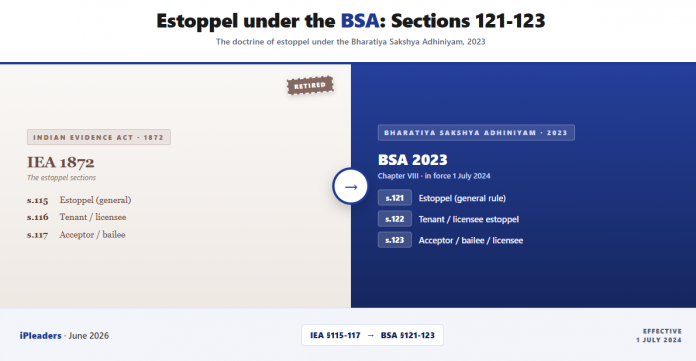
Estoppel under the Bharatiya Sakshya Adhiniyam, 2023 lives in Chapter VIII, Sections 121 to 123. Section 121 codifies the general rule that a person cannot deny a fact they led another to believe and act upon; Section 122 estops a tenant or licensee from denying the landlord’s or licensor’s title; Section 123 estops the acceptor of a bill of exchange, a bailee and a licensee from denying their counterparty’s authority. The three sections carry forward Sections 115, 116 and 117 of the Indian Evidence Act, 1872, with one textual addition in Section 122.
The chapter is short. Its reach is not. The rest of this guide unpacks every section, the kinds of estoppel that fall outside it, and the mistakes that cost cases.
1. What estoppel means under the BSA, and where Sections 121-123 sit
Start with the word itself. Estoppel stops a person from saying something. More precisely, it stops a litigant from asserting a fact that contradicts a position they earlier took and that another person relied on. The doctrine protects the person who relied, not the person who shifted ground. So why does a rule about consistency belong in an evidence statute rather than the law of contract or property?
Because estoppel operates on proof. It does not create rights or destroy them. It closes the door on a particular line of evidence: the party who is estopped simply cannot lead proof to contradict the fact they are estopped from denying. That is why the legislature placed it among the rules of evidence in 1872, and why it stays there in 2024.
1.1 The working definition
The cleanest working definition is this: where one person, by a declaration, an act, or an omission, has intentionally caused or permitted another to believe a thing to be true and to act on that belief, the first person cannot later deny the truth of that thing in a proceeding between the two. The belief must have been induced. The reliance must have followed. And the denial must come in litigation between the same parties or those claiming through them.
Notice what the definition does not require. It doesn’t require a contract. It doesn’t require fraud. It doesn’t even require that the original representation was false when made. What it requires is conduct that induced reliance, followed by an attempt to resile from that conduct.
1.2 Chapter VIII: the dedicated estoppel block
Under the Bharatiya Sakshya Adhiniyam, 2023, estoppel sits in Chapter VIII, a short chapter headed simply “Estoppel.” It contains three sections: 121, 122 and 123. This is a tidier home than the doctrine had before. In the Indian Evidence Act, 1872 the same three rules occupied Sections 115, 116 and 117, also grouped together near the end of the relevancy provisions.
The placement matters for one practical reason. Search engines, exam syllabi and the newer commentaries now index the doctrine as “estoppel under BSA Sections 121-123,” and the section numbers a litigant grew up with under the 1872 Act are gone. A bail note, a written statement or a second-appeal memo drafted in 2026 should cite Section 121 of the Bharatiya Sakshya Adhiniyam, 2023, not Section 115 of the old Act, even though the two say almost the same thing. Where the estoppel chapter fits within the larger architecture of the statute is mapped in our complete guide to India’s new evidence law.
1.3 A rule of evidence, not a cause of action
Here’s a distinction that decides cases: estoppel is a shield, not a sword. It bars a denial. It does not, on its own, confer a right or found a claim. A plaintiff cannot sue “on estoppel” the way they sue on a contract or a tort. The doctrine works defensively, preventing the other side from proving a fact, and a litigant who tries to build an independent cause of action out of Section 121 alone will usually fail.
Promissory estoppel, which we’ll come to, is the partial exception that proves the rule. Courts have allowed it to be used as a sword against the government in limited circumstances. But the general Section 121 rule remains evidentiary: it stops a denial; it does not manufacture a right that never existed.
1.4 The common-law origin: Pickard v. Sears
The statutory rule is a codification of a common-law principle most often traced to the King’s Bench decision in Pickard v. Sears, (1837) 6 Ad & E 469. Lord Denman’s formulation has survived nearly two centuries: where a person by words or conduct wilfully causes another to believe in a certain state of things, and induces him to act on that belief, he is concluded from later averring a different state of things.
That sentence is the spine of Section 121. The Indian legislature took the equitable idea, gave it statutory form, and the Supreme Court has refined it case by case since. So has the doctrine changed in two centuries? In its core, no. The trigger is still induced belief; the consequence is still that the party cannot deny what they led the other to act upon.
.ip-ig-estg *, .ip-ig-estg *::before, .ip-ig-estg *::after { box-sizing: border-box; }
.ip-ig-estg { color: #212121; line-height: 1.5; font-family: -apple-system, BlinkMacSystemFont, ‘Segoe UI’, Roboto, sans-serif; }
.ip-ig-estg .ig-wrap { background: #ffffff; border: 1px solid #e0e0e0; border-radius: 6px; overflow: hidden; }
.ip-ig-estg .ig-title { background: #1f3a93; color: #ffffff; padding: 18px 20px; font-size: 18px; font-weight: 700; letter-spacing: 0.2px; }
.ip-ig-estg .ig-sub { background: #eaf0ff; color: #16275f; padding: 8px 20px; font-size: 13px; border-bottom: 1px solid #cdd9ff; }
.ip-ig-estg .ig-legend { display: flex; flex-wrap: wrap; gap: 10px 18px; padding: 10px 20px; background: #fafafa; border-bottom: 1px solid #eeeeee; font-size: 12px; color: #424242; }
.ip-ig-estg .ig-legend .lg-item { display: flex; align-items: center; gap: 6px; }
.ip-ig-estg .ig-legend .lg-dot { width: 12px; height: 12px; border-radius: 3px; display: inline-block; }
.ip-ig-estg .lg-gen { background: #1f3a93; }
.ip-ig-estg .lg-ten { background: #2e7d32; }
.ip-ig-estg .lg-acc { background: #b45309; }
.ip-ig-estg .tbl { width: 100%; border-collapse: collapse; font-size: 13.5px; }
.ip-ig-estg .tbl thead th { background: #16275f; color: #ffffff; text-align: left; padding: 11px 10px; font-weight: 700; font-size: 12.5px; letter-spacing: 0.2px; }
.ip-ig-estg .tbl tbody td { padding: 11px 10px; vertical-align: top; border-top: 1px solid #f0f0f0; }
.ip-ig-estg .tbl tbody tr:nth-child(even) td { background: #f5f7ff; }
.ip-ig-estg .tbl tbody tr:nth-child(odd) td { background: #ffffff; }
.ip-ig-estg .tbl .rail { width: 6px; padding: 0; }
.ip-ig-estg .tbl .bsa { color: #16275f; font-variant-numeric: tabular-nums; white-space: nowrap; font-weight: 700; }
.ip-ig-estg .tbl .iea { color: #6d4c41; font-variant-numeric: tabular-nums; white-space: nowrap; font-weight: 600; }
.ip-ig-estg .tbl .topic { color: #212121; }
.ip-ig-estg .tbl .chg { color: #424242; font-size: 13px; }
.ip-ig-estg .tbl .chg.changed { color: #b45309; font-weight: 600; }
.ip-ig-estg .note-i { display: inline-block; margin-left: 4px; width: 14px; height: 14px; line-height: 14px; text-align: center; border-radius: 50%; background: #b45309; color: #ffffff; font-size: 10px; font-weight: 700; font-style: normal; cursor: help; }
.ip-ig-estg .footnote { padding: 10px 20px 4px; background: #fafafa; border-top: 1px solid #eeeeee; font-size: 12px; color: #5d4037; font-style: italic; line-height: 1.45; }
.ip-ig-estg .callouts { padding: 14px 20px 4px; background: #ffffff; border-top: 1px solid #eeeeee; }
.ip-ig-estg .callout { border-left: 4px solid #1f3a93; padding: 10px 12px; margin-bottom: 10px; background: #f5f7ff; font-size: 13px; color: #16275f; border-radius: 0 4px 4px 0; }
.ip-ig-estg .callout strong { color: #1f3a93; }
.ip-ig-estg .foot { display: flex; justify-content: space-between; align-items: center; padding: 10px 20px; font-size: 12px; color: #757575; background: #fafafa; border-top: 1px solid #eeeeee; }
.ip-ig-estg .brand { font-weight: 700; color: #1f3a93; letter-spacing: 0.3px; }
@media (max-width: 768px) {
.ip-ig-estg .tbl thead { display: none; }
.ip-ig-estg .tbl, .ip-ig-estg .tbl tbody, .ip-ig-estg .tbl tr, .ip-ig-estg .tbl td { display: block; width: 100%; }
.ip-ig-estg .tbl tr { border: 1px solid #eeeeee; border-radius: 4px; margin-bottom: 8px; overflow: hidden; position: relative; padding-left: 12px; }
.ip-ig-estg .tbl tbody tr:nth-child(even) td,
.ip-ig-estg .tbl tbody tr:nth-child(odd) td { background: #ffffff; }
.ip-ig-estg .tbl .rail { position: absolute; left: 0; top: 0; bottom: 0; width: 6px; height: auto; }
.ip-ig-estg .tbl td { border-top: none; padding: 5px 12px; }
.ip-ig-estg .tbl td.bsa { padding-top: 12px; font-size: 15px; }
.ip-ig-estg .tbl td.iea::before { content: “IEA predecessor: “; color: #757575; font-weight: 500; }
.ip-ig-estg .tbl td.topic::before { content: “Subject: “; color: #757575; font-weight: 500; }
.ip-ig-estg .tbl td.chg::before { content: “Change: “; color: #757575; font-weight: 500; }
.ip-ig-estg .tbl td.chg { padding-bottom: 12px; }
.ip-ig-estg .ig-legend { gap: 6px 12px; }
}
Estoppel under BSA Sections 121-123 at a glance
Chapter VIII of the Bharatiya Sakshya Adhiniyam, 2023 — in force from 1 July 2024.
General rule
Tenant / licensee
Acceptor / bailee
| BSA section | IEA predecessor | Subject | What it bars | Change from IEA | |
|---|---|---|---|---|---|
| s.121 | s.115 IEA | Estoppel (the general rule) | Denying a fact you led another to believe and act upon | No substantive change | |
| s.122i | s.116 IEA | Estoppel of tenant and of licensee of person in possession | A tenant or licensee denying the landlord’s / licensor’s title at the start | Adds “or any time thereafter” | |
| s.123 | s.117 IEA | Estoppel of acceptor of bill of exchange, bailee or licensee | An acceptor / bailee / licensee denying the counterparty’s authority | No substantive change (two Explanations retained) |
Effective date: 1 July 2024 (the BSA replaced the Indian Evidence Act, 1872).
Only substantive change: s.122 BSA adds “or any time thereafter”, so the tenant’s estoppel survives the end of the tenancy.
Outside this chapter: promissory estoppel against the government rests on equity and Article 14, not on Section 121.
2. Section 121 BSA: the general rule of estoppel
Section 121 is the engine of the chapter. Sections 122 and 123 are specific applications; Section 121 is the principle from which they draw. Most estoppel arguments in civil litigation, from boundary disputes to family settlements to commercial dealings, are built on Section 121 rather than its two narrower neighbours.
2.1 Text of Section 121 and its three ingredients
Section 121 of the Bharatiya Sakshya Adhiniyam, 2023 reads:
“When one person has, by his declaration, act or omission, intentionally caused or permitted another person to believe a thing to be true and to act upon such belief, neither he nor his representative shall be allowed, in any suit or proceeding between himself and such person or his representative, to deny the truth of that thing.”
Three ingredients hold the section together. First, a representation by declaration, act or omission, made intentionally and causing or permitting a belief. Second, the other party’s belief in that thing and action upon it. Third, a suit or proceeding between the two (or their representatives) in which the maker of the representation now wants to deny its truth.
Miss any one and the estoppel collapses. If there was no representation, there is nothing to be bound by. If the other party did not believe or did not act on the belief, there is no reliance to protect. And if the proceeding is between strangers to the representation, the section simply does not apply.
2.2 The statutory illustration
The section carries the same illustration the 1872 Act used. A intentionally and falsely leads B to believe that certain land belongs to A, and thereby induces B to buy and pay for it. The land afterwards becomes A’s property, and A seeks to set aside the sale on the ground that, at the time of the sale, he had no title. He is not allowed to prove his want of title.
The illustration repays close reading because it shows the rule’s indifference to the truth at the time of the representation. A genuinely had no title when he spoke. It didn’t matter. He had induced B to act, and the law held him to the picture he painted. The estoppel bound his conduct, not the underlying merits.
2.3 Representation of existing fact, not future intention
Now, here’s where it gets interesting, and where pleadings go wrong. Section 121 estoppel attaches to a representation of an existing fact. A promise about future conduct, “I will not enforce this clause,” “the concession will continue for five years,” is a different animal. It belongs to promissory estoppel, an equitable doctrine the courts developed separately, not to Section 121.
The practical consequence is sharp. If your client relied on a statement about how things stand today, plead Section 121. If your client relied on a promise about what the other side would do tomorrow, you are in promissory-estoppel territory, and the authorities you cite are the administrative-law line, not the evidence statute. We see juniors blur the two constantly, and the blur weakens both arguments.
2.4 Who can raise it, and between whom it operates
Estoppel binds the representor and “his representative,” and it protects the representee and “his representative.” So it runs to heirs, successors-in-interest and assignees, not just the original two parties. The shop tenant in the 2025 case could not escape by saying the rent deed was signed by an earlier generation; a person claiming through a party is bound to the same extent as the party.
But it does not bind the world. A stranger to the representation can dispute the fact freely. This is why a careful pleader frames estoppel narrowly, naming the representation, the reliance and the parties, rather than throwing the word into a paragraph and hoping it sticks.
3. The kinds of estoppel Indian courts recognise
Ask three lawyers to list the kinds of estoppel and you’ll get three different lists. The doctrine grew by accretion, and the labels overlap. Still, a working litigator needs the map, because the section you cite and the authority you rely on both turn on which kind you’re invoking.
3.1 Estoppel by record, by deed, and by conduct
The classical English division ran in three branches. Estoppel by record arises from a judgment: a matter decided by a competent court binds the parties and cannot be reopened. In Indian practice this is largely absorbed into res judicata under Section 11 of the Code of Civil Procedure, 1908, and into issue estoppel in criminal law, both discussed below.
Estoppel by deed binds a party to the recitals in a formal instrument they executed. Estoppel by conduct, also called estoppel in pais, is the branch Section 121 codifies: it arises from declarations, acts or omissions outside any record or deed. In Indian litigation, estoppel by conduct is by far the most frequently argued of the three.
3.2 Equitable and promissory estoppel
Equitable estoppel is the umbrella the courts use for estoppels that rest on fairness rather than on a strict representation of existing fact. Promissory estoppel is its best-known species: it holds a party to a clear promise about future conduct where the other side has altered its position in reliance. The doctrine is most developed in India against the government, which is why it has a section of its own below.
The line between Section 121 and promissory estoppel is the line between fact and promise. That single distinction, fact versus promise, decides which body of law you’re in, and a surprising number of appeals turn on it.
3.3 Proprietary estoppel: an English label, an Indian reality
Proprietary estoppel, familiar from English decisions like Crabb v. Arun District Council, arises where an owner encourages another to believe they have or will get a right over land, and the other spends or acts in reliance. Indian courts rarely use the label. The same facts are usually decided under Section 121 estoppel by conduct, or under Section 41 of the Transfer of Property Act, 1882, which protects a transferee from an ostensible owner.
The practical takeaway: don’t go searching for an Indian “proprietary estoppel” precedent to anchor a land claim. Plead estoppel by conduct under Section 121, or the ostensible-owner protection under the Transfer of Property Act, and cite the authority that actually governs the point.
3.4 The kinds at a glance
| Kind of estoppel | Source | Trigger | Where it is argued |
|---|---|---|---|
| Estoppel by conduct (in pais) | Section 121 BSA | Declaration, act or omission inducing belief | Most civil disputes |
| Tenant and licensee estoppel | Section 122 BSA | Possession taken by permission | Eviction and possession suits |
| Acceptor, bailee and licensee estoppel | Section 123 BSA | Acceptance of a bill; bailment or licence | Commercial and negotiable-instrument disputes |
| Estoppel by record | Section 11 CPC; issue estoppel | A matter decided by a competent court | Res judicata; criminal retrials |
| Promissory estoppel | Judge-made equity; Article 14 | Clear promise of future conduct, relied on | Tax exemptions, subsidies, government schemes |
| Proprietary estoppel | English origin; absorbed into s.121 / s.41 TPA | Encouraged belief in a right over land | Property disputes (rarely labelled as such) |
4. Promissory estoppel against the government
This is the section that the dedicated presumptions guide deliberately leaves out, and it is where a great deal of high-value litigation actually happens: tax holidays withdrawn, subsidy schemes reversed, industrial concessions curtailed. A business sets up a plant on the strength of a government promise; the government changes its mind; the business sues to hold it to its word. That is promissory estoppel, and against the State it has a rich and specific case law.
4.1 Why it is not Section 121
The first thing to fix is the source. Promissory estoppel is not Section 121 of the BSA. Section 121 binds a representation of existing fact; promissory estoppel binds a promise of future conduct. The doctrine against the government is built on equity and on Article 14 of the Constitution of India, the guarantee of non-arbitrary State action, not on the evidence statute.
A pleading that anchors a promissory-estoppel claim in Section 121 invites the court to say the statutory section doesn’t fit. The right anchoring is the dedicated Supreme Court line, plus Article 14. Keep the two analytically separate even where the facts overlap. This is where most applicants go wrong.
4.2 The case line: Indo-Afghan to Nestle
The Indian story begins with Union of India v. Indo-Afghan Agencies Ltd., AIR 1968 SC 718 (note the correct name: Indo-Afghan, not “Anglo-Afghan,” a common slip). The Supreme Court held the State to representations in an export-promotion scheme on which an exporter had relied, rejecting the idea that the government stands outside the reach of estoppel.
Century Spinning and Manufacturing Co. Ltd. v. Ulhasnagar Municipal Council, (1970) 1 SCC 582 extended the principle to public bodies: a municipality, like a private person, is bound to carry out a representation relied upon, and equity can enforce the obligation even without a formally executed statutory contract. The high-water mark came in Motilal Padampat Sugar Mills Co. v. State of Uttar Pradesh, (1979) 2 SCC 409, where the Court held that the doctrine binds the government on the same footing as a private individual and that the plea of “executive necessity” is no automatic answer.
Two later decisions sharpened the edges. In Pournami Oil Mills v. State of Kerala, 1986 Supp SCC 728, units that had set up industry relying on a tax-exemption order were allowed to hold the State to the promised concession. And in State of Punjab v. Nestle India Ltd., (2004) 6 SCC 465, the Court confirmed that promissory estoppel can bind the government even where a statute prescribes a mode for granting the relief, and that the absence of a formal notification does not erase a clear representation that was acted upon.
4.3 The escape routes: public interest and acts contrary to law
The doctrine is powerful but not absolute. Delhi Cloth and General Mills Ltd. v. Union of India, (1988) 1 SCC 86 maps the boundaries: the promise must be clear and unambiguous, not provisional or conditional, and estoppel cannot compel the government to do something contrary to law or beyond the authority of the officer who made the promise.
The other escape is overriding public interest. A mere change of policy is not enough; the State must show that an overwhelming public interest required it to resile, and the court will weigh the equities. So can the government always wriggle out by citing “public interest”? Not on the current law. The burden sits on the State, and it is a real one.
5. The limits of estoppel
Every powerful doctrine has its no-go zones, and estoppel’s are well marked. Three of them recur often enough that any litigator should know them cold, because opponents reach for estoppel precisely in the situations where these limits bite.
5.1 No estoppel against a statute
A party cannot be estopped from asserting what a statute requires, nor bound by conduct to a position the statute forbids. If the law mandates a thing, no amount of representation or reliance can override it. The Supreme Court treated this as a settled exception in Sneh Gupta v. Devi Sarup, (2009) 6 SCC 194, holding that the bar on approbating and reprobating yields where the result would be an estoppel against a statute.
The practical use is defensive. If your opponent argues that your client agreed to or acquiesced in something the statute does not permit, the answer is that there is no estoppel against a statute. Consent cannot validate what the law prohibits.
5.2 No estoppel against the Constitution
The same logic, raised to constitutional level, gives the most quotable limit of all. In Olga Tellis v. Bombay Municipal Corporation, (1985) 3 SCC 545, the pavement dwellers had earlier conceded in court that they claimed no fundamental right to occupy the footpaths. The Supreme Court held that the concession could not bind them, in the words that practitioners still quote: “There can be no estoppel against the Constitution.”
A waiver or concession cannot extinguish a fundamental right. This matters far beyond pavement-dwelling cases: it means a litigant who, at an earlier stage, gave up a constitutional argument by mistake or under pressure is not necessarily shut out from raising it later.
5.3 No estoppel on a question of law or to confer jurisdiction
Estoppel binds facts, not pure questions of law, and it cannot create jurisdiction that a court otherwise lacks. The point is closely linked to res judicata. In Mathura Prasad Bajoo Jaiswal v. Dossibai N.B. Jeejeebhoy, (1970) 1 SCC 613, the Supreme Court held that a pure question of law, especially one going to jurisdiction, does not become unassailable merely because it was decided in an earlier round; res judicata does not bar its reconsideration.
Translated into estoppel terms: parties cannot, by agreement or conduct, clothe a court with a jurisdiction the statute withholds, nor freeze an erroneous view of the law. Worth flagging for litigators: this is the standard reply when an opponent says “you accepted this position earlier.” If the position is a question of law or jurisdiction, the earlier acceptance does not estop.
6. Section 122 BSA: tenant and licensee estoppel
Section 122 is the rule that decided the shop case in the introduction, and it is the most litigated estoppel in Indian courts simply because tenancy and possession disputes are the bread and butter of the trial bar. It carries forward Section 116 of the Indian Evidence Act, 1872, with one genuine change.
6.1 Text of Section 122 and its ingredients
Section 122 of the Bharatiya Sakshya Adhiniyam, 2023 reads:
“No tenant of immovable property, or person claiming through such tenant, shall, during the continuance of the tenancy or any time thereafter, be permitted to deny that the landlord of such tenant had, at the beginning of the tenancy, a title to such immovable property; and no person who came upon any immovable property by the licence of the person in possession thereof shall be permitted to deny that such person had a title to such possession at the time when such licence was given.”
The tenant limb has four ingredients. There must be a tenancy of immovable property. The tenant must have entered by the landlord’s permission. The tenant, or someone claiming through the tenant, must be attempting to deny that the landlord had title at the beginning of the tenancy. And the proceeding must be between the landlord and the tenant or those claiming through them.
6.2 The trigger: possession by permission
The estoppel attaches to permissive entry. A trespasser is not estopped; an encroacher is not estopped; only a tenant who took possession on the footing that the other party had title is bound. The rationale is squarely equitable, and the Supreme Court applied it firmly in Sri Ram Pasricha v. Jagannath, (1976) 4 SCC 184: a tenant cannot question the landlord’s title at the commencement of the tenancy, and title is not the issue in a landlord-tenant suit.
In practice, the common battleground is whether entry was permissive at all, or whether the alleged tenant was really a co-owner or a trespasser. Where the landlord cannot show permissive entry, the estoppel doesn’t attach, and the occupant is free to contest title on the merits.
6.3 The “any time thereafter” change
Now the one real change. Section 116 of the 1872 Act barred the denial only “during the continuance of the tenancy.” Section 122 BSA extends the bar to “during the continuance of the tenancy or any time thereafter.” Those three added words mean a former tenant cannot escape the estoppel simply by having vacated or by the tenancy having ended.
This is exactly the spirit of the 2025 shop decision, where the Court refused to let seventy years and a claim of adverse possession defeat the estoppel. The deeper statutory comparison, clause by clause against the 1872 text, is set out in our companion analysis of the presumption-and-estoppel block in BSA Sections 116-122; the point to carry away here is that a defence built on “the tenancy is over, so the estoppel is spent” no longer works after 1 July 2024.
6.4 The licensee limb and persons claiming through the tenant
The second limb estops a licensee from denying that the person who gave the licence had title to the possession at the time the licence was granted. It is heavily invoked in commercial-occupancy disputes, paying-guest arrangements, branch-office occupancy, venue licences, where the line between lease, licence and tenancy is blurred. The Supreme Court looks at the substance of the arrangement, not the label the parties pinned on it.
Sub-tenants and others claiming through the tenant are bound to the same extent as the tenant. A person claiming through a tenant cannot raise an argument the tenant himself was estopped from raising; the derivative claim is barred to the same degree. So can a long-staying sub-tenant plead adverse possession against the head landlord during the currency of the head tenancy? No, the claim is derivative and is barred along with the head tenant’s.
7. Section 123 BSA: acceptor, bailee and licensee estoppel
Section 123 is the chapter’s quiet provision, the one the sister guide on presumptions doesn’t reach at all, and the one most students skim past. That’s a mistake. It governs a precise set of commercial situations, and when it applies it is decisive.
7.1 Text of Section 123 and its two limbs
Section 123 of the Bharatiya Sakshya Adhiniyam, 2023 provides that no acceptor of a bill of exchange shall be permitted to deny that the drawer had authority to draw or endorse it, and that no bailee or licensee shall be permitted to deny that the bailor or licensor had, at the time the bailment or licence commenced, authority to make the bailment or grant the licence.
Two limbs, then. The first is a negotiable-instruments rule: the acceptor of a bill is estopped from denying the drawer’s authority. The second mirrors Section 122 in the bailment context: a bailee cannot deny the bailor’s authority to bail, and a licensee cannot deny the licensor’s authority to license, as things stood when the relationship began.
7.2 The two Explanations
The section carries two carve-outs. Explanation 1 lets the acceptor of a bill deny that the bill was really drawn by the person by whom it purports to have been drawn. The estoppel covers the drawer’s authority, not the genuineness of the drawer’s signature, so a forgery defence survives. Explanation 2 lets a bailee who has delivered the goods to a third party prove that the third party had a right to them as against the bailor.
These are narrow but real. A litigant defending an acceptor on a forged bill, or a bailee sued after delivering to the true owner, looks to the Explanations, not the main rule. They are the statutory recognition that the estoppel protects reliance, not fraud.
7.3 Where Section 123 actually bites in practice
In day-to-day litigation, Section 123 surfaces in cheque and bill disputes, in warehousing and bailment claims, and in commercial-occupancy matters where authority to grant the arrangement is questioned. It runs alongside the Negotiable Instruments Act, 1881 for bills and the bailment provisions of the Indian Contract Act, 1872 for goods. The estoppel doesn’t decide who ultimately owns the money or the goods; it decides what the acceptor or bailee is allowed to deny.
Think of it this way. Section 123 fixes the starting position, the authority that existed when the relationship began, and forces the party who accepted that position to argue from it rather than against it. Frankly, this gets overlooked until a banking or warehousing dispute lands on the desk and the section turns out to be the whole answer.
8. Estoppel vs res judicata vs waiver vs acquiescence
Four doctrines crowd the same pleading paragraphs, and pleaders routinely run them together. They are not interchangeable, and the differences carry real consequences for what you must prove.
8.1 Estoppel and res judicata
Res judicata, codified in Section 11 of the Code of Civil Procedure, 1908, bars a court from re-trying a matter already finally decided between the same parties. Estoppel binds a party from denying a fact they induced the other to rely on. The Supreme Court drew the line cleanly in Bhanu Kumar Jain v. Archana Kumar, (2005) 1 SCC 787: res judicata operates against the court, preventing it from re-determining what has attained finality, while issue estoppel operates against the party who lost on an issue, estopping him from re-raising it.
The distinction is not academic. Res judicata can be raised by anyone and noticed by the court; estoppel must be pleaded and proved by the party who relies on it, with the representation and the reliance spelled out. And as Section 5.3 showed, neither doctrine freezes a pure question of law or jurisdiction.
8.2 Estoppel, waiver and acquiescence
Estoppel is a rule of evidence: it bars a denial. Waiver is a rule of substantive law: it requires the deliberate relinquishment of a known right, with knowledge of the consequences. Acquiescence is a rule of inference: consent to a state of affairs is inferred from conduct, typically prolonged silence or inaction.
The proof you need differs in each. A waiver argument requires evidence of the party’s actual knowledge of the right being given up; an acquiescence argument can rest on conduct alone; an estoppel argument needs the representation and the reliance. The mistake we see most often is pleading all three interchangeably in one paragraph, which dilutes each of them. Pick the doctrine the facts actually support, and plead its ingredients.
9. Issue estoppel in criminal trials
Estoppel is not only a civil doctrine. It has a criminal cousin, issue estoppel, that bars the prosecution from re-litigating a fact already decided in the accused’s favour by a competent court. It is distinct from the bar on double jeopardy, and confusing the two costs criminal appeals.
9.1 Pritam Singh and the rule
The leading authority is Pritam Singh v. State of Punjab, AIR 1956 SC 415. The accused had been acquitted on an Arms Act charge concerning a particular revolver. In a later murder trial, the prosecution sought to prove he possessed that very revolver. The Supreme Court held that the earlier finding in his favour could not be reopened: a fact decided for the accused by a competent court binds the prosecution in a subsequent trial.
That is issue estoppel. It does not depend on the two offences being the same; it depends on a specific fact having been judicially determined in the accused’s favour. The prosecution is estopped from leading evidence to contradict that finding.
9.2 Issue estoppel is not autrefois acquit
The point was clarified in Manipur Administration v. Thokchom Bira Singh, AIR 1965 SC 87, which separated issue estoppel from the autrefois acquit protection. Double jeopardy, now reflected in Article 20(2) of the Constitution and in the bar on a second trial for the same offence, prevents a fresh prosecution for the same offence. Issue estoppel is narrower and different: it allows a trial for a different offence but stops the prosecution from contradicting a fact already settled in the accused’s favour.
So the two rules answer different questions. One asks whether the accused can be tried again at all; the other asks what facts the prosecution may seek to prove if a later trial does take place. A defence counsel who runs them together loses the sharper of the two tools, and the place to deploy issue estoppel is at the stage of cross-examination under BSA Sections 137-145, where the prosecution’s attempt to reopen a settled fact can be blocked before it gathers momentum.
10. IEA to BSA: how Sections 115-117 became 121-123
For practitioners trained on the 1872 Act, the migration is mostly about numbers, with one substantive change to watch. The chapter moved, the sections were renumbered, and a single clause was added.
| BSA, 2023 | Subject | IEA, 1872 | Change |
|---|---|---|---|
| Section 121 | Estoppel (general rule) | Section 115 | No substantive change |
| Section 122 | Estoppel of tenant and of licensee of person in possession | Section 116 | Adds “or any time thereafter” |
| Section 123 | Estoppel of acceptor of bill of exchange, bailee or licensee | Section 117 | No substantive change |
The only substantive textual change in the whole chapter sits in Section 122, the tenant-estoppel rule, which now bars the denial “during the continuance of the tenancy or any time thereafter.” Section 121 and Section 123 carry forward their 1872 predecessors essentially word for word, including the illustration to Section 121 and the two Explanations to Section 123.
What this means for citation discipline is straightforward. A 2026 pleading should cite the BSA section numbers, but the case law decided under Sections 115, 116 and 117 of the Indian Evidence Act, 1872 remains good law and fully usable, because the substance is unchanged. The body of precedent built over a century, including the legacy commentary on Section 116 of the Indian Evidence Act, 1872, did not evaporate on 1 July 2024; it simply attaches to renumbered provisions.
11. Pleading and rebutting estoppel at trial: a practical roadmap
Estoppel is won and lost on the pleadings. A party who fails to plead it specifically usually cannot raise it later, and a party who pleads it loosely invites the court to ignore it. Here is the sequence we’d recommend, whether you are raising the estoppel or knocking it down.
-
Identify the representation. Pin down the exact declaration, act or omission, and who made it. “By conduct” is not enough; name the conduct. For a tenant-estoppel argument under Section 122, the representation is the permissive entry on the footing of the landlord’s title.
-
Prove inducement and reliance. Show that the other party believed the thing and acted on that belief. Without reliance there is no estoppel; a representation nobody acted on binds no one. Lead the evidence of the act done in reliance, the purchase, the rent paid, the position altered.
-
Confirm the parties. Estoppel runs only between the representor and representee and those claiming through them. Check that your proceeding is between the right parties before you build on it; a stranger to the representation is not bound.
-
Test it against the limits. Before relying on estoppel, ask whether it would operate against a statute, against the Constitution, or on a pure question of law or jurisdiction. If it would, the estoppel fails at the threshold, and your time is better spent elsewhere.
-
Pick the right doctrine and section. Section 121 for a representation of existing fact; Section 122 for tenant or licensee possession; Section 123 for bills, bailment and licence authority; the promissory-estoppel line plus Article 14 for a government promise of future conduct. Don’t mix waiver and acquiescence into the same paragraph unless their separate ingredients are made out.
-
Plead it expressly and in terms. Set out the representation, the reliance and the bar in the pleading itself, and frame the relevant issue. An estoppel argued for the first time in final submissions, with no foundation in the pleadings or evidence, will usually be refused.
To rebut an estoppel, attack any single ingredient: no clear representation, no reliance, parties not in privity, or the estoppel would offend a statute or the Constitution. Knock out one ingredient and the whole edifice falls, which is why the rebuttal is often simpler than the case in chief.
.ip-ig-road *, .ip-ig-road *::before, .ip-ig-road *::after { box-sizing: border-box; }
.ip-ig-road { color: #212121; line-height: 1.5; font-family: -apple-system, BlinkMacSystemFont, ‘Segoe UI’, Roboto, sans-serif; }
.ip-ig-road .ig-wrap { background: #ffffff; border: 1px solid #e0e0e0; border-radius: 6px; overflow: hidden; }
.ip-ig-road .ig-title { background: #1f3a93; color: #ffffff; padding: 18px 20px; font-size: 18px; font-weight: 700; letter-spacing: 0.2px; }
.ip-ig-road .ig-sub { background: #eaf0ff; color: #16275f; padding: 8px 20px; font-size: 13px; border-bottom: 1px solid #cdd9ff; }
.ip-ig-road .steps { padding: 16px 20px 4px; }
.ip-ig-road .step { display: grid; grid-template-columns: 44px 1fr; gap: 14px; margin-bottom: 14px; }
.ip-ig-road .roundel { width: 44px; height: 44px; border-radius: 50%; background: #1f3a93; color: #ffffff; font-weight: 800; font-size: 18px; display: flex; align-items: center; justify-content: center; }
.ip-ig-road .card { border: 1px solid #e6e9f2; border-radius: 6px; overflow: hidden; }
.ip-ig-road .card .head { background: #f5f7ff; padding: 9px 12px; font-weight: 700; color: #16275f; font-size: 14px; }
.ip-ig-road .card .body { padding: 9px 12px; font-size: 13px; color: #333333; }
.ip-ig-road .card .hook { display: block; margin-top: 5px; font-size: 12px; color: #1f3a93; font-weight: 600; }
.ip-ig-road .card .miss { display: block; margin-top: 6px; padding: 6px 9px; background: #fdecea; border-left: 3px solid #c0392b; border-radius: 0 4px 4px 0; font-size: 12px; color: #7b241c; }
.ip-ig-road .card .miss strong { color: #c0392b; }
.ip-ig-road .anchor-top, .ip-ig-road .anchor-bot { padding: 11px 20px; font-size: 12.5px; }
.ip-ig-road .anchor-top { background: #16275f; color: #cdd9ff; border-bottom: 1px solid #0f1c44; }
.ip-ig-road .anchor-bot { background: #f5f7ff; color: #16275f; border-top: 1px solid #cdd9ff; font-style: italic; }
.ip-ig-road .foot { display: flex; justify-content: space-between; align-items: center; padding: 10px 20px; font-size: 12px; color: #757575; background: #fafafa; border-top: 1px solid #eeeeee; }
.ip-ig-road .brand { font-weight: 700; color: #1f3a93; letter-spacing: 0.3px; }
@media (max-width: 768px) {
.ip-ig-road .step { grid-template-columns: 36px 1fr; gap: 10px; }
.ip-ig-road .roundel { width: 36px; height: 36px; font-size: 15px; }
}
Pleading and rebutting estoppel at trial: a 6-step roadmap
For raising or defeating an estoppel under Sections 121-123 of the Bharatiya Sakshya Adhiniyam, 2023.
Read Section 121 (general rule) with Section 122 (tenant / licensee) and Section 123 (acceptor / bailee / licensee).
1
Identify the representation
Pin down the exact declaration, act or omission, and who made it. “By conduct” is not enough; name the conduct.Hook: s.121 BSA / s.122 permissive entry.Avoid: pleading estoppel as a vague label with no identified representation.
2
Prove inducement and reliance
Show the other party believed the thing and acted on it: the purchase, the rent paid, the position altered.Hook: the “and to act upon such belief” limb of s.121.Avoid: asserting a representation nobody actually relied on.
3
Confirm the parties
Estoppel runs only between the representor and representee and those claiming through them.Hook: “between himself and such person or his representative” (s.121).Avoid: raising estoppel against a stranger to the representation.
4
Test it against the limits
Ask whether the estoppel would operate against a statute, the Constitution, or a pure question of law or jurisdiction.Hook: Olga Tellis; Sneh Gupta; Mathura Prasad.Avoid: running an estoppel that offends a statute or fundamental right.
5
Pick the right doctrine and section
s.121 for a present fact; s.122 for tenant / licensee possession; s.123 for bills, bailment and licence authority; promissory estoppel plus Article 14 for a government promise.Hook: fact vs promise decides the body of law.Avoid: merging waiver and acquiescence into the same paragraph.
6
Plead it expressly and in terms
Set out the representation, the reliance and the bar in the pleading, and frame the issue.Hook: estoppel must be specifically pleaded and proved.Avoid: springing estoppel for the first time in final arguments.
To rebut: knock out any single ingredient — no clear representation, no reliance, parties not in privity, or the estoppel offends a statute or the Constitution — and the whole argument falls.
12. Common mistakes advocates make with estoppel
The doctrine is old, but the errors are evergreen. A handful recur often enough to be worth naming.
The first is anchoring a promissory-estoppel-against-government claim in Section 121. The court accepts the equity but rejects the statutory peg; the correct foundation is the dedicated Supreme Court line and Article 14. The second is treating estoppel as a cause of action, pleading it as the basis of a claim rather than as a bar to the other side’s denial.
The third is forgetting the limits, running an estoppel that would operate against a statute or the Constitution and watching it collapse on a one-line reply. The fourth is the “tenancy is over” defence under Section 122, which no longer survives the “any time thereafter” amendment. And the fifth, the quietest killer, is failing to plead estoppel specifically, then trying to spring it in argument. The practical reality is that a well-pleaded, narrowly-framed estoppel beats a broad one every time.
13. Frequently asked questions
Which sections of the BSA deal with estoppel?
Sections 121, 122 and 123 of the Bharatiya Sakshya Adhiniyam, 2023, gathered in Chapter VIII. Section 121 is the general rule, Section 122 covers tenant and licensee estoppel, and Section 123 covers the acceptor of a bill of exchange, a bailee and a licensee.
What were the corresponding sections in the Indian Evidence Act, 1872?
Section 121 BSA corresponds to Section 115 IEA, Section 122 to Section 116, and Section 123 to Section 117. The substance carried forward; only Section 122 was changed, by the addition of “or any time thereafter.”
What is the one change the BSA made to estoppel?
Section 122 now bars a tenant from denying the landlord’s title “during the continuance of the tenancy or any time thereafter.” The old Section 116 IEA limited the bar to the period “during the continuance of the tenancy.”
Is estoppel a cause of action?
No. Estoppel under Section 121 is a rule of evidence. It bars a party from denying a fact; it does not, on its own, create a right or found a claim. Promissory estoppel against the government is the limited exception that can be used affirmatively.
What are the three ingredients of Section 121 estoppel?
A representation by declaration, act or omission that intentionally caused or permitted a belief; the other party’s belief in and action on that thing; and a proceeding between the parties or their representatives in which the maker now seeks to deny the truth of it.
Does estoppel apply to a representation about future conduct?
Not under Section 121, which attaches to a representation of existing fact. A promise about future conduct falls under promissory estoppel, an equitable doctrine the courts developed separately and anchored in Article 14 against the government.
Can promissory estoppel be used against the government?
Yes, in defined circumstances. The Supreme Court has held the State bound by clear promises relied upon, from Union of India v. Indo-Afghan Agencies through Motilal Padampat Sugar Mills to State of Punjab v. Nestle India, subject to escape routes for acts contrary to law and overriding public interest.
Is there estoppel against a statute?
No. A party cannot be estopped from asserting what a statute requires, nor bound by conduct to a position the statute forbids. The Supreme Court treated this as settled in Sneh Gupta v. Devi Sarup.
Is there estoppel against the Constitution?
No. In Olga Tellis v. Bombay Municipal Corporation the Supreme Court held that “there can be no estoppel against the Constitution,” so a concession cannot extinguish a fundamental right.
Can a tenant ever deny the landlord’s title?
Not as to the landlord’s title at the beginning of the tenancy, by reason of Section 122. The tenant may, however, show that the tenancy has been determined and that the landlord’s title has since come to an end, which is a different point from denying the title at inception.
Does Section 122 bind sub-tenants?
Yes. A person claiming through a tenant is bound to the same extent as the tenant. A sub-tenant cannot raise a denial the head tenant was estopped from raising while the head tenancy subsists.
What does Section 123 estop an acceptor of a bill from denying?
That the drawer had authority to draw or endorse the bill. Under Explanation 1, the acceptor may still deny that the bill was really drawn by the person by whom it purports to have been drawn, so a forgery defence remains open.
What is issue estoppel in criminal law?
It bars the prosecution from re-litigating a fact already decided in the accused’s favour by a competent court, as in Pritam Singh v. State of Punjab. It is distinct from double jeopardy and can apply even where the later trial concerns a different offence.
How is issue estoppel different from double jeopardy?
Double jeopardy bars a second trial for the same offence. Issue estoppel allows a trial for a different offence but stops the prosecution from contradicting a fact already settled for the accused, as clarified in Manipur Administration v. Thokchom Bira Singh.
How is estoppel different from res judicata?
Res judicata, under Section 11 of the Code of Civil Procedure, 1908, bars the court from re-deciding a finally decided matter; estoppel bars a party from denying an induced fact. Bhanu Kumar Jain v. Archana Kumar draws the distinction. Neither freezes a pure question of law or jurisdiction.
Is the old Evidence Act case law on estoppel still good?
Yes. Because Sections 121 and 123 reproduce the 1872 provisions and Section 122 changed only by adding “or any time thereafter,” the precedent decided under Sections 115 to 117 IEA remains fully usable, attaching to the renumbered BSA sections.
Must estoppel be specifically pleaded?
Yes. Estoppel is generally to be pleaded with particulars, the representation, the reliance and the bar, and proved by the party relying on it. An estoppel raised for the first time in argument, with no foundation in the pleadings, is usually refused.
14. References
Case law
- Bhanu Kumar Jain v. Archana Kumar, (2005) 1 SCC 787 — AIR 2005 SC 626
- Century Spinning and Manufacturing Co. Ltd. v. Ulhasnagar Municipal Council, (1970) 1 SCC 582 — AIR 1971 SC 1021
- Delhi Cloth and General Mills Ltd. v. Union of India, (1988) 1 SCC 86 — AIR 1987 SC 2414
- Jyoti Sharma v. Vishnu Goyal, 2025 INSC 1099 — Supreme Court, 11 September 2025
- Manipur Administration v. Thokchom Bira Singh, AIR 1965 SC 87 — (1964) 7 SCR 123
- Mathura Prasad Bajoo Jaiswal v. Dossibai N.B. Jeejeebhoy, (1970) 1 SCC 613 — AIR 1971 SC 2355
- Motilal Padampat Sugar Mills Co. v. State of Uttar Pradesh, (1979) 2 SCC 409 — AIR 1979 SC 621
- Olga Tellis v. Bombay Municipal Corporation, (1985) 3 SCC 545 — AIR 1986 SC 180
- Pickard v. Sears, (1837) 6 Ad & E 469 — King’s Bench (common-law origin of estoppel by representation)
- Pournami Oil Mills v. State of Kerala, 1986 Supp SCC 728 — AIR 1987 SC 590
- Pritam Singh v. State of Punjab, AIR 1956 SC 415 — 1956 SCR 415
- Sneh Gupta v. Devi Sarup, (2009) 6 SCC 194 — Supreme Court of India
- Sri Ram Pasricha v. Jagannath, (1976) 4 SCC 184 — AIR 1976 SC 2335
- State of Punjab v. Nestle India Ltd., (2004) 6 SCC 465 — AIR 2004 SC 4559
- Union of India v. Indo-Afghan Agencies Ltd., AIR 1968 SC 718 — (1968) 2 SCR 366
Statutes
- Indian Evidence Act, 1872 — sections cited: 115, 116, 117
- Indian Contract Act, 1872 — bailment provisions (general reference)
- Code of Civil Procedure, 1908 — Section 11 (res judicata)
- Negotiable Instruments Act, 1881 — bill-of-exchange provisions (general reference)
- Transfer of Property Act, 1882 — Section 41 (ostensible owner)
- Constitution of India — Articles 14 and 20(2)
- Bharatiya Sakshya Adhiniyam, 2023 — sections cited: 121, 122, 123
This article is for informational and educational purposes only and does not constitute legal advice. Estoppel turns closely on the facts of each case and on the precise terms of the representation, the tenancy, or the instrument in question. Readers should consult a qualified advocate before acting on any matter involving estoppel, tenancy, or evidence law under the Bharatiya Sakshya Adhiniyam, 2023. Statutory references are stated as in force on the last-verified date above.
{
“@context”: “https://schema.org”,
“@type”: “Article”,
“headline”: “Estoppel under BSA Sections 121-123 (2026 Guide)”,
“description”: “Estoppel under BSA Sections 121-123 explained: the general rule, tenant and licensee estoppel, promissory estoppel against government, issue estoppel, IEA mapping. June 2026.”,
“author”: {
“@type”: “Organization”,
“name”: “iPleaders”,
“url”: “https://blog.ipleaders.in”
},
“publisher”: {
“@type”: “Organization”,
“name”: “iPleaders”,
“logo”: {
“@type”: “ImageObject”,
“url”: “https://blog.ipleaders.in/logo.png”
}
},
“datePublished”: “2026-06-15”,
“dateModified”: “2026-06-15”,
“mainEntityOfPage”: {
“@type”: “WebPage”,
“@id”: “https://blog.ipleaders.in/estoppel-under-bsa-sections-121-123/”
},
“image”: “https://blog.ipleaders.in/wp-content/uploads/2026/06/estoppel-under-bsa-sections-121-123.png”,
“inLanguage”: “en-IN”,
“articleSection”: “Evidence Law”,
“keywords”: “estoppel under BSA, doctrine of estoppel, BSA Section 121, BSA Section 122 tenant estoppel, BSA Section 123 acceptor bailee, promissory estoppel against government, issue estoppel criminal law, no estoppel against statute, no estoppel against the Constitution, estoppel vs res judicata, estoppel under Bharatiya Sakshya Adhiniyam, IEA Section 115 116 117 mapping”,
“about”: [
{
“@type”: “Thing”,
“name”: “Estoppel under Indian evidence law”
},
{
“@type”: “Thing”,
“name”: “Bharatiya Sakshya Adhiniyam, 2023”
},
{
“@type”: “Thing”,
“name”: “Promissory estoppel against the government”
}
],
“mentions”: [
{
“@type”: “Legislation”,
“name”: “Bharatiya Sakshya Adhiniyam, 2023”,
“url”: “https://indiankanoon.org/doc/62015538/”,
“legislationJurisdiction”: “IN”
},
{
“@type”: “Legislation”,
“name”: “Indian Evidence Act, 1872”,
“url”: “https://cdnbbsr.s3waas.gov.in/s380537a945c7aaa788ccfcdf1b99b5d8f/uploads/2022/12/2022122817.pdf”,
“legislationJurisdiction”: “IN”
},
{
“@type”: “Legislation”,
“name”: “Code of Civil Procedure, 1908”,
“legislationJurisdiction”: “IN”
},
{
“@type”: “Legislation”,
“name”: “Transfer of Property Act, 1882”,
“legislationJurisdiction”: “IN”
},
{
“@type”: “Legislation”,
“name”: “Negotiable Instruments Act, 1881”,
“legislationJurisdiction”: “IN”
},
{
“@type”: “Legislation”,
“name”: “Indian Contract Act, 1872”,
“legislationJurisdiction”: “IN”
},
{
“@type”: “Legislation”,
“name”: “Constitution of India, 1950”,
“url”: “https://cdnbbsr.s3waas.gov.in/s380537a945c7aaa788ccfcdf1b99b5d8f/uploads/2024/07/20240716890312078.pdf”,
“legislationJurisdiction”: “IN”
}
],
“citation”: [
{
“@type”: “CreativeWork”,
“name”: “Bhanu Kumar Jain v. Archana Kumar”,
“identifier”: “(2005) 1 SCC 787”,
“url”: “https://indiankanoon.org/doc/785132/”,
“datePublished”: “2004-12-17”
},
{
“@type”: “CreativeWork”,
“name”: “Century Spinning and Manufacturing Co. Ltd. v. Ulhasnagar Municipal Council”,
“identifier”: “(1970) 1 SCC 582”,
“url”: “https://indiankanoon.org/doc/113707/”,
“datePublished”: “1970-02-27”
},
{
“@type”: “CreativeWork”,
“name”: “Delhi Cloth and General Mills Ltd. v. Union of India”,
“identifier”: “(1988) 1 SCC 86”,
“url”: “https://indiankanoon.org/doc/1348961/”,
“datePublished”: “1987-10-08”
},
{
“@type”: “CreativeWork”,
“name”: “Jyoti Sharma v. Vishnu Goyal”,
“identifier”: “2025 INSC 1099”,
“url”: “https://indiankanoon.org/doc/171695497/”,
“datePublished”: “2025-09-11”
},
{
“@type”: “CreativeWork”,
“name”: “Manipur Administration v. Thokchom Bira Singh”,
“identifier”: “AIR 1965 SC 87”,
“url”: “https://indiankanoon.org/doc/1432787/”,
“datePublished”: “1964-03-11”
},
{
“@type”: “CreativeWork”,
“name”: “Mathura Prasad Bajoo Jaiswal v. Dossibai N.B. Jeejeebhoy”,
“identifier”: “(1970) 1 SCC 613”,
“url”: “https://indiankanoon.org/doc/1006709/”,
“datePublished”: “1970-03-13”
},
{
“@type”: “CreativeWork”,
“name”: “Motilal Padampat Sugar Mills Co. v. State of Uttar Pradesh”,
“identifier”: “(1979) 2 SCC 409”,
“url”: “https://indiankanoon.org/doc/871220/”,
“datePublished”: “1978-12-12”
},
{
“@type”: “CreativeWork”,
“name”: “Olga Tellis v. Bombay Municipal Corporation”,
“identifier”: “(1985) 3 SCC 545”,
“url”: “https://indiankanoon.org/doc/709776/”,
“datePublished”: “1985-07-10”
},
{
“@type”: “CreativeWork”,
“name”: “Pickard v. Sears”,
“identifier”: “(1837) 6 Ad & E 469”,
“datePublished”: “1837-01-01”
},
{
“@type”: “CreativeWork”,
“name”: “Pournami Oil Mills v. State of Kerala”,
“identifier”: “1986 Supp SCC 728”,
“url”: “https://indiankanoon.org/doc/1877956/”,
“datePublished”: “1986-12-19”
},
{
“@type”: “CreativeWork”,
“name”: “Pritam Singh v. State of Punjab”,
“identifier”: “AIR 1956 SC 415”,
“url”: “https://indiankanoon.org/doc/1283903/”,
“datePublished”: “1955-11-04”
},
{
“@type”: “CreativeWork”,
“name”: “Sneh Gupta v. Devi Sarup”,
“identifier”: “(2009) 6 SCC 194”,
“url”: “https://indiankanoon.org/doc/1121698/”,
“datePublished”: “2009-02-17”
},
{
“@type”: “CreativeWork”,
“name”: “Sri Ram Pasricha v. Jagannath”,
“identifier”: “(1976) 4 SCC 184”,
“url”: “https://indiankanoon.org/doc/942903/”,
“datePublished”: “1976-08-24”
},
{
“@type”: “CreativeWork”,
“name”: “State of Punjab v. Nestle India Ltd.”,
“identifier”: “(2004) 6 SCC 465”,
“url”: “https://indiankanoon.org/doc/994554/”,
“datePublished”: “2004-05-05”
},
{
“@type”: “CreativeWork”,
“name”: “Union of India v. Indo-Afghan Agencies Ltd.”,
“identifier”: “AIR 1968 SC 718”,
“url”: “https://indiankanoon.org/doc/1882267/”,
“datePublished”: “1967-11-22”
}
]
}
{
“@context”: “https://schema.org”,
“@type”: “FAQPage”,
“mainEntity”: [
{
“@type”: “Question”,
“name”: “Which sections of the BSA deal with estoppel?”,
“acceptedAnswer”: {
“@type”: “Answer”,
“text”: “Sections 121, 122 and 123 of the Bharatiya Sakshya Adhiniyam, 2023, gathered in Chapter VIII. Section 121 is the general rule, Section 122 covers tenant and licensee estoppel, and Section 123 covers the acceptor of a bill of exchange, a bailee and a licensee.”
}
},
{
“@type”: “Question”,
“name”: “What were the corresponding sections in the Indian Evidence Act, 1872?”,
“acceptedAnswer”: {
“@type”: “Answer”,
“text”: “Section 121 BSA corresponds to Section 115 IEA, Section 122 to Section 116, and Section 123 to Section 117. The substance carried forward; only Section 122 was changed, by the addition of the words ‘or any time thereafter’.”
}
},
{
“@type”: “Question”,
“name”: “What is the one change the BSA made to estoppel?”,
“acceptedAnswer”: {
“@type”: “Answer”,
“text”: “Section 122 now bars a tenant from denying the landlord’s title ‘during the continuance of the tenancy or any time thereafter’. The old Section 116 of the Indian Evidence Act, 1872 limited the bar to the period ‘during the continuance of the tenancy’.”
}
},
{
“@type”: “Question”,
“name”: “Is estoppel a cause of action?”,
“acceptedAnswer”: {
“@type”: “Answer”,
“text”: “No. Estoppel under Section 121 is a rule of evidence. It bars a party from denying a fact; it does not, on its own, create a right or found a claim. Promissory estoppel against the government is the limited exception that can be used affirmatively.”
}
},
{
“@type”: “Question”,
“name”: “What are the three ingredients of Section 121 estoppel?”,
“acceptedAnswer”: {
“@type”: “Answer”,
“text”: “A representation by declaration, act or omission that intentionally caused or permitted a belief; the other party’s belief in and action on that thing; and a proceeding between the parties or their representatives in which the maker now seeks to deny the truth of it.”
}
},
{
“@type”: “Question”,
“name”: “Does estoppel apply to a representation about future conduct?”,
“acceptedAnswer”: {
“@type”: “Answer”,
“text”: “Not under Section 121, which attaches to a representation of existing fact. A promise about future conduct falls under promissory estoppel, an equitable doctrine the courts developed separately and anchored in Article 14 against the government.”
}
},
{
“@type”: “Question”,
“name”: “Can promissory estoppel be used against the government?”,
“acceptedAnswer”: {
“@type”: “Answer”,
“text”: “Yes, in defined circumstances. The Supreme Court has held the State bound by clear promises relied upon, from Union of India v. Indo-Afghan Agencies through Motilal Padampat Sugar Mills to State of Punjab v. Nestle India, subject to escape routes for acts contrary to law and overriding public interest.”
}
},
{
“@type”: “Question”,
“name”: “Is there estoppel against a statute?”,
“acceptedAnswer”: {
“@type”: “Answer”,
“text”: “No. A party cannot be estopped from asserting what a statute requires, nor bound by conduct to a position the statute forbids. The Supreme Court treated this as settled in Sneh Gupta v. Devi Sarup.”
}
},
{
“@type”: “Question”,
“name”: “Is there estoppel against the Constitution?”,
“acceptedAnswer”: {
“@type”: “Answer”,
“text”: “No. In Olga Tellis v. Bombay Municipal Corporation the Supreme Court held that ‘there can be no estoppel against the Constitution’, so a concession cannot extinguish a fundamental right.”
}
},
{
“@type”: “Question”,
“name”: “Can a tenant ever deny the landlord’s title?”,
“acceptedAnswer”: {
“@type”: “Answer”,
“text”: “Not as to the landlord’s title at the beginning of the tenancy, by reason of Section 122. The tenant may, however, show that the tenancy has been determined and that the landlord’s title has since come to an end, which is a different point from denying the title at inception.”
}
},
{
“@type”: “Question”,
“name”: “Does Section 122 bind sub-tenants?”,
“acceptedAnswer”: {
“@type”: “Answer”,
“text”: “Yes. A person claiming through a tenant is bound to the same extent as the tenant. A sub-tenant cannot raise a denial the head tenant was estopped from raising while the head tenancy subsists.”
}
},
{
“@type”: “Question”,
“name”: “What does Section 123 estop an acceptor of a bill from denying?”,
“acceptedAnswer”: {
“@type”: “Answer”,
“text”: “That the drawer had authority to draw or endorse the bill. Under Explanation 1, the acceptor may still deny that the bill was really drawn by the person by whom it purports to have been drawn, so a forgery defence remains open.”
}
},
{
“@type”: “Question”,
“name”: “What is issue estoppel in criminal law?”,
“acceptedAnswer”: {
“@type”: “Answer”,
“text”: “It bars the prosecution from re-litigating a fact already decided in the accused’s favour by a competent court, as in Pritam Singh v. State of Punjab. It is distinct from double jeopardy and can apply even where the later trial concerns a different offence.”
}
},
{
“@type”: “Question”,
“name”: “How is issue estoppel different from double jeopardy?”,
“acceptedAnswer”: {
“@type”: “Answer”,
“text”: “Double jeopardy bars a second trial for the same offence. Issue estoppel allows a trial for a different offence but stops the prosecution from contradicting a fact already settled for the accused, as clarified in Manipur Administration v. Thokchom Bira Singh.”
}
},
{
“@type”: “Question”,
“name”: “How is estoppel different from res judicata?”,
“acceptedAnswer”: {
“@type”: “Answer”,
“text”: “Res judicata, under Section 11 of the Code of Civil Procedure, 1908, bars the court from re-deciding a finally decided matter; estoppel bars a party from denying an induced fact. Bhanu Kumar Jain v. Archana Kumar draws the distinction. Neither freezes a pure question of law or jurisdiction.”
}
},
{
“@type”: “Question”,
“name”: “Is the old Evidence Act case law on estoppel still good?”,
“acceptedAnswer”: {
“@type”: “Answer”,
“text”: “Yes. Because Sections 121 and 123 reproduce the 1872 provisions and Section 122 changed only by adding ‘or any time thereafter’, the precedent decided under Sections 115 to 117 of the Indian Evidence Act, 1872 remains fully usable, attaching to the renumbered BSA sections.”
}
},
{
“@type”: “Question”,
“name”: “Must estoppel be specifically pleaded?”,
“acceptedAnswer”: {
“@type”: “Answer”,
“text”: “Yes. Estoppel is generally to be pleaded with particulars, the representation, the reliance and the bar, and proved by the party relying on it. An estoppel raised for the first time in argument, with no foundation in the pleadings, is usually refused.”
}
}
]
}