

Last verified: July 2026
A cloth trader in Nagpur sells 12 lakh rupees of fabric to a garment unit and never gets paid. He files a recovery suit, and because of the amount involved, it lands before the Court of the Civil Judge (Senior Division). He loses on a technicality about how the invoices were proved. Annoyed but not finished, he files a first appeal, which goes up to the District Court. He loses there too. So he files a second appeal in the Bombay High Court, at its Nagpur bench, arguing the lower courts got the law on documentary evidence wrong. The High Court disagrees. His last option is a special leave petition to the Supreme Court in Delhi under Article 136 of the Constitution.
One unpaid bill. Four different courts. Each of them sitting at a defined level, with a defined power to hear the matter for the first time or only on appeal. That ladder is the hierarchy of courts, and most people meet it the way the trader did: while already climbing it, discovering rung by rung where they can go next and where the road ends.
Here’s the thing about that ladder in 2026. Two parts of it no longer look the way the textbooks describe. The criminal half was rebuilt when the Bharatiya Nagarik Suraksha Sanhita, 2023 replaced the old Code of Criminal Procedure on 1 July 2024, and one whole rank of magistrate, the Metropolitan Magistrate, was quietly abolished in the process. And the court at the very top just got bigger: a May 2026 ordinance raised the Supreme Court’s sanctioned strength from 34 judges to 38, the first increase since 2019.

So a guide written even three years ago will tell you there are 31 judges in the Supreme Court and a Chief Metropolitan Magistrate in every big city. Both statements are now wrong. If you’re a law student, a litigant, a judiciary aspirant, or simply someone trying to work out which court your problem belongs in, the structure is worth understanding as it actually stands today, not as it stood before the criminal law overhaul.
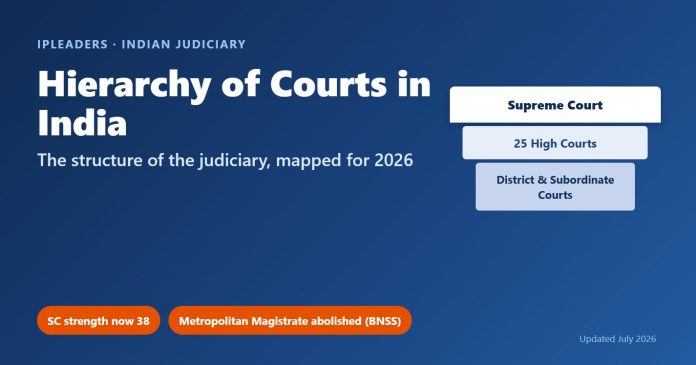
The short version: India has a single, integrated judiciary shaped like a pyramid. The Supreme Court of India sits at the apex. Below it are 25 High Courts, one for each state or group of states and union territories. At the base sit the district and subordinate courts, which split into a civil side (District Judge down to Civil Judge Junior Division) and a criminal side (Court of Session down to Judicial Magistrate, now governed by the BNSS). Running alongside this main structure are tribunals (such as the NCLT, NGT and CAT), and at the grassroots, Lok Adalats and Gram Nyayalayas. A case generally starts at the lowest competent court and can travel upward on appeal.
Below is how each tier works, what it can and can’t do, and where the 2026 changes bite.
What the hierarchy of courts means, and why it’s one pyramid
The single most important thing to understand about Indian courts is that they form one integrated system, not two parallel ones. In the United States, federal courts and state courts run as separate ladders with separate final courts. India rejected that model. The Constitution built a single hierarchy in which the Supreme Court sits above every High Court, and every High Court sits above the district and subordinate courts in its territory, so that one chain of authority runs from a taluka courtroom all the way to Delhi.
Why does that matter in practice? Because it means a law laid down by the Supreme Court binds every court in the country, and a litigant in the smallest civil court is ultimately under the same apex authority as a corporation arguing before a Constitution Bench. Article 141 of the Constitution puts it plainly: the law declared by the Supreme Court is binding on all courts within the territory of India. There is no state supreme court that can go its own way.
The pyramid has three main tiers. At the top, the Supreme Court. In the middle, the High Courts, which are the highest courts of the states. At the bottom, the district judiciary, which is where the overwhelming majority of cases are filed, heard and decided. This base tier is itself divided by subject: civil disputes go down one branch, criminal cases down another, and the two branches have different court names and different presiding officers even though they often sit in the same building.
Two other structures sit next to the pyramid rather than inside it. Tribunals are specialised bodies set up to decide particular kinds of disputes (company law, tax, environment, service matters) faster than ordinary courts can. And at the grassroots, alternative forums like Lok Adalats and Gram Nyayalayas handle settlement and small local matters. Neither replaces the main hierarchy; both feed into it, because appeals from tribunals and Lok Adalat references ultimately connect back to the High Courts and the Supreme Court.
| Tier | Court | Constitutional / statutory basis | Territory |
|---|---|---|---|
| Apex | Supreme Court of India | Article 124 | Whole of India |
| State | High Court (25 in total) | Article 214 | One or more states / UTs |
| District (civil) | District Court, Civil Judge (Sr & Jr Division) | State Civil Courts Acts, Articles 233 to 237 | District |
| District (criminal) | Court of Session, Judicial Magistrates | BNSS, 2023 (Sections 6 to 14) | Sessions division / district |
| Grassroots | Gram Nyayalayas, Lok Adalats | Gram Nyayalayas Act, 2008; Legal Services Authorities Act, 1987 | Village / local |
The reason the courts are ranked this way is not bureaucratic neatness. It’s error correction. Every rung above the trial court exists so that a mistake made below can be caught and fixed on appeal, while the court at the top exists to keep the law uniform across a country of 28 states and 8 union territories. Keep that logic in mind and the rest of the structure stops being a list to memorise and starts making sense.
The Supreme Court of India: the apex court
At the top of everything sits the Supreme Court of India, established under Article 124 of the Constitution and functioning from New Delhi. It is the final court of appeal, the guardian of the Constitution, and a court of record under Article 129, meaning its proceedings and judgments are recorded as conclusive evidence and it can punish for contempt of itself. When the Supreme Court finally decides a question of law, that question is, for practical purposes, settled for the entire country.
How many judges does it have? This is exactly where a stale guide will mislead you. For years the answer was 31, then 34 after the Supreme Court (Number of Judges) Amendment Act, 2019. As of 2026 the answer has changed again. On 16 May 2026, the President promulgated the Supreme Court (Number of Judges) Amendment Ordinance, 2026, raising the sanctioned strength from 34 to 38, that is, the Chief Justice of India plus 37 other judges. The government moved by ordinance ahead of Parliament (a Bill to the same effect had been cleared by the Union Cabinet on 5 May 2026 and is to be ratified in the monsoon session), citing a backlog of over 92,000 cases pending before the Court. So the current sanctioned strength is 38, with the confirming legislation pending. Worth flagging for anyone quoting a number in an exam or a pleading: cite it as “38 (raised by the May 2026 ordinance)” until the Bill is passed.
The Supreme Court’s real power lies in the breadth of its jurisdiction. It doesn’t only hear appeals. It can take certain disputes directly, advise the President, protect fundamental rights, and reach down into any case in the country through its discretionary appeal power.
| Jurisdiction | Source | What it covers |
|---|---|---|
| Original | Article 131 | Disputes between the Centre and states, or between states |
| Writ | Article 32 | Direct petitions to enforce fundamental rights |
| Appellate (constitutional, civil, criminal) | Articles 132, 133, 134 | Appeals from High Courts, on certificate |
| Special leave | Article 136 | Discretionary appeal from any court or tribunal (except armed forces tribunals) |
| Advisory | Article 143 | Opinion on a question of law referred by the President |
| Review | Article 137 | Power to review its own judgments |
The provision that does the heaviest lifting is Article 136, the special leave petition, or SLP. It lets the Supreme Court grant leave to appeal against virtually any judgment or order of any court or tribunal in India, which is how the Nagpur trader’s fabric dispute could, in theory, reach the same bench that hears constitutional challenges. The discretion is wide, and the Court uses it sparingly, but on paper it is the widest appellate net any court in the country casts.
Then there’s the function that sits above all of this: judicial review. The Supreme Court (and the High Courts) can strike down a law made by Parliament or a state legislature if it violates the Constitution. That power flows from the basic structure doctrine laid down in Kesavananda Bharati v. State of Kerala, (1973) 4 SCC 225, where a 13-judge bench held that Parliament cannot amend the Constitution so as to destroy its essential features, and that judicial review is one of those features. It is why the court at the apex is not merely the last stop for appeals, but the institution that polices the limits of the other two branches of government. For how this fits into the wider constitutional design, our explainer on the separation of powers traces the boundary lines.
High Courts: the top of the state judiciary
One rung down sit the High Courts, established under Article 214, which says there shall be a High Court for each state. In practice the map is tidier than that promise, because some High Courts serve more than one state or union territory. As of 2026 there are 25 High Courts in India. Each is a court of record under Article 215, headed by a Chief Justice, with a sanctioned number of other judges that varies by the size of the state and its caseload.
The number 25 is itself a recent fact. For a long while there were 24; the twenty-fifth, the Andhra Pradesh High Court at Amaravati, came into existence on 1 January 2019 when the common High Court for Andhra Pradesh and Telangana was bifurcated and a separate Telangana High Court was set up at Hyderabad. Any page still saying “24 High Courts” predates that split. The three oldest, at Calcutta, Bombay and Madras, were all established back in 1862, which is why you’ll sometimes see the Calcutta High Court described as the oldest in the country.
What can a High Court do that a district court can’t? Two big things. First, it has writ jurisdiction under Article 226, and here is a point most students get slightly wrong: the High Court’s writ power is actually wider than the Supreme Court’s. Article 32 lets the Supreme Court issue writs only to enforce fundamental rights, but Article 226 lets a High Court issue writs to enforce fundamental rights “and for any other purpose,” which includes ordinary legal rights. That “any other purpose” is why so much litigation against government action starts in the High Court. We cover the narrower apex-court version in detail in our piece on the writ jurisdiction of the Supreme Court.
Second, a High Court exercises superintendence over every court and tribunal within its territory under Article 227, and administrative control over the district judiciary under Article 235. In plain terms, the High Court supervises the courts below it, both on the judicial side (through appeals and revisions) and on the administrative side (through control over postings, discipline and the functioning of subordinate judges). The district courts don’t just appeal to the High Court; they answer to it.
Here is the full list as it stands in 2026, with the seat of each court and the territory it covers.
| High Court | Principal seat | Jurisdiction over |
|---|---|---|
| Allahabad | Prayagraj | Uttar Pradesh |
| Andhra Pradesh | Amaravati | Andhra Pradesh |
| Bombay | Mumbai | Maharashtra, Goa, Dadra & Nagar Haveli and Daman & Diu |
| Calcutta | Kolkata | West Bengal, Andaman & Nicobar Islands |
| Chhattisgarh | Bilaspur | Chhattisgarh |
| Delhi | New Delhi | NCT of Delhi |
| Gauhati | Guwahati | Assam, Nagaland, Mizoram, Arunachal Pradesh |
| Gujarat | Ahmedabad | Gujarat |
| Himachal Pradesh | Shimla | Himachal Pradesh |
| Jammu & Kashmir and Ladakh | Srinagar / Jammu | J&K and Ladakh (UTs) |
| Jharkhand | Ranchi | Jharkhand |
| Karnataka | Bengaluru | Karnataka |
| Kerala | Kochi | Kerala, Lakshadweep |
| Madhya Pradesh | Jabalpur | Madhya Pradesh |
| Madras | Chennai | Tamil Nadu, Puducherry |
| Manipur | Imphal | Manipur |
| Meghalaya | Shillong | Meghalaya |
| Orissa | Cuttack | Odisha |
| Patna | Patna | Bihar |
| Punjab & Haryana | Chandigarh | Punjab, Haryana, Chandigarh |
| Rajasthan | Jodhpur | Rajasthan |
| Sikkim | Gangtok | Sikkim |
| Telangana | Hyderabad | Telangana |
| Tripura | Agartala | Tripura |
| Uttarakhand | Nainital | Uttarakhand |
District and subordinate courts: where most cases begin
Below the High Courts lies the district judiciary, and this is where the system actually meets the citizen. More than 80% of all pending cases in India sit in these courts, not in the High Courts or the Supreme Court. If you file a suit or a first information report leads to a charge, this is almost always where it begins. The district judiciary divides into two branches, civil and criminal, and it helps to take them one at a time.
The civil courts hierarchy
Civil courts decide disputes about money, property, contracts, family matters, injunctions and the like. Their structure is set not by a single central law but by each state’s civil courts legislation, so the exact names and pecuniary limits vary a little from state to state. The broad ladder, though, is consistent across the country.
At the top of the district civil structure is the District Judge, who presides over the District Court and hears the most valuable suits and the appeals from courts below. Alongside sit Additional District Judges, who exercise the same powers to share the load. Below them is the Court of the Civil Judge (Senior Division), which handles civil suits above a certain value, and below that the Court of the Civil Judge (Junior Division), which handles suits of lower value. Many states also run Courts of Small Causes for quick disposal of low-value money claims. The appointment and control of these judges is governed by Articles 233 to 237 of the Constitution, with the High Court in charge of the district judiciary.
What separates one civil court from the next is jurisdiction, and jurisdiction comes in three flavours worth knowing. Pecuniary jurisdiction is about the value of the suit: a low-value claim goes to the Junior Division, a higher-value one to the Senior Division or the District Court, with the cut-offs fixed by state law. Territorial jurisdiction is about place: you file where the cause of action arose or where the defendant resides. Subject-matter jurisdiction is about type: some disputes are reserved for special courts (a rent matter, a family dispute) and can’t be filed in an ordinary civil court at all. Get any of the three wrong and your plaint can be returned before it’s even heard.
The criminal courts hierarchy under the BNSS
Now, here’s where the 2026 changes matter most. The criminal courts used to be constituted under the Code of Criminal Procedure, 1973. Since 1 July 2024 they are constituted under the Bharatiya Nagarik Suraksha Sanhita, 2023 (“BNSS”). Section 6 of the BNSS lists the classes of criminal courts in every state, and the list is shorter than it used to be: Courts of Session; Judicial Magistrates of the first class; Judicial Magistrates of the second class; and Executive Magistrates.
Notice what’s missing. Under the old CrPC, cities with a population over one million were designated “metropolitan areas” and had their own tier of Metropolitan Magistrates and a Chief Metropolitan Magistrate. The BNSS abolished that distinction entirely. There are no Metropolitan Magistrates any more. Whether a case arises in Mumbai or in a rural tehsil, the magistrate hearing it is now a Judicial Magistrate of the first or second class. This is the single biggest structural change to the court hierarchy in decades, and it’s the clearest tell that a guide hasn’t been updated: if it still lists a Chief Metropolitan Magistrate, it’s describing a court that no longer exists.
The criminal ladder, from top to bottom, now runs like this. The Court of Session, established for each sessions division under Section 8, is the senior trial court for serious offences. The Chief Judicial Magistrate heads the magistracy in each district, with Additional Chief Judicial Magistrates to assist. Below sit the Judicial Magistrates of the first class (JMFC) and second class (JMSC). Separately, Executive Magistrates under Section 14 (the District Magistrate, Sub-Divisional Magistrates and others) handle preventive and administrative functions like maintaining public order, not trials.
Each court can only pass sentences up to a ceiling set by the BNSS, and those ceilings changed too. The fine limits in particular went up, so a guide quoting the old CrPC figures will understate them.
| Criminal court | Governing section (BNSS) | Maximum sentence it can pass |
|---|---|---|
| Court of Session / Sessions Judge | Section 21 | Any sentence authorised by law, including death (a death sentence needs High Court confirmation) |
| Additional Sessions Judge | Section 21 | Same as Sessions Judge |
| Assistant Sessions Judge | Section 22 | Up to 10 years’ imprisonment, and fine |
| Chief Judicial Magistrate | Section 23 | Any sentence except death, life, or imprisonment over 7 years |
| Judicial Magistrate first class | Section 23 | Up to 3 years, or fine up to ₹50,000, or both, or community service |
| Judicial Magistrate second class | Section 23 | Up to 1 year, or fine up to ₹10,000, or both, or community service |
That last column carries another 2026 novelty: community service. The BNSS introduced it as a formal punishment, defined as work a convict is ordered to do for the benefit of the community without any payment. It’s a genuinely new sentencing option that the CrPC never had, and it now sits in the statutory toolkit of every magistrate. For a fuller walk-through of what these criminal courts actually do case by case, see our detailed guide to the powers and hierarchy of criminal courts in India, and for how a prosecution moves through them, the stages of a criminal trial under the BNSS.
How a case climbs the ladder: appeals, revisions and references
A hierarchy is only meaningful if cases can move through it, so how exactly does a matter travel from the bottom of the pyramid toward the top? Through three mechanisms: appeals, revisions and references. Understanding the difference is what separates someone who knows the court system from someone who has merely memorised its floor plan.
An appeal is a full re-hearing of a case by a higher court, on both facts and law (for a first appeal) or usually on law alone (for a second appeal). The fabric-trader example from the start is a chain of appeals. His suit was decided by the Civil Judge (Senior Division); his first appeal went to the District Court, which could re-examine the facts; his second appeal went to the Bombay High Court under Section 100 of the Code of Civil Procedure, 1908, which could intervene only on a substantial question of law. On the criminal side, an appeal from a conviction by a magistrate typically goes to the Court of Session, and from the Court of Session to the High Court.
A revision is narrower. It’s a supervisory look by a higher court (the Sessions Court or the High Court) to check that the court below acted within its jurisdiction and didn’t commit a gross illegality. You can’t use a revision to re-argue the facts. It’s a correction tool, not a second bite at the merits.
A reference is when a lower court itself sends a question up, usually a doubt about the constitutional validity of a law, for the higher court to answer before the case proceeds. Add to these the Supreme Court’s special leave power under Article 136, which lets it pull up almost any matter from anywhere, and you have the full set of channels through which the pyramid stays connected. The general rule is simple: start at the lowest court competent to hear the matter, and move up only when the law gives you a route.
Tribunals: the parallel judicial system
Not every dispute goes through the ordinary courts. Since the 1980s, India has built a parallel network of tribunals: specialised, quasi-judicial bodies designed to decide narrow categories of disputes with subject expertise and (in theory) more speed than a crowded civil court can offer. They were given constitutional backing by Articles 323A and 323B, inserted by the 42nd Amendment, and today they’re governed largely by the Tribunals Reforms Act, 2021, which standardised the tenure and service conditions of their members.
The list is long, and each tribunal owns a slice of litigation that would otherwise sit in the regular courts. The National Company Law Tribunal (NCLT) and its appellate body the NCLAT handle company law and insolvency. The National Green Tribunal (NGT) decides environmental disputes. The Central Administrative Tribunal (CAT) hears service matters of central government employees. Debt Recovery Tribunals (DRTs) and Debt Recovery Appellate Tribunals (DRATs) deal with bank recovery. Others include the Securities Appellate Tribunal (SAT), the Income Tax Appellate Tribunal (ITAT), the Customs, Excise and Service Tax Appellate Tribunal (CESTAT), the Armed Forces Tribunal (AFT), and the GST Appellate Tribunal (GSTAT).
So where do tribunals sit in the hierarchy? This was fought out in the Supreme Court, and the answer is settled. In L. Chandra Kumar v. Union of India, (1997) 3 SCC 261, a seven-judge bench held that tribunals cannot oust the judicial review power of the High Courts under Articles 226 and 227, or of the Supreme Court under Article 32, because that power is part of the Constitution’s basic structure. Tribunals can supplement the courts, but they can’t replace the constitutional courts standing above them. The independence of tribunals was reinforced in Union of India v. R. Gandhi, (2010) 11 SCC 1, which upheld the NCLT and NCLAT but laid down strict conditions to keep them free of executive control. The practical takeaway: a tribunal’s decision isn’t the end of the road, because it still connects upward to a High Court or the Supreme Court.
The tribunal system has been under visible strain lately. In March 2026 the Supreme Court had to step in and allow the Union government to extend the tenures of tribunal chairpersons and members until 8 September 2026, after bar associations warned that bodies like the CAT, NCLT, NCLAT and GSTAT were heading toward dysfunction because members were retiring faster than replacements were being appointed. It’s a reminder that a specialised court is only as functional as the appointments that keep it staffed. If you ask us, the recurring vacancy crisis is the biggest practical weakness of the tribunal model, not the design itself.
Specialised and grassroots courts
Between the ordinary civil and criminal courts and the tribunals, India runs a set of specialised courts for particular subjects, plus a grassroots tier meant to deliver justice closer to where people actually live. These don’t sit neatly on the main pyramid, but you can’t map the judiciary honestly without them.
On the specialised side, several forums exist because Parliament decided certain disputes needed dedicated benches. Family Courts, set up under the Family Courts Act, 1984, handle divorce, maintenance, custody and related matrimonial disputes. Commercial Courts, created by the Commercial Courts Act, 2015, fast-track high-value business disputes at the district and High Court level. Consumer Disputes Redressal Commissions, under the Consumer Protection Act, 2019, run a three-tier structure of their own (District, State and National Commissions) for consumer complaints. And across the country, Fast Track Special Courts and dedicated POCSO courts have been set up to speed up trials of sexual offences, alongside special courts for NIA and CBI cases.
At the grassroots, the aim shifts from adjudication to access and settlement. Lok Adalats, organised under the Legal Services Authorities Act, 1987, bring parties together to settle disputes by compromise, and a settlement reached there has the force of a civil court decree with no appeal against it. Permanent Lok Adalats handle certain public utility disputes. Gram Nyayalayas, established under the Gram Nyayalayas Act, 2008, are mobile village-level courts intended to take justice to rural India, though their rollout across states has been uneven. These forums take pressure off the base of the pyramid, but they operate under it, not outside it: a matter that can’t be settled at a Lok Adalat simply returns to the regular court.
Does a citizen need to track all of this? Not really. But knowing that a rent dispute, a consumer complaint and a matrimonial matter each have a purpose-built forum can save months of filing in the wrong place, which is the most common and most avoidable mistake in Indian litigation.
Who staffs these courts, and how they are appointed
A structure is only as good as the people in it, so who becomes a judge, and how? The answer differs sharply between the higher judiciary and the district judiciary, and the difference is one of the more contested features of the Indian system.
Judges of the Supreme Court and the High Courts are appointed by the President under Articles 124 and 217, but the effective power to select them lies with the collegium: the Chief Justice of India and the senior-most judges of the Supreme Court, and, for High Court appointments, the collegium in consultation with the relevant Chief Justice. This system wasn’t written into the Constitution; it was built by the Supreme Court through a series of rulings, notably the Supreme Court Advocates-on-Record Association v. Union of India cases. When Parliament tried to replace it with a National Judicial Appointments Commission in 2014, the Supreme Court struck that down in 2015 as a threat to judicial independence, and the collegium survived. Love it or criticise it, the collegium is how the top two tiers are filled.
The district judiciary is recruited very differently: through competitive examinations conducted by state public service commissions and High Courts. Fresh law graduates can typically enter as Civil Judge (Junior Division) through the judicial services examination, while experienced advocates can be recruited directly as District Judges under Article 233. In a significant 2025 ruling, the Supreme Court restored the requirement that candidates have a minimum of three years’ practice as an advocate before they can sit the entry-level judicial services exam, reversing a two-decade-old position that had allowed fresh graduates to apply directly. If a judicial career is what you’re after, our guide on how to become a civil judge in India walks through the eligibility, the exam and that three-year rule in detail.
The gap between the two systems is stark, and it’s worth sitting with. The higher judiciary essentially appoints itself through the collegium, insulated from the executive, while the district judiciary is recruited through open examinations and then controlled administratively by the High Courts under Article 235. One route prizes independence at the top; the other prizes merit-based entry at the base. Both feed the same pyramid.
Common points of confusion
A few things about the court hierarchy trip people up again and again, including law students who should know better. Worth clearing them up directly.
Is the District Court the same as the Sessions Court? Effectively yes, but wearing two hats. The same senior judge at the district headquarters presides over the District Court when hearing civil matters and is called the District Judge, and over the Court of Session when hearing serious criminal matters, where the title becomes Sessions Judge. Same person, same building, different jurisdiction depending on whether the case is civil or criminal. The names confuse people into thinking these are two separate courts on different rungs. They aren’t.
What’s the difference between Article 32 and Article 226? Both are writ powers, but Article 32 is a fundamental right in itself and can only be used to enforce other fundamental rights, and only before the Supreme Court. Article 226 is a constitutional power of the High Courts, and it’s broader, because it covers fundamental rights “and any other purpose,” meaning ordinary legal rights too. Practically, that’s why a huge volume of litigation against the state begins in the High Court rather than the Supreme Court.
Is a tribunal a court? Not in the strict sense. A tribunal is a quasi-judicial body created by statute for a specific subject, and while it decides disputes like a court, it isn’t part of the regular civil or criminal court hierarchy and its members aren’t always career judges. As L. Chandra Kumar settled, tribunals remain subject to the writ jurisdiction of the High Courts, which sit above them.
And the one that catches everyone in 2026: is there still a Metropolitan Magistrate? No. The BNSS abolished the metropolitan magistracy when it replaced the CrPC on 1 July 2024. If a form, a website or a textbook still refers to a Chief Metropolitan Magistrate, it’s out of date. Every magistrate is now a Judicial Magistrate of the first or second class, regardless of city size.
Frequently asked questions
What is the hierarchy of courts in India?
India has a single integrated judiciary with three main tiers: the Supreme Court of India at the top, 25 High Courts at the state level, and district and subordinate courts (civil and criminal) at the base. Tribunals and grassroots forums like Lok Adalats and Gram Nyayalayas run alongside this structure. A case generally starts at the lowest competent court and moves up on appeal.
How many courts are there at the top of the hierarchy?
There is one apex court, the Supreme Court of India, in New Delhi. Below it are 25 High Courts as of 2026, the newest being the Andhra Pradesh High Court at Amaravati, created on 1 January 2019.
How many judges does the Supreme Court of India have in 2026?
The sanctioned strength is 38 (the Chief Justice of India plus 37 other judges), raised from 34 by the Supreme Court (Number of Judges) Amendment Ordinance promulgated on 16 May 2026. A confirming Bill, cleared by the Cabinet on 5 May 2026, is pending in Parliament.
What is the highest court in a state?
The High Court is the highest court in a state (or, in several cases, a group of states and union territories). It has writ jurisdiction under Article 226, appellate jurisdiction over the district courts, and supervisory control over all courts and tribunals in its territory under Articles 227 and 235.
What are the different levels of courts under the district judiciary?
On the civil side: District Judge and Additional District Judge, then Civil Judge (Senior Division), then Civil Judge (Junior Division), plus Courts of Small Causes. On the criminal side under the BNSS: Court of Session, then Chief Judicial Magistrate, then Judicial Magistrate first class and second class, with Executive Magistrates handling preventive functions.
Did the BNSS change the hierarchy of criminal courts?
Yes. The Bharatiya Nagarik Suraksha Sanhita, 2023, in force since 1 July 2024, abolished the Metropolitan Magistrate class entirely. Criminal courts are now uniformly classified as Courts of Session, Judicial Magistrates of the first and second class, and Executive Magistrates, with no separate metropolitan magistracy in large cities.
What is the difference between a court and a tribunal?
Courts are part of the general judicial hierarchy and decide all kinds of disputes; tribunals are specialised statutory bodies that decide a narrow category (company law, tax, environment, service matters). Tribunals are quasi-judicial and remain subject to the writ jurisdiction of the High Courts, as held in L. Chandra Kumar v. Union of India (1997).
Where do most cases in India get filed?
In the district and subordinate courts. More than 80% of all pending cases in India are at this level, not in the High Courts or the Supreme Court. The district judiciary is where the ordinary citizen almost always encounters the court system first.
Can you appeal directly to the Supreme Court?
Only in limited situations. Most matters reach the Supreme Court by appeal from a High Court, or by a special leave petition under Article 136, which is discretionary. You can also approach the Supreme Court directly under Article 32 to enforce a fundamental right, and it has original jurisdiction under Article 131 for Centre-state disputes.
Are Lok Adalats and Gram Nyayalayas part of the court hierarchy?
They operate under it rather than as separate rungs. Lok Adalats (under the Legal Services Authorities Act, 1987) settle disputes by compromise, and their awards have the force of a civil decree. Gram Nyayalayas (under the Gram Nyayalayas Act, 2008) are village-level courts. Matters they can’t resolve return to the regular courts.
References
Case law
- Kesavananda Bharati v. State of Kerala, (1973) 4 SCC 225 – 13-judge bench; basic structure doctrine; judicial review as an essential feature.
- L. Chandra Kumar v. Union of India, (1997) 3 SCC 261 – 7-judge bench; tribunals cannot exclude the writ jurisdiction of the High Courts and Supreme Court.
- Union of India v. R. Gandhi, (2010) 11 SCC 1 – constitutional validity of the NCLT and NCLAT; conditions for tribunal independence.
Statutes and Constitution
- Constitution of India – Articles 32, 124, 129, 131 to 137, 141, 143, 214 to 217, 226, 227, 233 to 237, 323A, 323B.
- Bharatiya Nagarik Suraksha Sanhita, 2023 – Sections 6 to 14 (constitution of criminal courts), 21 to 23 (sentencing powers).
- Supreme Court (Number of Judges) Amendment Ordinance, 2026 – sanctioned strength raised to 38 (Gazette notification, 16 May 2026).
- Tribunals Reforms Act, 2021; Legal Services Authorities Act, 1987; Gram Nyayalayas Act, 2008; Commercial Courts Act, 2015; Family Courts Act, 1984; Consumer Protection Act, 2019.
This article is for informational and educational purposes only and does not constitute legal advice. Court structures, judge strengths and statutory provisions change; verify the current position with the relevant statute, official notification or a qualified advocate before relying on it for any specific matter.