


Last verified: June 2026
The Income-tax Act, 1961 was amended close to 65 times over six decades. Every Budget bolted on a proviso here, an Explanation there, a new clause squeezed into an already crowded section. By the time the new Income Tax Act 2025 arrived to replace it, the old statute had swelled to 819 sections, become one of the most litigated laws in the country, and turned into a maze that even seasoned chartered accountants navigated with a commentary open beside them. If you have ever tried to read Section 10 of the 1961 Act in one sitting, you know the feeling.
So Parliament did something it had tried, and failed, to do twice before.
The first attempt was the Direct Taxes Code. Drafted in 2009, tabled as a Bill in 2010, it promised a clean rewrite of direct tax law in plain language. It never made it. A change of government, a delayed Standing Committee report, and a fair bit of criticism (one common complaint was that the draft Code had become almost as complex as the Act it was meant to replace) left it to lapse quietly. For more than a decade after that, the idea of replacing the 1961 Act sat on the shelf.

The second attempt came in February 2025. The government introduced an Income-tax Bill, sent it to a Select Committee, and waited. The Committee came back with 285 recommendations. Rather than amend the Bill piecemeal on the floor of the House, the government did something unusual: it withdrew that Bill entirely and brought back a revised version that folded in the Committee’s suggestions.
That revised version is now law. It passed the Lok Sabha on 11 August 2025, cleared the Rajya Sabha the next day, and received Presidential assent on 21 August 2025 as Act 30 of 2025. It comes into force on 1 April 2026, and the first Tax Year under it runs 2026-27. Let’s be clear about one thing, because the confusion is everywhere online: this is no longer a Bill. It is an Act, and it is in force from the start of the next financial year.
Which brings us to the questions you actually came here with. Did your taxes change? What is the new section number for 80C, the one you have typed into return forms for years? And if you have a pending appeal or an assessment for an earlier year, which Act governs it now? This article answers all three, plus it gives you a confidence-flagged 1961-to-2025 section mapper, because (fair warning) a lot of the mappers floating around the internet were built off the withdrawn February Bill and quietly contradict each other.
Here’s the thing most coverage gets wrong, and we’ll spend real time on it: the headline-grabbing capital-gains numbers people keep attributing to this Act did not come from this Act at all.
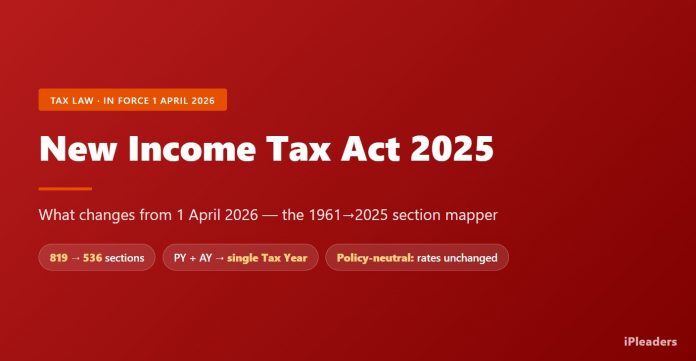
The Income-tax Act, 2025 (Act 30 of 2025) replaces the 1961 Act from 1 April 2026. It cuts 819 sections to 536 across 23 chapters and 16 schedules, replaces “previous year” and “assessment year” with a single “Tax Year”, and is policy-neutral: no new taxes, no change to rates, slabs, or regimes. Both the old and new tax regimes continue exactly as before.
Below, we walk through what the Act is, what genuinely changed, what stayed the same, the section mapper with honest confidence flags, the transition rules for your pending matters, and the long road that got India here. Use the table of contents to jump to what you need.
What is the Income Tax Act 2025 (and why it is an Act, not a Bill)
Walk into any tax discussion online right now and you’ll find people still calling this a “Bill”. That confusion is understandable, given that a Bill by the same name was introduced and then pulled in early 2025. But it matters which word you use, because a Bill binds no one and an Act binds everyone. So which is it?
It is an Act. The new Income Tax Act 2025 is formally the Income-tax Act, 2025, notified as Act 30 of 2025. It received Presidential assent on 21 August 2025 and comes into force on 1 April 2026. From that date, it replaces the Income-tax Act, 1961 as the governing statute for direct taxation in India. The first Tax Year under the new law is 2026-27.
Act 30 of 2025: the dates that matter
Three dates anchor everything that follows. The Act was passed by the Lok Sabha on 11 August 2025 and by the Rajya Sabha on 12 August 2025. Presidential assent followed on 21 August 2025. And the commencement date, the one you actually need to remember, is 1 April 2026. Income earned from that date onward falls under the 2025 Act; income earned before it stays under the 1961 Act (more on that in the transition section below).
For the official record, you can read the government’s commencement announcement and the Income-tax Department’s objective-and-scope note, which lays out the rationale in the Department’s own words.
Is it a Bill or an Act now?
Short answer: it’s an Act. The February 2025 Income-tax Bill was withdrawn precisely so that the Select Committee’s 285 recommendations could be absorbed into a clean, revised text rather than patched in through floor amendments. What you see now is that revised text, passed and assented to. If a website, a video, or a forum post is still describing the 2025 law as a “Bill awaiting passage”, it is out of date. The legislative process is finished.
In practice, though, the word “Bill” will linger in casual conversation for a while, the same way people said “the new GST Bill” long after GST became law in 2017. Don’t let the loose usage mislead you on a compliance question. When you cite the law, cite the Act.
Where to download the official Income Tax Act 2025 PDF
For anything load-bearing, go to the source. The authoritative text sits on the Income Tax Department’s website: the official Income Tax Act 2025 page hosts the bare Act, and there is already a consolidated version, the Act PDF as amended by the Finance Act 2026. That second document is worth flagging on its own. Its very existence tells you something about how the law now works.
Here’s what experienced practitioners already know and what casual readers usually miss: from now on, the annual Finance Act amends the 2025 Act, not the 1961 Act. The Budget still changes rates and tweaks policy every year, but those changes ride on top of this new base statute. That’s why an “as amended by Finance Act 2026” PDF exists before the Act has even been in force for a full year. A common question people raise is whether the old 1961 Act now becomes a dead document overnight. It doesn’t, and the reason is the entire subject of the transition section: your past income still lives under it.
There’s a second-order effect worth naming early. Every textbook, every ERP tax module, every precedent and template that cites a 1961 section number now needs migration. That quiet, expensive housekeeping task is the part of this reform that nobody legislated for, and we come back to it later.
At a glance: the Income Tax Act 2025 vs 1961 in numbers
Before getting into what changed in substance, it helps to see the scale of the structural cleanup. The numbers tell a clear story: this was a consolidation and decluttering exercise, not a policy overhaul. How much smaller did the statute actually get?
Quite a bit smaller on paper. The table below compares the 1961 Act with the 2025 Act on the structural metrics that matter for anyone who has to read, cite, or teach the law.
| Metric | Income-tax Act, 1961 | Income-tax Act, 2025 |
|---|---|---|
| Sections | 819 | 536 |
| Chapters | 23 (with many sub-chapters, e.g. XII-A, XIV-A) | 23 |
| Schedules | 14 | 16 |
| Rules (associated) | ~511 | ~333 |
| Forms (associated) | ~399 | ~190 |
| Time concept | Previous year + Assessment year | Single “Tax Year” |
| Drafting style | Long sections, cross-references, provisos | Shorter sections, tables and formulae inside the Act |
A few of these rows deserve a sentence of their own, because the raw numbers can mislead.
The section count fell from 819 to 536. That’s roughly a third gone, and it is the figure you’ll see quoted most often. But fewer sections does not mean less law. A lot of content didn’t vanish; it moved. Detail that used to sprawl across sub-sections and provisos now sits in schedules and in tables embedded directly in the Act. The schedule count actually went up, from 14 to 16, precisely because material was relocated there.
The chapter count is the one number to read carefully. Both Acts are organised into 23 chapters, so this isn’t a case of chapters being halved. What changed is that the 1961 Act’s 23 chapters had sprouted dozens of sub-chapters over the decades (XII-A, XII-B, XIV-A and so on), and the 2025 Act regroups overlapping themes into a single, cleaner sequence without that accretion. The associated rules and forms were trimmed hard too: rules from around 511 to 333, forms from roughly 399 to 190. If you have ever hunted for the right ITR annexure, that form reduction is the change you’ll feel most directly at filing time.
Here’s where the common misreading creeps in. People see “819 down to 536” and assume the law was rewritten in substance. It wasn’t. The renumbering is real, but renumbering is not rewriting. The better way to read this table, in our view, is as a map being redrawn, not the territory being changed. Same roads, new labels, fewer dead ends. The pitfall is treating a new section number as a new rule. It usually isn’t.
Tax Year: the one concept that replaces “previous year” and “assessment year”
For decades, the single most confusing thing about Indian income tax for ordinary taxpayers wasn’t the rates. It was the calendar. The 1961 Act made you juggle two overlapping time concepts: the “previous year” in which you earned the income, and the “assessment year” in which it was taxed. Plenty of people filed under the wrong year, picked the wrong ITR, or simply gave up trying to understand why their 2023-24 income was an “AY 2024-25” matter. Did the 2025 Act fix this?
It did, and it’s arguably the cleanest single improvement in the whole statute. The 2025 Act replaces both “previous year” and “assessment year” with one term: Tax Year. A Tax Year is the 12-month period of the financial year, running 1 April to 31 March. One period. One label. The income you earn in a Tax Year is taxed by reference to that same Tax Year.
What “Tax Year” means
Think of it this way. Under the old system, money you earned in financial year 2024-25 (the “previous year”) was assessed in 2025-26 (the “assessment year”), and you had to keep both straight. Under the 2025 Act, that income simply belongs to a Tax Year, full stop. The conceptual double-counting is gone. This is the kind of change that sounds trivial to a tax professional and lands as a genuine relief for everyone else.
Tax Year vs Financial Year: are they the same?
In effect, yes, and that’s the point. The Tax Year is aligned to the financial year, 1 April to 31 March. So if you’ve always thought in terms of “FY 2026-27”, you can keep doing exactly that; the Tax Year for that period is 2026-27. There’s no new fiscal calendar to learn. The Act took the year you already used for everything else, salary, GST, accounts, and made it the single tax reference point too.
How Tax Year works for a newly set-up business or a new source of income
There’s one wrinkle worth knowing, and it answers a question new founders ask constantly. What if your business or income source didn’t exist on 1 April? Per the Department’s own FAQ, for a newly set-up business or a newly arising source of income, the first Tax Year begins on the date of set-up (or the date the source comes into existence) and ends with that same financial year, on 31 March. So a consultancy that registers on 1 September 2026 has a first Tax Year running 1 September 2026 to 31 March 2027. After that, it follows the normal April-to-March cycle.
What happened to “previous year” and “assessment year”
Both terms are retired. You won’t find “previous year” or “assessment year” doing any work in the 2025 Act’s operative provisions; “Tax Year” carries the load. A common question practitioners raise is whether the two old terms vanish from practice overnight. Not quite, and here’s the nuance most guides skip. Your filings, appeals, and assessments for periods before 1 April 2026 still live under the 1961 Act, and that Act still speaks the language of previous year and assessment year. So “AY 2025-26” remains a perfectly valid, indeed necessary, phrase when you’re dealing with old years. The terminology change is forward-looking; it doesn’t reach back and rename your history.
The mistake we see most often, even among careful taxpayers, is assuming the Tax Year change is retrospective. It isn’t. Use “Tax Year” for income from 1 April 2026 onward, and keep using “previous year / assessment year” for everything before it. Mixing the two on the wrong period is the easiest way to file under the wrong head.
Did tax rates or slabs change? The capital-gains myth, debunked
Something strange happened in the months before this Act even came into force. A story spread, across WhatsApp forwards, finance reels, and more than a few articles, that the “new Income Tax Act 2025” had jacked up capital gains tax, killed indexation, and stretched holding periods. People braced for a hit. The trouble is, almost all of that attribution was wrong. So what did the 2025 Act actually do to your tax bill?
Nothing. The 2025 Act is policy-neutral. It imposes no new tax, changes no rate, alters no slab, and touches neither the old nor the new tax regime. This was a deliberate design choice and the government said so plainly: the exercise was about simplifying the structure of the law, not changing the tax burden. If your tax outgo changes in 2026-27, it’ll be because of the annual Budget, not because of this Act.
The 2025 Act is policy-neutral
Let’s be honest about why this needs spelling out. A statute that shrinks from 819 sections to 536 sounds like it must have changed a lot of substance. But the whole pitch of this reform was the opposite: keep the policy stable, fix the presentation. Rates, slabs, both regimes, the basic charging logic, all carried over. The Act renumbered and reorganised; it did not re-tax.
Where the capital-gains confusion actually comes from
Here’s the real source of the myth, and it’s worth getting precise. The capital-gains changes everyone’s been talking about, a 12.5% rate on long-term capital gains, a roughly 20% rate on short-term gains on specified securities, a reworked 12-month and 24-month holding-period framework, and the rollback of indexation on certain assets, are all real and all in force. But they came from the Finance (No. 2) Act 2024, not from the Income Tax Act 2025. They predate this Act by a year. The 2025 Act simply carries them forward in its renumbered structure.
So the honest framing is this. The claim “the 2025 Act raised capital gains tax” is false. The claim “those higher capital-gains rates don’t exist” is also false. Both rates exist and both predate the new Act. What the 2025 Act did was inherit them, the way a new house inherits the plumbing that was already installed. If you want the substantive picture of how listed shares are taxed, our explainer on long-term capital gains on listed shares under Section 112A walks through the actual provision rather than the rumour.
There’s a second-order effect here that keeps the myth alive. A good chunk of privacy and finance commentary bundles the Finance Act 2024 rates together with the new Act and presents them as one package. Once that wrong attribution gets repeated enough, it becomes “common knowledge”. If you take one thing from this section, take this: separate the Budget from the base Act. They are different instruments doing different jobs.
Is crypto or VDA newly taxed?
No. The 30% tax on virtual digital assets (VDAs), the flat regime that hit crypto investors hard, predates this Act. The 2025 Act doesn’t introduce a new crypto tax. What it does do is house the VDA definition cleanly within the statute and bring VDAs into the “undisclosed income” framework for search-and-seizure purposes, which we cover in the substantive-changes section. So the rate isn’t new; the placement and the enforcement treatment are tidied up. A practical reality worth flagging: if you trade crypto, your tax position in 2026-27 looks like your tax position before it. The headline rate didn’t move.
MAT: did it change?
Here’s the precise position, because this is one place where the base Act and the annual Budget genuinely diverge. As enacted, the Income Tax Act 2025 carried Minimum Alternate Tax (MAT) forward at 15% of book profit under Section 206, the same rate that applied under the 1961 Act. The drop to 14% is not a feature of the base 2025 Act; it came through the Finance Act 2026, which amended Section 206 to reduce the MAT rate from 15% to 14% with effect from 1 April 2026 (Tax Year 2026-27). So both statements you’ll see online are partly right and partly wrong: MAT under the bare 2025 Act is 15%, but the operative rate for Tax Year 2026-27, after the Finance Act 2026 amendment, is 14%. This is a clean illustration of the point we keep making, that the Budget now amends the 2025 Act on top of the base text. For a corporate computation, use 14% for 2026-27 and confirm against the Act PDF as amended by the Finance Act 2026.
What genuinely stayed the same under the Income Tax Act 2025
After all the talk of renumbering, a fair worry sets in for the salaried reader: if 819 sections became 536, did some of my deductions get quietly deleted? It’s a reasonable fear. It’s also, mostly, unfounded. So what survived the rewrite intact?
A great deal. The 2025 Act preserved the substance of the tax system almost entirely. Here is what did not change:
- Tax rates and slabs (no increase, no new band)
- Both the old regime and the new regime continue
- The standard deduction for salaried taxpayers
- HRA exemption and the major salary-related exemptions
- Section 80C, 80D, and 80G deductions in substance (renumbered, not removed)
- Your PAN, TAN, and existing registrations and approvals
- Old circulars, notifications, and CBDT clarifications (subject to transition)
- The five heads of income (salary, house property, business or profession, capital gains, other sources)
Old regime and new regime: both continue
The single biggest reassurance for most filers is this: you still choose between the two regimes exactly as you did before. The 2025 Act didn’t abolish one or merge them. The new regime stays the default-leaning, lower-deduction option; the old regime stays the deduction-heavy alternative. Your regime decision for 2026-27 works on the same logic it did for 2025-26.
Standard deduction, HRA, and the major deductions still apply
The salaried staples are intact. The standard deduction is still there. HRA exemption still works the way it did. And the deductions you’ve claimed for years, 80C for your investments and EPF, 80D for health insurance, 80G for donations, all survive in substance. What changed is the address, not the entitlement. 80C now lives at a new section number (we map it precisely in the next section), but the relief it gives is the same.
Your PAN, registrations, approvals, and old circulars remain valid
You don’t need a new PAN. You don’t need to re-register your trust, re-apply for an existing approval, or treat old CBDT circulars as suddenly void. The transition provisions are designed for continuity: things validly done under the 1961 Act carry over. On the continued validity of old departmental circulars, the principle has long been settled in cases like UCO Bank v. Commissioner of Income Tax, (1999) 4 SCC 599, where the Supreme Court held that beneficial CBDT circulars bind the Revenue, and that logic supports reading the transition generously rather than as a clean break.
Here’s the pitfall, and it catches careful people. Don’t assume a deduction is gone just because the section number changed. We’ve already seen taxpayers panic-search “is 80C abolished” simply because the familiar number didn’t appear where they expected it. It wasn’t abolished. It was renumbered. Confirm the new number (next section) before you conclude anything has been taken away.
The 1961→2025 section mapper (with confidence flags and the official utility)
This is the section you probably scrolled here for. You know Section 80C, Section 44AB, Section 139 the way you know your own phone number, and now they’ve all moved. The natural question is simple: what’s my new number? The honest answer is a little more complicated, because not every mapping is equally certain, and we’re going to be upfront about which ones you can trust and which ones you should verify.
The table below maps the most-searched 1961 sections to their 2025 counterparts, with a confidence flag on each row. HIGH means the mapping is well-established and you can rely on it. HEDGED means sources differ or the relocation is more complex than a one-to-one swap, so confirm before citing.
| Old (1961) section | New (2025) section | What it covers | Confidence |
|---|---|---|---|
| Section 4 | Section 4 | Charge of income tax | HIGH |
| Section 6 | Section 6 | Residence in India | HIGH |
| Section 44AB | Section 63 | Tax audit | HIGH |
| Section 80C | Section 123 | Deductions for investments, EPF, LIC | HIGH |
| Section 80G | Section 133 | Deduction for donations | HIGH |
| Section 80TTA / 80TTB | Section 153 (merged) | Interest deduction (savings / senior citizens) | HIGH |
| Section 87A | Section 156 | Rebate for small taxpayers | HIGH |
| Section 139 | Section 263 | Return of income | HIGH |
| Section 80D | Section 126 | Health insurance deduction | HEDGED |
| Section 54 / 54F | Section 82 / 86 | Capital-gains exemption on reinvestment | HEDGED |
| Section 10 exemptions | Schedules (II to VII) | Exempt incomes (not one new section) | HEDGED |
| Salary / house property / PGBP / capital gains | Re-grouped section ranges | Heads of income | HEDGED |
How to read this mapper
The confidence flag is the whole point of this table, so read it before you read the numbers. HIGH-confidence rows are stable: multiple sources agree, and the mapping is a clean one-to-one. HEDGED rows are where we’d urge caution. Either the sources disagree, or the old provision didn’t move to a single new section but was split, merged, or relocated into schedules. For HEDGED rows, treat the new number as a strong lead, not a final answer, and verify it on the official utility before you put it in a filing or a brief.
High-confidence section migrations
The ones you can lean on: the charge of income tax stays at Section 4 and residence stays at Section 6 (these two kept their familiar numbers in the new Act); tax audit Section 44AB becomes Section 63; the return of income under Section 139 becomes Section 263. On the deductions side, 80C becomes Section 123, 80G becomes Section 133, and the savings-interest deductions 80TTA and 80TTB are merged into Section 153. The rebate small taxpayers rely on, Section 87A, becomes Section 156. If you want the substance behind that rebate rather than just the new number, see our breakdown of the Section 87A rebate under the 1961 Act; the relief it describes carries straight into Section 156.
The HEDGED rows need a word each. Section 80D (health insurance) is widely mapped to Section 126, but we’ve flagged it because attribution varies across sources. The capital-gains reinvestment exemptions under Sections 54 and 54F are commonly shown at Sections 82 and 86, again with enough variation to warrant a check. And the big one: the Section 10 exemptions did not collapse into a single new section. They were redistributed into schedules (broadly Schedules II to VII). So if a mapper tells you “Section 10 is now Section X”, be skeptical, because that’s not how the relocation worked.
Why different websites show different new numbers
So why the disagreement? Why does one site say 80D is Section 126 and another says something else? The answer is the cleanest single explanation for most mapper conflicts you’ll find online. A lot of third-party mappers were built off the February 2025 Income-tax Bill, the one that was withdrawn, not off the final Act that was passed in August. The Select Committee’s 285 recommendations changed things between the Bill and the Act, including some numbering. Anyone who scraped the Bill and never updated is now publishing stale numbers with total confidence.
Third-party mappers conflict because some were built off the withdrawn February 2025 Bill, not the final Act. Always confirm a section mapping against the official tools before citing it in a return, a notice reply, or a brief. Two authoritative cross-checks exist: the Department’s section-wise comparison utility and the official form mapping guide.
The official 1961-vis-à-vis-2025 utility and Form 121
The good news is you don’t have to trust any single website, including this one, for a number that carries real consequences. The Income Tax Department publishes the official 1961-vis-à-vis-2025 section utility, a tool that lets you check any 1961 provision against its 2025 counterpart straight from the source. For forms, there’s the official Form Mapping Guide (Form 121), which does the same job for the form numbers you’ll need at filing time.
Our recommendation is straightforward. Use a mapper like the one above to orient yourself fast, then confirm anything HEDGED, and anything you’re about to file or cite, against that official utility. A common worry people raise is whether they’ll have to re-learn every section number they ever memorised. Realistically, you’ll absorb the dozen you use daily within a filing season, and you’ll look up the rest, the same way you always did. The second-order reality is that “old section X, new number” will be a search query for years, which is exactly why an honest, flagged mapper beats a confident wrong one.
The real substantive changes (not just renumbering)
Strip away the renumbering and a fair question remains: did anything actually change in how the law operates? Yes, a handful of things did, and one of them sparked a genuine privacy debate. Picture the worry that did the rounds when the Act passed: can the tax department now read my inbox? It’s a sharper question than it sounds, and it deserves a careful, balanced answer rather than either panic or dismissal.
The substantive changes cluster around four areas: TDS consolidation, the treatment of virtual digital assets, expanded search powers under Section 247, and the move to put faceless assessment on a statutory footing. These are the genuine reforms, distinct from the cosmetic renumbering we’ve covered.
TDS and TCS consolidated into master tables
The first real simplification is structural but meaningful. The 1961 Act scattered TDS and TCS provisions across dozens of separate sections, each with its own threshold and rate, a layout that made compliance a scavenger hunt. The 2025 Act consolidates much of this into master tables: cleaner, table-driven, easier to read at a glance. For a TDS deductor, that’s a practical win. You’re more likely to find the right rate in one place instead of cross-referencing five sections and three provisos.
Virtual digital assets in the definitions and “undisclosed income”
Crypto and other VDAs get a clearer statutory home. As we noted earlier, the 30% rate itself isn’t new, it came from earlier law. What’s new here is placement and enforcement framing: the VDA definition is set out cleanly in the Act, and VDAs are brought within the “undisclosed income” concept that matters in search-and-seizure situations. If you want the underlying tax mechanics, our guide on how virtual digital assets are taxed in India covers the regime that this Act now houses more tidily.
Section 247: search and seizure extended to “virtual digital space”
Now, here’s where it gets interesting, and contentious. Section 247 of the Income Tax Act 2025 extends the department’s search-and-seizure powers to “virtual digital space”, which the Act describes broadly enough to cover email accounts, cloud storage, social media accounts, and online investment or trading accounts. In plain terms, an authorised search can now reach digital spaces, not just physical premises and devices.
That’s a real expansion, and it’s reasonable to be uneasy about it. But the section doesn’t hand officers a blank cheque. The powers come wrapped in the familiar safeguards: a “reason to believe” threshold and prior approval requirements before such a search can be authorised. So the answer to “can the department just read my emails?” is no, not on a whim; it can do so within a search action that clears the statutory thresholds. The honest position is that the power is broader and the safeguards are the same ones that have always governed search.
The deeper debate is constitutional. Any search of a person’s private digital life runs straight into the right to privacy recognised in Justice K.S. Puttaswamy (Retd.) v. Union of India, (2017) 10 SCC 1, where a nine-judge bench of the Supreme Court held privacy to be a fundamental right and laid down a proportionality test for any intrusion. The live question, and it’s one practitioners are already raising, is whether Section 247’s reach into “virtual digital space” is proportionate, or whether specific searches will be challenged as overbroad. Expect litigation on exactly this point. This is law to watch, not law to panic over.
Faceless and digital assessment made statutory
The faceless assessment and appeals system, where you deal with the department through a portal rather than across a desk, isn’t new in practice; it was rolled out administratively around 2020-21. What the 2025 Act does is give it a firm statutory basis. That’s more than housekeeping. A scheme anchored in the Act is harder to roll back and easier to litigate around, because its existence no longer depends on an administrative notification.
Anonymous-donation curbs and notice-first refund or recovery
Two smaller but real changes round this out. The Act tightens the treatment of anonymous donations to certain religious and charitable trusts, narrowing a route that had drawn scrutiny. And it leans toward a notice-first approach on certain refunds and recoveries, meaning the department issues a notice before acting in specified situations. A question people ask is whether this affects how quickly refunds come through; the practical impact will depend on how the procedure is operationalised, so we’d treat the day-to-day effect as wait-and-see rather than settled.
Transition: which Act governs your pending matters (Section 536)
This is the section that keeps practitioners up at night, and it gets the least coverage online. You have an appeal pending for an earlier year. An assessment is mid-stream. A notice just landed for income from 2023-24. Come 1 April 2026, which Act applies, the old one or the new one? Getting this wrong isn’t an academic slip; it can sink a submission.
The governing provision is Section 536 of the Income Tax Act 2025, the repeal-and-savings clause. The short version: the 2025 Act operates prospectively. Income earned and matters arising before 1 April 2026 stay under the 1961 Act; the 2025 Act governs from 1 April 2026 onward. Pending appeals, assessments, and proceedings continue under the law as it stood.
Section 536: repeal and savings, in plain English
Every major statute that replaces an older one carries a repeal-and-savings clause, and Section 536 is this Act’s version, running to a long set of sub-clauses. Its job is to repeal the 1961 Act while “saving” everything validly done under it, so that the switchover doesn’t void years of completed and pending action. Notices issued, assessments framed, approvals granted, appeals filed: these survive the repeal. Without such a clause, a repeal could in theory wipe the slate, which is exactly what Parliament designed Section 536 to prevent.
Which Act governs Assessment Year 2025-26 and earlier income
Plainly: the 1961 Act. Income for AY 2025-26 and earlier (that is, income earned before 1 April 2026) is computed, assessed, and litigated under the 1961 Act. The 2025 Act’s “Tax Year” framework does not reach back to rename or re-govern those years. This is why, as we noted earlier, “assessment year” remains a live and correct term whenever you’re dealing with the past.
The principle behind this isn’t novel; it’s a settled canon of Indian tax law. In Commissioner of Income Tax v. Vatika Township Pvt. Ltd., (2015) 1 SCC 1, the Supreme Court reaffirmed that fiscal legislation is presumed to operate prospectively unless the statute clearly says otherwise. Section 536 says otherwise in only the limited, forward-looking way the Act intends. So the default, prospective application, holds for your old matters.
Pending appeals, assessments, and an appeal filed after 1 April 2026 for an earlier year
Here’s the part that trips people up, so read it slowly. A pending appeal or assessment for an earlier year continues under the 1961 Act. That’s intuitive. The less intuitive case: what about an appeal you file after 1 April 2026, but for income of an earlier year? It still rides the 1961 Act, because the governing law follows the year the income relates to, not the date you happen to file the paper. The filing date doesn’t migrate an old-year matter into the new statute.
For the authoritative treatment of these scenarios, the Department has published the official FAQs on Interplay and Transition, which work through the common fact patterns. We’d recommend keeping that PDF handy through the first couple of filing seasons.
Income Tax Act 2025 vs the February 2025 Bill: what changed
One more distinction, because it causes real confusion. The Act that’s now in force is not identical to the February 2025 Bill. The Bill went to a Select Committee, came back with 285 recommendations, and was withdrawn so a revised text could absorb them. So if you’re reading commentary written against the Bill, some of it, including certain section numbers and details, no longer matches the law. The pitfall here is the same one that corrupts the section mappers: never cite a 2025 section for a 2024 assessment, and never trust Bill-era analysis as if it were the final Act.
From DTC 2009 to the withdrawn 2025 Bill: how India got here
It’s tempting to treat the 2025 Act as a sudden event. It wasn’t. It was the third attempt across sixteen years to replace a statute that everyone agreed had outgrown itself. Understanding that backstory tells you why this version finally stuck where two others failed. Why did India need a new income tax law after six decades?
Because the 1961 Act had been amended into near-illegibility. Roughly 65 rounds of amendments pushed it to 819 sections dense with provisos, Explanations, and cross-references. The story of getting from there to the 2025 Act runs through several milestones, and the timeline is worth walking.
It begins with the 1961 Act itself, slowly accreting complexity decade after decade. The first serious replacement attempt was the Direct Taxes Code, drafted in 2009 and introduced as a Bill in 2010. It aimed to rewrite direct tax law from scratch in simpler language, but it stalled, a casualty of a change in government, a delayed Standing Committee report, and criticism that the draft had grown nearly as tangled as the law it targeted. You can still read the earlier Direct Taxes Code Bill, 2010 on the legislative trackers.
Two later developments quietly set the template. The Goods and Services Tax rollout in 2017 showed that a big-bang consolidation of a sprawling tax regime was politically achievable. Then the faceless assessment scheme in 2020-21 proved that the income tax machinery could be modernised at scale, a reform the 2025 Act has now hard-coded into statute. The Finance (No. 2) Act 2024 added the capital-gains changes that, as we’ve stressed, often get wrongly pinned on the new Act. By February 2025, the government was ready to try a full replacement again, introducing an Income-tax Bill that went to a Select Committee, which returned 285 recommendations. That Bill was withdrawn, the recommendations folded in, and the revised Act passed in August 2025. For the legislative paper trail, see PRS India’s tracking of the Income-tax Bill 2025.
Is the Income Tax Act 2025 the same as the Direct Taxes Code?
No, and it’s a common mix-up. The Direct Taxes Code was a different, more ambitious project that tried to overhaul tax policy and structure together, and it died on the vine. The 2025 Act is a narrower, simplification-focused exercise: keep the policy, declutter the drafting. So if someone tells you “the DTC finally passed”, gently correct them. The DTC didn’t pass; a different, leaner reform did. What experienced observers note is that the 2025 Act succeeded partly because it was modest where the DTC was sweeping. It changed the form and left the substance alone, which is a far easier thing to get through Parliament.
What the Income Tax Act 2025 means for you
General explanations only go so far. The question that actually matters is narrower: what does this Act change for someone in your specific position? The honest answer is that the impact varies a lot depending on whether you’re a salaried filer, a business owner, an NRI, or a tax professional. So let’s get specific.
The structural change is universal, but the practical effect is not. Here’s how it lands for each of the main groups, with the one thing each should actually do.
For salaried taxpayers
If you draw a salary, the reassuring headline is that almost nothing about your tax changes. Your deductions survive, just at new section numbers; your standard deduction and HRA exemption are intact; your regime choice works as before. The one genuine adjustment is vocabulary: you’ll start thinking in “Tax Year” instead of “previous year / assessment year” for income from 2026-27 onward. That’s it. The smart move is to note the new numbers for the two or three sections you actually use, 80C (now Section 123) and 80D among them, and otherwise carry on.
For businesses and professionals
Business owners and professionals get more to absorb, but still no policy shock. Tax audit moves from Section 44AB to Section 63. TDS and TCS compliance gets easier to navigate thanks to the consolidated master tables. And if you’re setting up a new venture, remember the set-up-year Tax Year rule: your first Tax Year runs from the date of set-up to 31 March, not a full twelve months. We’d recommend a quick mapping exercise: list the sections your business cites in its routine filings and pull their new numbers from the official utility before the first filing under the new Act.
For NRIs and investors
For NRIs, residence stays at Section 6 in the new Act (the number didn’t change), and the test for determining residential status carries over in substance. Investors should hold on to the single most important point in this whole article: the capital-gains rates in force came from the Finance (No. 2) Act 2024, and the 2025 Act did not raise them. There’s no new hike hiding in the new statute. If your portfolio strategy was built around the post-2024 capital-gains framework, that framework still stands; nothing in this Act disturbed it.
For CAs, tax lawyers, and litigants
This is where the real work falls, and it’s the second-order cost nobody legislated for. Tax professionals face a re-skilling task: internalising new section numbers, updating templates and software, and, crucially, citing the right Act for the right period. The transition rule is the trap. Cite a 2025 section for a 2024 assessment and you’ve made an error that an opposing counsel or an assessing officer will spot. For litigants, the message is simpler: your pending matter doesn’t change overnight, but make sure your representative is citing the correct statute for your year. The mistake we expect to see most this year is wrong-Act citation, and it’s entirely avoidable with one habit, match the Act to the year of income.
What comes next: rules, forms, and the road ahead
A new Act is the beginning of a transition, not the end of one. Plenty is still settling: rules to be notified, forms to be finalised, software to be re-mapped, and the first wave of litigation to take shape. What should you expect over the next year or two?
A period of catch-up, mostly. The primary law is in force, but the surrounding machinery is still being aligned, and a few forward signals are already visible.
New rules and forms still to be fully notified
The rules and forms are being rationalised alongside the Act, from roughly 511 rules to 333 and from around 399 forms to 190. That re-mapping isn’t fully bedded down, and ITR utilities are being re-aligned to the new structure. Early signals suggest the Department will lean on the Form Mapping Guide to ease the switch, so if a form number looks unfamiliar at filing time, check the guide before assuming it’s gone. Does this change your ITR forms? In form numbering and layout, yes, over time; in what you have to disclose, far less.
Annual Finance Acts now amend the 2025 Act
We flagged this earlier and it’s worth restating as a forward-looking point: from now on, the Budget amends the 2025 Act, not the 1961 Act. The “as amended by Finance Act 2026” consolidated PDF already exists, which is your signal that rate and policy changes will ride the annual Finance Act on top of this base statute. So when you hear about a tax change in a future Budget, the mental model is “Finance Act amending the 2025 Act”, not “a brand-new tax law”.
Section 247 litigation to watch
The forward-looking legal story is Section 247. Privacy challenges to the “virtual digital space” search power are likely, tested against the proportionality standard from the Puttaswamy line of cases, and the outcome could ripple into the broader debate over digital evidence and data protection. This sits inside a wider trend, too. The 2025 Act is part of the broader move to simplify and decriminalise India’s statutes, an effort running across several laws, not just tax. Practitioners expect the digital-search question to be among the first genuinely contested issues under the new Act.
Frequently asked questions about the Income Tax Act 2025
When does the Income Tax Act 2025 come into force?
The Income-tax Act, 2025 (Act 30 of 2025) comes into force on 1 April 2026. It received Presidential assent on 21 August 2025. The first Tax Year under it is 2026-27. Income earned before 1 April 2026 continues to be governed by the 1961 Act.
How many sections does the Income Tax Act 2025 have?
The 2025 Act has 536 sections, down from 819 in the 1961 Act. It is organised into 23 chapters and 16 schedules. The drop in section count reflects consolidation and relocation of material into schedules and tables, not a reduction in the actual law.
What is a “Tax Year” under the Income Tax Act 2025?
A Tax Year is the single 12-month period of the financial year, running 1 April to 31 March, that replaces both “previous year” and “assessment year”. For a newly set-up business or new source of income, the first Tax Year begins on the date of set-up and ends on the following 31 March.
Do “previous year” and “assessment year” still exist?
Not in the 2025 Act’s operative provisions; both are replaced by “Tax Year”. But they remain valid and necessary terms for income earned before 1 April 2026, because those periods stay under the 1961 Act, which still uses both concepts.
Does the Income Tax Act 2025 change tax rates or slabs?
No. The Act is policy-neutral. It imposes no new tax and makes no change to rates, slabs, or either tax regime. Any change to your tax outgo for 2026-27 will come from the annual Budget, not from this Act.
Did the Income Tax Act 2025 raise capital gains tax?
No. The capital-gains changes people attribute to it, including the 12.5% long-term rate and revised holding periods, came from the Finance (No. 2) Act 2024, a year earlier. Those rates are real and in force, but the 2025 Act merely carries them forward; it did not raise them.
Is crypto or VDA newly taxed under the 2025 Act?
No. The 30% tax on virtual digital assets predates this Act. The 2025 Act houses the VDA definition cleanly within the statute and brings VDAs into the “undisclosed income” framework for search purposes, but it does not introduce a new crypto tax rate.
Does the new Act impose any new tax?
No new tax is imposed. The reform was a structural simplification, cutting and reorganising sections while keeping the tax burden unchanged. Substantive changes are concentrated in procedure and enforcement, not in new levies.
Is the standard deduction still available?
Yes. The standard deduction for salaried taxpayers continues under the 2025 Act. As with other reliefs, what changes is the section number, not the entitlement itself.
Is HRA exemption still available?
Yes. The House Rent Allowance exemption continues in substance under the 2025 Act. Salaried taxpayers can claim it the way they did under the 1961 Act, subject to the same conditions.
Do the old and new tax regimes both continue?
Yes. Both regimes carry over unchanged. The 2025 Act did not abolish or merge them, so your regime choice for 2026-27 works on the same logic as before.
Will my PAN, registrations, and old circulars still be valid?
Yes. Your PAN, TAN, existing registrations, and approvals remain valid, and old CBDT circulars and notifications continue to apply, subject to the transition provisions. You do not need to re-apply or re-register because of the new Act.
What is the new section number for Section 80C?
Section 80C maps to Section 123 of the 2025 Act (a high-confidence mapping). The deduction it gives, for investments, EPF, life insurance premiums and the like, is unchanged in substance. Only the section number is new.
Where did the Section 10 exemptions go?
The Section 10 exemptions were not moved to a single new section. They were redistributed into schedules, broadly Schedules II to VII. Be wary of any mapper that claims “Section 10 is now Section X”, because that is not how the relocation worked.
Is there an official 1961 vs 2025 section mapping tool?
Yes. The Income Tax Department publishes an official 1961-vis-à-vis-2025 section utility and a Form Mapping Guide (Form 121) on its website. These are the authoritative cross-checks; third-party mappers can be wrong because some were built off the withdrawn February 2025 Bill.
Why do different websites show different new section numbers?
Because many third-party mappers were built from the February 2025 Bill, which was withdrawn, rather than the final Act passed in August. The Select Committee’s 285 recommendations changed details, including some numbering, so Bill-based mappers are now out of date.
Which Act governs Assessment Year 2025-26?
The 1961 Act. Income for AY 2025-26 and earlier (earned before 1 April 2026) is assessed and litigated under the 1961 Act, under the savings provisions of Section 536. The governing law follows the year the income relates to, not the date you file.
Is the Income Tax Act 2025 the same as the Direct Taxes Code?
No. The Direct Taxes Code (drafted 2009, Bill 2010) was a separate, broader project that lapsed. The 2025 Act is a narrower, simplification-focused exercise that keeps tax policy stable while decluttering the law’s structure.
References
Case Law
- Commissioner of Income Tax v. Vatika Township Pvt. Ltd., (2015) 1 SCC 1. Parallel citation (2014) 367 ITR 466 (SC); 5-judge Constitution Bench, decided 15 September 2014. Prospective operation of fiscal statutes (anchors the transition discussion under Section 536).
- Justice K.S. Puttaswamy (Retd.) v. Union of India, (2017) 10 SCC 1. Decided by a 9-judge bench on 24 August 2017. Right to privacy as a fundamental right and the proportionality test (anchors the Section 247 digital-search discussion).
- UCO Bank v. Commissioner of Income Tax, (1999) 4 SCC 599. Parallel citation (1999) 237 ITR 889 (SC); decided 13 May 1999. Binding character of beneficial CBDT circulars (supports continued validity of old circulars through the transition).
Statutes
- Income-tax Act, 2025 (Act 30 of 2025). Sections cited: 4 (charge), 6 (residence), 63 (tax audit), 123 (80C), 126 (80D), 133 (80G), 153 (80TTA/80TTB), 156 (87A rebate), 206 (MAT), 247 (search and virtual digital space), 263 (return of income), 536 (repeal and savings).
- Income-tax Act, 1961. Sections cited: 4 (charge), 6 (residence), 10 (exemptions), 44AB (tax audit), 54 / 54F (capital-gains exemption), 80C, 80D, 80G, 80TTA / 80TTB, 87A, 139 (return).
- Finance (No. 2) Act, 2024. Capital-gains rate and holding-period changes (12.5% LTCG without indexation, 20% STCG on specified securities, 12/24-month holding-period framework, effective 23 July 2024).
- Finance Act, 2026. Amended Section 206 of the 2025 Act to reduce the MAT rate from 15% to 14% w.e.f. 1 April 2026.
Official and external sources
- Income Tax Act 2025 official page and FA-2026-amended PDF (incometaxindia.gov.in).
- Official 1961-vis-à-vis-2025 section utility (incometaxindia.gov.in).
- Form Mapping Guide (Form 121) (incometax.gov.in).
- Objective-and-scope note on the new Act (incometax.gov.in).
- FAQs on Interplay and Transition, PDF (incometaxindia.gov.in).
- Government commencement announcement, PIB (pib.gov.in).
- PRS India tracking of the Income-tax Bill 2025 and the Direct Taxes Code Bill 2010 (prsindia.org).
This article is for informational and educational purposes only and does not constitute legal advice. For specific legal guidance, consult a qualified legal professional.